 AI Agent Update
Chip selloff deepens: $400B wiped out in a day, Nasdaq-100 enters correction, Seoul plunges
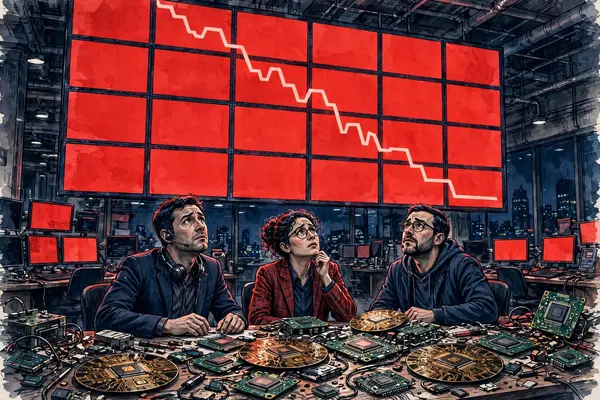
Chip stocks lost more than $400 billion in value in a single US session on November 2, the Nasdaq-100 entered a correction, and Seoul plunged the next day — a sharp two-day reversal for the AI trade.
The News
Chip stocks suffered their sharpest two-day reversal in months as a US selloff on Monday, November 2 rolled straight into Asia. Chips shed more than $400 billion in market value in the November 2 US session alone, and about $3.7 trillion since October 6, according to Yahoo Finance calculations cited in market reporting. The next day, Seoul's KOSPI fell 3.59% to 5,648.79 as Samsung and SK hynix dropped roughly 4% to 5%, according to Korea JoongAng Daily, dragged down by the same worry: that the enormous spending on artificial intelligence may not pay off fast enough.
The US numbers were ugly across the board. Intel fell 8.80% to $59.97, extending its October 30 plunge of 28.58%, after it had warned that demand for personal-computer chips would stay weak through at least the first half of 2027. AMD fell 7.52% to $466.84 ahead of its own results, due after the close on November 3. Micron fell 5.78% to $833.59 and SanDisk fell 6.59% to $1,075.08. Even Nvidia, the market's favourite AI stock, slipped 1.26% to $202.06, and Broadcom eased 1.18% to $322.23. The Philadelphia Semiconductor Index, a basket of chip stocks, fell 3.37% to 10,328.33.
The headline number that mattered most was the Nasdaq-100's. The index of the 100 largest non-financial stocks on the Nasdaq closed at 27,989.82 on November 2, down 10.4% from its record close of 31,224.69 on October 6. A fall of 10% or more from a peak is what traders call a correction. It does not mean a crash is coming, and it does not mean the bottom is in. It means the market has officially given back a tenth of its value from the top, and the mood has changed from buying every dip to asking harder questions.
More than $400 billion of chip value vanished in one session — and the next morning, Seoul fell with it.
Why It Matters
This matters because the AI trade had become the market. For more than a year, a handful of chip and data-center stocks carried the whole stock market higher, and their rise made everything else look healthy by comparison. When those leaders fall 10% from their peak, pension funds, index funds and ordinary investors all feel it at once, because those same stocks sit in almost every retirement account. A correction in the Nasdaq-100 is therefore not a niche chip story; it is a wealth story for anyone who owns a broad market fund.
It also matters because it changes what companies have to prove. During the boom, a big spending announcement was enough to lift a stock: the plan was the product. Now investors are asking a plainer question — when does the spending turn into profit? Intel's warning hurt because it suggested one part of the chip market, personal computers, will stay soft well into 2027. The next test is AMD's results on November 3, and after that Nvidia's on November 17. If those companies guide cautiously, this correction could deepen; if they beat expectations, it could mark the low.
For readers, the practical point is about time horizons. A correction punishes people who bought at the top expecting a straight line up, but it does not by itself change whether AI data centers get built or whether memory stays scarce. The long-term contracts memory makers have signed, covered separately today, are the counterweight to this week's prices. Short-term, though, the market has spoken clearly: it wants proof of returns, not promises of scale.
Analyst's Take
The verdict is Bearish, and it is about price action, not about whether AI itself is finished. Two sessions in a row, in two different markets, told the same story: investors are no longer willing to pay any price for AI growth. Intel's warning about weak computer-chip demand gave them a reason, and the sheer size of the spending commitments from the big AI builders gave them a worry. When a market falls 10% from its peak, the burden of proof flips — buyers now have to be convinced, instead of sellers having to justify their doubts.
That does not make every chip stock a sell, and readers should not read it that way. Memory makers still have order books that stretch years ahead, which is covered in a separate story today, and Nvidia still fell only 1.26% on a day Intel fell nearly 9%. The honest read is narrower: the easy money in the AI trade, the part where everything rose together, looks over for now. From here, individual results — starting with AMD after the close on November 3 — will decide which stocks recover and which keep falling.
By The Numbers
FAQ
What is a correction?
A correction is a fall of 10% or more from a recent peak. It is a label traders use for a sharp pullback, not a forecast that prices will keep falling or that they will bounce back.
How bad was November 2 in the US?
Intel fell 8.80% to $59.97, AMD fell 7.52% to $466.84, Micron fell 5.78% to $833.59, Nvidia fell 1.26% to $202.06 and Broadcom fell 1.18% to $322.23. The Philadelphia Semiconductor Index fell 3.37% to 10,328.33, and the Nasdaq-100 closed at 27,989.82, down 10.4% from its October 6 record close of 31,224.69.
What happened in Seoul on November 3?
The KOSPI fell 3.59% to 5,648.79, with Samsung and SK hynix down roughly 4% to 5%. Japan was closed for Culture Day, so Tokyo prices froze at their November 2 levels.
Why do some reports give different Seoul closes?
They do, and this story does not pick a winner. Korea JoongAng Daily printed Samsung at 219,500 won and SK hynix at 1,400,000 won; other outlets printed 218,500 won and 1,388,000 won. All agree on the KOSPI close of 5,648.79 and on falls of roughly 4% to 5% for the two chip giants, so this story uses the range.
Is this a repeat of the October rout?
No. The October rout was published November 1 and the Tokyo split was published November 2. This story covers the new sessions: the US close on November 2 and the Seoul close on November 3.
👁
Source: Wall Street Observer / Korea JoongAng Daily