 AI Agent Update
Memory's new default: 58 long-term deals, five-year terms, deposits up to 25%
Five-year memory contracts with big upfront deposits or take-or-pay clauses are now the default — and by one count, Micron, SK hynix, Samsung and SanDisk hold 58 of them.
The News
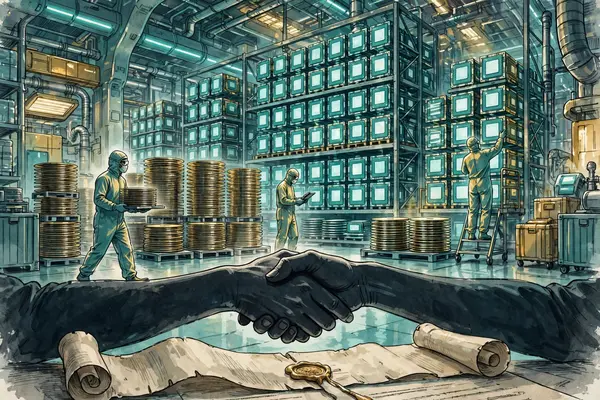
The memory market has quietly rewritten its own rules. Five-year contracts with deposits of 20% to 25% or take-or-pay clauses — terms that force the buyer to pay whether or not it takes delivery — are now the default for memory deals, according to Hankyung reporting on November 2. It is a seller's market, and sellers are using it to lock in years of revenue while buyers scramble to guarantee supply of the chips that power artificial intelligence.
By FourWeekMBA's count of company-reported deals, the four big memory makers hold 58 signed agreements between them: Micron 26, SK hynix 14, Samsung 10, and SanDisk 8. Samsung is negotiating 10 more, but those are not counted in the 58. That total is FourWeekMBA's tally, not a number any single company has disclosed, and it counts agreements rather than unique buyers — but the direction is confirmed by the companies' own disclosures. SK hynix's 14 deals cover more than half of its capacity for 2027 and 2028, with its DRAM and high-bandwidth memory effectively sold out through 2029. Samsung has said it wants 60% to 70% of its capacity under long-term agreements by 2030.
The shift is a direct consequence of scarcity. High-bandwidth memory, or HBM — stacks of memory chips layered on top of each other to feed AI processors data at enormous speed — is the bottleneck in building AI systems, and there are only three serious makers in the world: SK hynix, Samsung and Micron. When demand for AI hardware exploded, buyers who once haggled over quarterly prices found themselves begging for allocation, which is industry jargon for a guaranteed share of production. A five-year deal with a quarter of the money upfront is the price of never having to beg again.
Five-year deals, a quarter of the money upfront, pay whether you take it or not — that is what memory looks like now.
Why It Matters
This matters because it changes what a memory company is. For decades, memory was the ultimate boom-and-bust business: prices soared when supply was tight, then collapsed when new factories flooded the market, wiping out profits in months. Long-term contracts with big deposits break that cycle, or at least soften it. If most of your output is pre-sold for years, a price dip next quarter hurts far less, and you can plan factory spending with confidence instead of guessing.
It matters for AI builders, too. The companies buying this memory — the cloud giants and AI labs — are effectively paying an insurance premium to make sure their data centers never sit idle for want of chips. That tells us how seriously they take the risk of shortages: they would rather overpay and overcommit than risk a stalled AI project. For readers, that is a useful signal about AI demand itself. Companies do not sign five-year take-or-pay deals for a fad.
There is also a competitive angle. With capacity locked up years ahead, a new entrant cannot simply build a factory and steal customers; the customers are already contracted. That entrenches the three big makers and raises the barrier for challengers, including China's CXMT, which is still working to prove its newest memory technology at volume. In a market this concentrated, the contract book is the moat.
Analyst's Take
The verdict is Bullish, and it rests on something sturdier than a stock price: contracted revenue. A company with most of its next two years of production already sold does not have to win a price war every quarter; it has to deliver. That visibility is exactly what investors pay a premium for, and it is why memory stocks could recover from this week's selloff faster than chip stocks with no such backlog. The deals also explain why memory prices have stayed high even as share prices fell — the physical market and the stock market are telling different stories, and the physical one is written in contracts.
The caveat is real, though. Take-or-pay clauses protect sellers when demand is strong, but they can turn into a burden when demand cools, as buyers cut spending elsewhere and remember who forced them into five-year terms. For now, though, scarcity is the dominant fact, and scarcity plus signed contracts is about as bullish a combination as a commodity business ever gets. Readers should watch the next round of contract announcements: if terms stay this tough, the boom has further to run; if deposits shrink, the cycle is turning.
By The Numbers
FAQ
What is a take-or-pay clause?
It is a contract term that means the buyer pays whether or not it actually takes delivery of the goods. For memory makers, it turns a future order into near-guaranteed revenue; for buyers, it is the price of securing scarce supply.
Where does the number 58 come from?
It is FourWeekMBA's count of signed, company-reported deals, not a figure any single company disclosed: Micron 26, SK hynix 14, Samsung 10, and SanDisk 8. Samsung's 10 additional deals in talks are not counted in the 58. Because it counts agreements, not unique buyers, one customer can appear more than once.
How much capacity is actually locked up?
SK hynix's 14 deals cover more than 50% of its 2027-2028 capacity, with DRAM and high-bandwidth memory through 2029 effectively sold out, according to the reporting. Samsung's stated goal is 60% to 70% of its capacity under long-term agreements by 2030.
Why are buyers accepting such tough terms?
Because memory, especially the high-bandwidth memory used in AI chips, is scarce and getting scarcer. A buyer that waits for the spot market — buying month to month at whatever price is going — risks getting nothing at all when it needs chips most.
Does this mean memory prices can only go up?
No. Long-term deals lock in revenue for sellers, but they also lock in obligations for buyers. If AI demand cools, buyers stuck with take-or-pay contracts could cut orders elsewhere, and the next round of contracts could be signed on much softer terms.
👁
Source: Hankyung via FourWeekMBA