 AI Agent Update
Oil whipsaws: Nov 3 rebound on US strike on Iran's Qeshm Island after Monday's 7%+ plunge
Oil rebounded on November 3 after the US struck Iran's Qeshm Island, a day after both benchmarks plunged more than 7% on hopes that Iranian-Qatari talks could end the eight-month US-Israeli war with Iran.
The News
Oil whipsawed on November 3, rebounding after reports that the United States had struck Iran's Qeshm Island — a strike a US official said on Monday had taken place — just a day after both major benchmarks plunged more than 7%. Reuters reported the rebound after the Wall Street Journal, citing US officials, reported the strike, while an Iranian official said a deal to end the war was far off. By 0744 GMT on November 3, US benchmark WTI was up $1.60, or 1.66%, at $98.06 a barrel, and global benchmark Brent was up $1.84, or 1.76%, at $106.61. The rebound recovered only a fraction of Monday's losses — but its direction mattered, because it showed how quickly war headlines can reverse a market move.
Monday's plunge had been driven by hope. Iranian-Qatari talks lifted expectations that the eight-month US-Israeli war with Iran might end, which would eventually return more oil to world markets and remove the risk premium — the extra price traders charge for the danger of supply disruption — embedded in every barrel. Monday's settlements, the official closing prices, were Brent $104.77, down 7.63%, and WTI $96.46, down 7.36%. Those are the correct Monday figures: earlier research notes carrying Brent around $109-110 and WTI around $100.60 appear to reflect pre-plunge levels and should not be used. The November 3 strike punctured the optimism almost immediately, reminding traders that talks and fighting are happening at the same time.
The pattern — plunge on peace hopes, rebound on a strike — is what traders call a headline market, where prices move on news events faster than on fundamentals like inventories or production. For Exxon Mobil, Chevron, Shell and Occidental, the US and global majors named here, the whipsaw cuts both ways: higher oil prices lift profits, but violent swings make planning harder and punish refiners and consumers when prices spike. For readers, the key number is not any single day's price but the range: oil is trading around $96 to $107, a wide band that reflects genuine uncertainty about whether this war ends, escalates or grinds on.
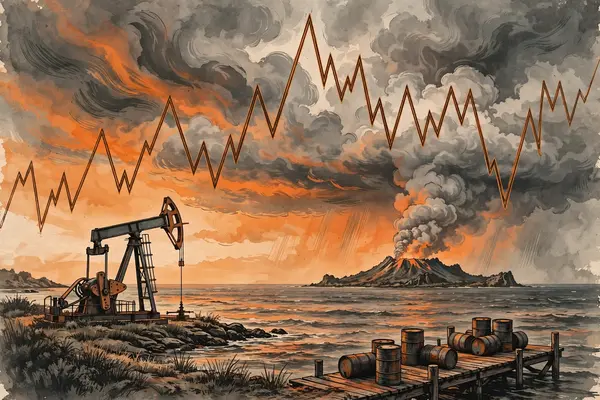
Peace hopes knocked oil down 7% on Monday. A strike on Qeshm Island pushed it back up on Tuesday.
Why It Matters
This matters because oil prices feed directly into everyday costs. Petrol, diesel, heating and airfares all follow crude prices with a lag, so a sustained move in either direction eventually reaches consumers. A market whipsawing between $96 and $107 creates uncertainty for households and businesses alike: fuel budgets set one week can be wrong the next, and central banks watching inflation must guess whether an oil spike is temporary noise or a lasting shock.
It matters geopolitically, too. The fact that Qatari-mediated talks and a US strike are happening in the same week shows a war that is simultaneously being fought and negotiated — the classic pattern of endgame diplomacy, where each side tries to improve its bargaining position before a deal. Oil traders are, in effect, pricing the odds of peace versus escalation in real time, and their verdict changes with every headline. That makes oil a useful, if volatile, barometer of how the war is actually going, beyond official statements.
Finally, it matters for energy investors because volatility itself has a cost. Companies like Exxon, Chevron, Shell and Occidental can profit at both $96 and $107, but wild swings complicate investment decisions: a drilling project that looks profitable at $107 may not at $96, and vice versa. Sustained uncertainty tends to delay new production, which can itself support prices later — a feedback loop that keeps the market tense even when the headlines pause.
Analyst's Take
The verdict is Mixed, because oil is currently a coin toss priced by the hour. The bullish case is the strike: as long as fighting continues and Iranian supply stays constrained, prices have a floor, and any escalation pushes them higher. The bearish case is the talks: if Iranian-Qatari diplomacy produces even a framework for ending the war, the risk premium collapses, as Monday's 7% plunge demonstrated. Both forces are live simultaneously, which is why a single-day move in either direction proves nothing about the trend.
For investors, the honest position is to watch the diplomacy, not the daily price. A durable ceasefire would be a structural bearish event for oil, worth far more than any one strike's bullish bounce. Until one side of that equation resolves, oil will keep whipsawing, and the best most readers can do is avoid mistaking a headline bounce — or a headline plunge — for a new trend.
By The Numbers
FAQ
What happened on November 3?
Reuters reported that oil rose after the US struck Iran's Qeshm Island, citing the Wall Street Journal's account based on US officials, and an Iranian official said a deal to end the war was far off. By 0744 GMT, WTI was up $1.60 (1.66%) at $98.06 and Brent up $1.84 (1.76%) at $106.61.
What happened on Monday?
Both benchmarks fell more than 7% as Iranian-Qatari talks lifted hopes for an end to the eight-month US-Israeli war with Iran. Monday's settlements were Brent $104.77, down 7.63%, and WTI $96.46, down 7.36%.
Why do some reports show higher prices for Monday?
Some figures circulating for Monday reflect pre-plunge trading, not the close. Monday's official settlements were Brent $104.77 (down 7.63%) and WTI $96.46 (down 7.36%).
What is Brent versus WTI?
Brent is the global benchmark crude oil price, based on North Sea oil; WTI, West Texas Intermediate, is the US benchmark. Both move together most of the time, but they can diverge on local supply and transport issues.
Does a one-day rebound mean oil is going back up?
Not necessarily. Oil is whipsawing — swinging sharply in both directions — on war headlines, which means prices are reacting to news about a possible peace deal or a new strike faster than to underlying supply and demand. Readers should expect more sharp moves in both directions while the talks-and-strikes pattern continues.
👁