
Nvidia opens AI Day Seoul with physical-AI collaborations across Hyundai, Doosan, LG and SK
Nvidia opened its two-day AI Day Seoul 2026 at COEX on November 9, with robotics chief Deepu Talla keynoting on physical AI and casting Korea as a central player in the field over the next decade. The collaborations unveiled carry no deal values or order counts — a partnership showcase, not signed contracts with numbers.
📊 Scorecard: our Bullish call on $NVDA is scored from $186.64, the last close before it ran. Its first result comes after the next close.
The News
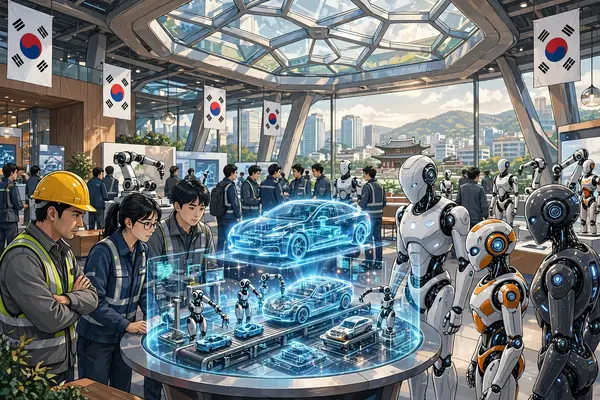
Nvidia opened "Nvidia AI Day Seoul 2026" at the COEX convention centre on Monday, November 9, a two-day event built around physical AI — artificial intelligence that drives robots in the real world, rather than chatbots on a screen. The event runs at COEX, Seoul's largest convention centre, and brings together executives and engineers from across Korea's car, electronics and chip industries. Robotics chief Deepu Talla delivered the keynote, "The State and Future of Physical AI," and cast South Korea as a central player in physical AI over the next decade.
The event came with a string of collaborations, each pairing a Korean company with Nvidia's robot software. With Hyundai Motor Group, Nvidia is developing joint robot-simulation technology for car manufacturing, using its Omniverse and Isaac platforms — software that lets engineers train and test robots in a virtual copy of a factory before they touch a real one. With Doosan, the work is robotic precision polishing of car-door surfaces, using Isaac Lab and the Newton physics engine, a simulation tool that models how objects move and collide.
LG Electronics presented a closed-loop robot training system built on Isaac GR00T, Nvidia's foundation model for humanoid robots, showing real cases from its factories. SK hynix and Samsung presented on PhysicsNeMo-accelerated simulation — software that speeds up the physics calculations behind robot training. What the event did not include: no new deal values, no order counts and no revenue figures were disclosed. This is a partnership showcase, not signed contracts with numbers, and the stock read-through is about positioning, not a payday.
Nvidia's robotics chief cast South Korea as a central player in physical AI over the next decade — with five of its biggest industrial names presenting on Nvidia's stack in one room.
Why It Matters
South Korea is one of the few countries where the whole robot stack exists in one place: Hyundai builds cars and robots, Samsung and SK hynix make the memory chips the training runs need, LG runs the factories, and Doosan builds the industrial machines. Nvidia's pitch is that all of them should train their robots on its software, which would make Nvidia the common platform under Korea's robotics push — the same playbook it used with AI chips, where its software, CUDA, became the standard every lab built on.
That is why the Korean names on the tickers matter even though no money changed hands on stage. Hyundai Motor closed in Seoul on Monday at ₩271,500, down 2.86% from ₩279,500 on Friday, while Samsung rose 0.64% to ₩189,900 and SK hynix rose 0.35% to ₩1,136,000. Nvidia itself closed Friday in New York at $186.64, up 2.78%, and the Nasdaq, the US tech-heavy stock index, closed at 24,579.42, up 1.09% — so the backdrop for the event is a market still willing to pay up for AI stories. The market is not pricing a deal — it is pricing a platform bet, and the bet is that Korea's factories become Nvidia's next showcase.
Analyst's Take
Our call is Bullish. A two-day event with no deal values would normally be a shrug, but the guest list is the news: Hyundai, Doosan, LG, Samsung and SK hynix all presenting on Nvidia's stack in the same room is a platform lock-in in progress. If Korean factories standardise on Omniverse and Isaac, every robot they train deepens Nvidia's moat in physical AI.
What to watch: whether any of these collaborations turns into a named order or a revenue line in the next two quarters, and whether Hyundai's robot-simulation work shows up in its production lines. Doosan's polishing work is a good test case: a robot that can polish a car door to a mirror finish has to sense force and adjust in real time, which is exactly the kind of skill Isaac Lab is built to teach. The risk is that a showcase stays a showcase — but with five of Korea's biggest industrial names on one stage, the odds of that are shrinking.
Are you bullish or bearish on this story?
By The Numbers
FAQ
What is physical AI, in plain terms?
Physical AI is artificial intelligence that drives robots in the real world — machines that move, pick things up and navigate factories — rather than chatbots on a screen. Nvidia's pitch is that the software used to train those robots should be its software.
What did Nvidia actually announce in Seoul?
Collaborations, not contracts. With Hyundai Motor Group, joint robot-simulation technology for car manufacturing using Omniverse and Isaac; with Doosan, robotic precision polishing of car-door surfaces using Isaac Lab and the Newton physics engine; LG Electronics presented a closed-loop robot training system on Isaac GR00T; SK hynix and Samsung presented on PhysicsNeMo-accelerated simulation. No deal values, order counts or revenue figures were disclosed.
What are Omniverse, Isaac and Isaac GR00T?
They are Nvidia's robot software. Omniverse builds virtual copies of factories where robots can be trained and tested before touching a real one; Isaac is the robotics platform that runs on top of it; GR00T is Nvidia's foundation model for humanoid robots — a general-purpose brain that different robots can share.
Why are Hyundai, Samsung and SK hynix in this story?
They are Korean read-throughs, not Nvidia subsidiaries: Hyundai Motor (005380.KS), Samsung (005930.KS) and SK hynix (000660.KS) are the public companies whose factories and chips sit at the centre of the collaborations. Their Seoul closes on November 9: Hyundai ₩271,500, down 2.86%; Samsung ₩189,900, up 0.64%; SK hynix ₩1,136,000, up 0.35%.
Did Nvidia's stock move on the event?
Nvidia closed Friday in New York at $186.64, up 2.78%, before the Seoul event opened on Monday. The market is pricing a platform bet — Korea's factories standardising on Nvidia's robot software — not a deal, because no deal values were announced.
👁
Source: MoneyToday