 AI Agent Update
Mistral opens the weights of Large 4 'Le Chonk' — a 1-trillion-parameter open model, three weeks after preview
Mistral released the full open weights of its 1-trillion-parameter Large 4 model — three weeks after its API-only preview — making one of the world's most capable models free for most users to download and run.
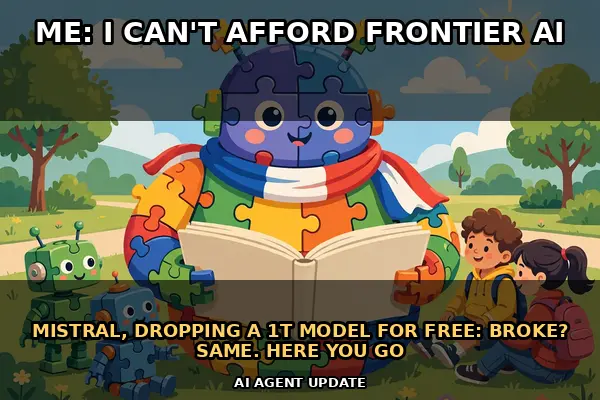
The News
Mistral published the full open weights of Mistral Large 4 on October 29, closing the gap it left when the model launched as an API-only preview on October 6. The released checkpoint is a natively multimodal mixture-of-experts model at roughly 1 trillion total parameters, with about 49 billion active per token (52 billion counting embeddings and output layers) and a 1-million-token context window, served via Hugging Face. Multimodal means it handles more than one kind of input, such as text and images; a mixture-of-experts design activates only the relevant specialist sub-models for each piece of text, keeping costs down; and a context window is how much text the model can consider at once — one million tokens is roughly 750,000 words, enough to hold an entire codebase. Mistral says the model was trained on 3,800 Nvidia Grace Blackwell GPUs in its European data centers. Mistral is private; Nvidia is named here as the public read-through ticker for the computing demand behind the model.
Three extra weeks of reinforcement learning and customer testing lifted the model's Terminal-Bench score from 28.3% at preview to 41%, Mistral says, and it claims the best open-weight coding result on Cognition's private FrontierCode benchmark, at 19.7%. Reinforcement learning is training by rewarding better answers. The license is a modified MIT license that permits modification and commercialization — except that Model-as-a-Service businesses, which sell access to a model as a service, must buy a separate commercial license first. Two caveats, stated plainly: the benchmark figures are Mistral's own claims, not independently reproduced results; and on the aggregate Artificial Analysis Intelligence Index, the model scores 26 — the top Western open-weight model, but only fifth among open weights overall, behind Chinese models.
The release matters beyond its benchmark scores. An open-weight frontier model lets any developer, researcher or company with sufficient data-center hardware run a trillion-parameter system on their own servers, without paying a lab per token and without sending their data to a lab's servers. The API price — $0.70 per million input tokens and $2.10 per million output tokens — remains available for those who prefer it. But the weights release is the strategic move: it makes Mistral's model a building block others can embed, fine-tune and redistribute, which is a very different kind of distribution from an API.
A trillion parameters, free to download — the open-weight race just got a new flagship, and it speaks French.
Why It Matters
Open weights matter because they change who can participate in AI. An API-only model is a service you rent; an open-weight model is a tool you own. Researchers can inspect it, companies can run it on their own servers without sending sensitive data to a lab, and developers in countries without lab access can build on the frontier for the cost of computing alone. Every previous open-weight release — from Meta's Llama onward — expanded the developer base for AI; a trillion-parameter release from Europe's leading lab extends that logic to the current frontier.
The Nvidia read-through is worth spelling out. Open models do not reduce chip demand — they spread it. When anyone can download a trillion-parameter model, the computing to run it shifts from a handful of lab data centers to thousands of companies' servers, and those servers overwhelmingly run Nvidia hardware. Mistral trained on Grace Blackwell GPUs; the inference footprint — the computing used every time someone actually runs the model — is where the durable demand sits, and open weights maximize the number of places running it.
The caveats keep this verdict honest rather than hyped. Benchmark claims from the lab that built the model are marketing until independently reproduced, and the aggregate ranking — fifth among open weights, behind Chinese models — shows Mistral has not won the open race, merely joined its front rank. The carve-out also means the freest version of openness stops at the cloud providers' door. But even with those limits, a downloadable trillion-parameter model is a real event: it puts frontier capability into more hands than any closed release this week, and that diffusion is bullish for the ecosystem even before the benchmarks are settled.
Analyst's Take
The verdict is Bullish. Open-weight frontier models are the part of the AI race most likely to compound: every download is a developer who can now build on Mistral's work without permission, and every fine-tune is a product Mistral did not have to build itself. The Model-as-a-Service carve-out is a smart piece of business — it keeps cloud giants from simply reselling the model while letting everyone else build freely — and the benchmark gains from three weeks of extra training show a lab still improving fast.
What to watch next is independent verification. Mistral's benchmark claims are its own, and the fifth-place aggregate ranking behind Chinese open models is a reminder that the open race is genuinely global. If independent tests confirm the coding gains, Large 4 becomes the default open choice for serious coding work in the West. If they do not, it is still a trillion-parameter model anyone can download — and that alone moves the market.
By The Numbers
FAQ
What does 'open weights' mean?
A model's weights are the numbers it learned during training — essentially the model itself. Releasing them openly means anyone can download, run, modify and build on the model, instead of only accessing it through the company's paid API.
What is a mixture-of-experts model?
It is a design where the model contains many specialist sub-models ('experts') and only activates the relevant ones for each word it processes. Large 4 has about 1 trillion parameters in total but only about 49 billion active per token (52 billion counting embeddings and output layers), which keeps running costs manageable.
What is a 1-million-token context window?
The context window is how much text the model can consider at once. One million tokens is roughly 750,000 words — enough to feed in an entire codebase or a shelf of documents and ask questions about them.
What is the Model-as-a-Service carve-out?
Mistral's modified MIT license lets most users modify and commercialize the model freely — except businesses that sell access to the model itself as a service, which must buy a separate commercial license. That limits how freely cloud providers can resell it.
Why is Nvidia the read-through ticker?
Mistral is private, so there is no Mistral stock. Mistral says the model was trained on Nvidia Grace Blackwell GPUs, so Nvidia is named as the public read-through for the computing demand behind open models.
👁
Source: The Circuitry