
LG reorganises for 2027 around robotics and physical AI
LG Electronics is reshaping itself for 2027 around robotics and physical AI, creating a new partnership centre under the CEO and promoting its robotics chief to senior vice president.
📊 Scorecard: our Bullish call on $066570.KS is scored from ₩130,600, the last close before it ran. Its first result comes after the next close.
The News
LG Electronics announced on November 19 organisational changes and executive appointments for 2027 designed to accelerate its future businesses, including robotics, AI data-centre cooling, mobility and smart factories. The changes, approved by LG's board, take effect December 1, 2026, with executive promotions effective January 1, 2027.
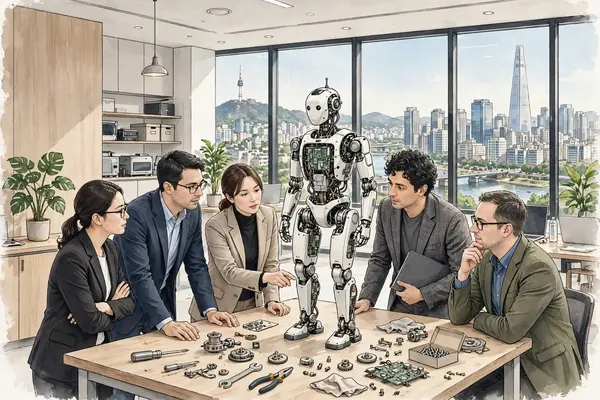
LG is creating a new Global Partnership Center reporting directly to the CEO, to expand strategic collaboration with global technology companies in the era of physical AI — AI that works through real machines. The centre builds on the Robotics Business Center established under the CEO in July 2026. Song Shi-yong, head of the Robotics Business Center, is promoted to senior vice president, and LG says the promotions advance talent in robotics, AI data-centre cooling and research and development.
The company is also creating an Applied Business unit for AI data-centre cooling and an HPC/ADAS division for autonomous driving and next-generation vehicle computing. LG plans to unveil a bipedal humanoid — a two-legged robot — built on Nvidia's Isaac GR00T humanoid foundation model in the first quarter of 2027, and it signed an agreement with the Korea Institute for Robot Industry Advancement on November 13 to build humanoid safety assessment standards. LG also said on its October 28 third-quarter earnings call that it expects to accumulate 500,000 hours of robot-training data this year — five times its original target of 100,000 hours.
LG is not just adding a robotics team — it is putting robotics at the centre of the company, reporting to the CEO.
Why It Matters
A reorganisation matters because it shows where a company is putting its people and its money. LG could have left robotics as a small research project; instead it gave the robotics chief a promotion, created a partnership centre that reports to the CEO, and set up new units for data-centre cooling and vehicle computing. That is a company rearranging itself around a bet, and the bet is physical AI.
The timing matters too. The Robotics Business Center was only set up in July 2026, and four months later LG is already building on it with a CEO-level partnership centre. Moving that fast suggests the company sees a window — rivals from Tesla to XPeng are showing humanoids now — and does not want to be left selling only the screens and appliances of the last decade.
The humanoid plan matters because it gives the reorganisation a product to be judged by. A bipedal robot based on Nvidia's blueprint, due to be unveiled in the first quarter of 2027, is a concrete deadline, and the safety-standards agreement signed on November 13 shows LG is already thinking about how a robot gets approved for real use. If the unveil lands on time, LG joins the humanoid race as a serious entrant; if it slips, the reorganisation will look like paperwork.
Analyst's Take
Our call is Bullish. The shape of this reorganisation is the story: robotics is no longer a division buried inside LG, it is a business that reports to the CEO, with its own partnership centre and its chief promoted to senior vice president. Companies promote the people and the units they expect to matter most, and LG has just told the market that robotics, data-centre cooling and smart factories are where its future sits.
The supporting moves line up with that message. A new unit for AI data-centre cooling, a division for autonomous driving and vehicle computing, and a humanoid unveil targeted for the first quarter of 2027 all point the same way — LG wants to sell the machines and the cooling that the AI age runs on, not just the televisions and appliances it is known for. The November 13 safety-standards agreement with Korea's robot industry institute is the quiet, practical step that comes before selling robots to real customers.
The caveat is that a reorganisation is a plan, not a product. The humanoid does not exist yet in public, and the 500,000-hour training-data target was stated by LG on its October 28 earnings call, so it carries the company's own word behind it. What to watch is the first quarter of 2027: if the Nvidia-based bipedal humanoid appears on schedule, this reorganisation will look like the moment LG got serious about robots. Reader poll: Will LG unveil its humanoid in Q1 2027? Vote: Smart bet, Too slow, Wait for Q1.
Are you bullish or bearish on this story?
By The Numbers
FAQ
What is physical AI?
Physical AI is artificial intelligence that works in the real world through machines — robots, cars and factory equipment — rather than only in software on a screen. It is the AI that lets a robot see, move and handle objects.
What is a reorganisation?
A reorganisation is when a company changes its internal structure — creating new teams, moving reporting lines and promoting people — to focus on different businesses. LG's changes take effect December 1, 2026, with promotions from January 1, 2027.
What is a senior vice president?
A senior vice president is a high-ranking executive, one step below the top leadership of a company. Promoting the robotics chief to that level signals that robotics now matters more inside LG.
What is a reference architecture?
A reference architecture is a blueprint from a chipmaker — in this case Nvidia — that shows other companies how to build a product around its technology. LG's planned humanoid is based on Nvidia's blueprint, so it will use Nvidia's design as its starting point.
👁
Source: LG Electronics