
J.P. Morgan says humanoids hit 'accelerated execution' as Unitree target jumps to RMB 1,060
J.P. Morgan raises Unitree's price target to RMB 1,060 and upgrades UBTECH to Overweight, saying physical AI's 'ChatGPT moment' could come within a year — and that Tesla's Optimus could reach 2,000 units a week, a figure Tesla has not confirmed.
📊 Scorecard: our Bullish call on $688836.SS is a miss so far: from CN¥718.00 to CN¥666.00 at the latest close (-7.2%). Against QQQ the call is wrong: the stock is 4.6 points behind the index.
The News
J.P. Morgan says humanoid robots and physical AI are moving from 'hype and demonstrations to real-world implementation,' with data, deployment and customer return on investment now the deciding factors. The bank's post-TIG-conference note says physical AI's 'ChatGPT moment' — the point at which the technology suddenly goes mainstream — could arrive within a year. On the stocks, it keeps its Overweight rating on Unitree Robotics and raises its price target to RMB 1,060 from RMB 995, about 50% above the shares, and upgrades UBTECH Robotics from Neutral to Overweight, lifting its target to HK$77 from HK$74, about 30% upside.
The Tesla numbers are the new material in the note. J.P. Morgan says Tesla plans 10,000 to 20,000 Optimus robots for internal use at its Optimus Academy, with sales to outside customers expected to begin by late 2027. Analyst Rajat Gupta notes potential weekly production of 2,000 units over the next 12 to 15 months — implying a 2027 volume of about 200,000 units as the ramp builds, which the bank calls 'significantly faster than prior expectations.' Dexterous hands remain the main hardware challenge: 11 degrees of freedom in the second-generation hand, about 22 in the next one. The first jobs are simple material-handling and logistics tasks.
The policy backdrop is moving too. Beijing's 2026–28 plan aims for 10 leading humanoid makers, 200,000 units of annual production capacity and more than 1 million hours of high-quality training data. Shanghai plans to put 8,000 humanoids in factories by 2028 and grow its AI equipment industry to RMB 200 billion, and a new plan launched on November 23 promotes robots for elderly care and childcare. The market has already responded: Unitree closed Tuesday in Shanghai at RMB 718, up from RMB 590 on November 20, and UBTECH closed at HK$62.90, up from HK$57.90. Tesla closed Monday at $385.46, up 11.5%.
The bank's message is blunt: humanoids are leaving the demo stage, and the numbers are now on the table.
Why It Matters
This matters because a major bank is now putting hard numbers on the humanoid ramp instead of talking in general terms. A price target is a bank's estimate of where a stock could trade, and an Overweight rating means the bank expects the stock to do better than the market as a whole. Raising Unitree's target by about 50% and upgrading UBTECH at the same time is a bet that the sector's winners are starting to separate from the pack — and the market agreed, with Unitree up more than a fifth in two sessions.
The Optimus figures deserve a careful read. They are J.P. Morgan's reading of a third-quarter briefing and conference discussion, not a Tesla disclosure: Tesla has not confirmed a 2,000-a-week production rate or a late-2027 date for outside sales in any filing. That distinction matters because an analyst estimate can move fast if Tesla's own plans differ. But even as an estimate, a 200,000-unit annualised run rate is far ahead of what the market had assumed, and it frames Optimus as a manufacturing programme, not a research project.
The caveats in the note are as important as the upgrades. UBTECH's cash fell from RMB 4.9 billion at the end of 2025 to RMB 2.4 billion at the end of the first half of 2026 — about 28 months of runway at current spending — and its receivables run at 242 days, meaning customers take a long time to pay. Unitree's RMB 1,060 target is 32 times forecast 2028 sales, a scarcity premium, not an earnings multiple: investors are paying for a scarce asset, not for profits. The bank also kept Overweight ratings on Orbbec, Leader Harmonious Drive, Hengli Hydraulic and Sanhua Intelligent Controls, spreading the call across the supply chain. Tesla is named here only as a public read-through for the humanoid theme — the production figures are the bank's, not Tesla's.
Analyst's Take
Our call is Bullish. A major bank has moved from describing humanoids to pricing them, with a 50% target raise, an upgrade, a quantified Optimus production path and a policy tailwind behind it. The numbers are analyst estimates, not company guidance, and the balance-sheet flags on UBTECH are real — but the direction of travel is now backed by targets, timelines and a market that is already paying up.
What to watch next is XPeng's AI Day on November 25, where its IRON humanoid is expected to feature, and the Humanoids Summit on December 1–2. Watch whether Unitree and UBTECH hold their gains once the conference glow fades, and whether Tesla says anything of its own about Optimus production — a company confirmation would matter far more than another analyst note.
For now, the humanoid trade has a bank, a timetable and a production number behind it — and that is a step up from demos. Reader poll: Is Tesla or Unitree the humanoid winner? Vote: Tesla Optimus, Unitree, UBTECH, Too early.
Are you bullish or bearish on this story?
By The Numbers
FAQ
What is a price target?
A price target is a bank analyst's estimate of where a stock's price could go, usually over the next year. It is a guess based on the analyst's model, not a promise — the stock can go higher, lower, or nowhere near it.
What does Overweight mean?
Overweight is a bank's rating that says a stock should do better than the market as a whole. Neutral means it should roughly match the market, and Underweight means it should do worse.
What is physical AI?
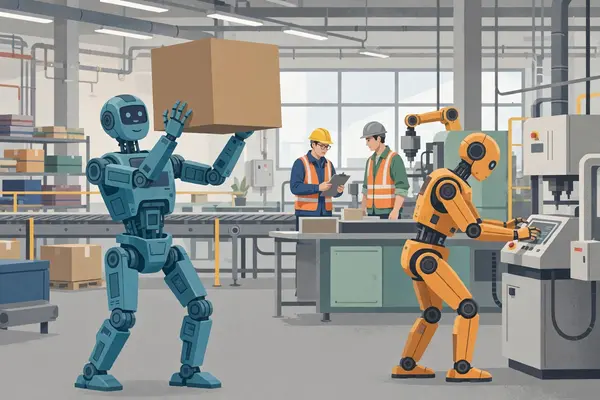
Physical AI means artificial intelligence that controls machines in the real world — robots, cars, drones — rather than just answering questions on a screen. A humanoid robot that picks up boxes in a warehouse is physical AI.
What is a degree of freedom?
A degree of freedom is one independent way a joint can move. A robot hand with 11 degrees of freedom can move in 11 different ways; more degrees of freedom means a more flexible, human-like hand.
👁
Source: Macrostream