
Unitree plans industrial AI robotics JV with CNPC's Kunlun Manufacturing
Unitree Robotics plans an industrial embodied-AI robotics venture with Kunlun Manufacturing — an equipment platform under state-owned China National Petroleum Corporation — and Beijing Fanjie Intelligent Technology, for inspection and emergency-response robots at oil, refining, storage and transport sites. It is a proposed joint venture under antitrust review, not a closed deal.
📊 Scorecard: our Bullish call on $688836.SS is scored from CN¥656.62, the last close before it ran. Its first result comes after the next close.
The News
Unitree Robotics plans an industrial embodied-AI robotics venture with Kunlun Manufacturing — an equipment platform under state-owned China National Petroleum Corporation — and Beijing Fanjie Intelligent Technology, for inspection and emergency-response robots at oil, refining, storage and transport sites. Kunlun and its concert party Kunlun Capital would hold 60% of the venture, with Unitree and Fanjie holding 20% each. The Beijing market regulator published the business-combination filing on November 4, and the simplified antitrust-review comment period runs from November 4 to 13.
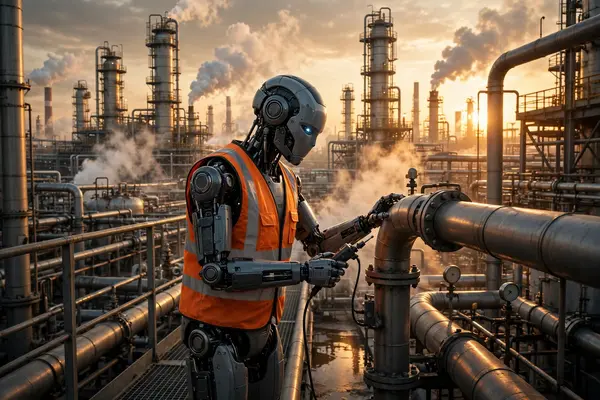
This is a proposed joint venture under review, not a closed deal. No deployment scale, timetable or investment size has been disclosed, and the robots themselves are described only by their purpose: inspection and emergency response at the kinds of industrial sites — oil fields, refineries, storage depots, transport hubs — where a robot is safer than a person and a legged machine can reach places a wheeled one cannot. The filing is the news; the robots are still a plan.
The deal matters because of who Unitree is dealing with, and when. It is Unitree's first major state-owned-partner deal since the United States labelled it a Chinese military company and moved to block its robots from the US market. A partnership with the equipment arm of China's national oil company is a vote of confidence from the Chinese state, and a route into industrial customers that a consumer robotics company would struggle to reach on its own. Unitree is listed in Shanghai under ticker 688836.SS; the public read-through for the oil parent is PetroChina, listed in Shanghai as 601857.SS.
Unitree's first major state-owned-partner deal since the US labelled it a Chinese military company.
Why It Matters
Industrial robotics is where the money is, and Unitree has just been invited into it by the biggest industrial customer in China. Consumer humanoids make headlines; inspection robots at refineries make revenue, and they do it in places where a robot is safer than a person and where the customer — a state oil company — does not haggle over the price. The 60/20/20 split tells you who is in charge, and it is not Unitree. But Unitree does not need to be in charge: it needs a route into industrial sites, and Kunlun is that route.
That is why the verdict is Bullish, with the caveat stated plainly. The deal is proposed, not closed, and the filing contains no scale, no timetable and no money. What it does contain is a state-owned partner, a real industrial use case, and a company that has been shut out of the US market finding its next big customer at home. If the review clears, this is the deal that turns Unitree from a robotics curiosity into an industrial supplier. The ownership split tells you who is in charge: Kunlun and its concert party hold 60%, Unitree and Fanjie 20% each. Unitree is the junior partner, and it is also the one bringing the technology — a familiar bargain in Chinese industrial joint ventures, where the state-owned partner brings the customers and the market, and the tech company brings the product.
Analyst's Take
Our call is Bullish. A joint venture with the equipment arm of China's national oil company is a different kind of deal from a consumer robotics launch: it is industrial, state-backed, and aimed at the oil sites where robots are genuinely useful rather than merely impressive. For a company the US has labelled a military company and moved to block, a 60% state-owned partner is a shield as well as a customer.
What to watch: whether the antitrust review clears after November 13, and whether the venture announces a deployment scale, a timetable or an investment figure — the three things the filing does not contain. Until then, this is a proposed deal with a powerful partner, not a closed one, and the verdict is about the direction, not the deal.
Are you bullish or bearish on this story?
By The Numbers
FAQ
What is an embodied-AI robot?
A robot with a body that acts in the physical world, rather than software that only works on a screen. "Embodied AI" is the field of giving AI systems hands, legs and sensors so they can do physical work — in this case, inspecting oil sites and responding to emergencies.
Who owns what in the venture?
Kunlun Manufacturing and its concert party Kunlun Capital would hold 60%, with Unitree and Beijing Fanjie Intelligent Technology holding 20% each. Kunlun is an equipment platform under China National Petroleum Corporation, the state-owned oil giant, whose listed arm is PetroChina.
Is the deal done?
No. The Beijing market regulator published the business-combination filing on November 4, and the simplified antitrust-review comment period runs from November 4 to 13. This is a proposed joint venture under review, not a closed deal — and no deployment scale, timetable or investment size has been disclosed.
What would the robots actually do?
Inspection and emergency-response work at oil, refining, storage and transport sites — the kind of places where a robot is safer than a person, and where a humanoid or legged robot can reach areas a wheeled machine cannot. The filing does not say how many robots, where they would be deployed, or when.
Why does this matter for Unitree?
Because it is Unitree's first major state-owned-partner deal since the United States labelled it a Chinese military company and moved to block its robots from the US market. A partnership with the equipment arm of China's national oil company is a vote of confidence from the Chinese state, and a route into industrial customers that a consumer robotics company would struggle to reach on its own.
👁
Source: Yonhap / Global Times via Molroo