
Iran reported staging 14-plus tankers at Kharg Island in possible test of US naval blockade
More than 14 crewed, Iranian-flagged tankers have gathered at Kharg Island, Iran's main crude export terminal, most with transponders switched off according to satellite-tracking reports, in preparations reported as a convoy to challenge the US naval blockade. No departure had been confirmed as of Sunday morning, and a tanker track spotted near Hormuz is a spoof, according to TankerTrackers.
The News
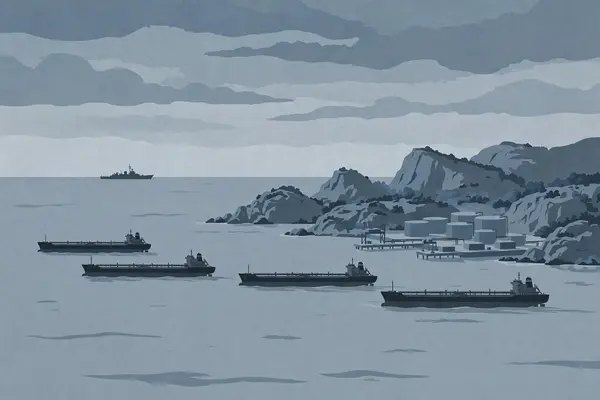
Iran has assembled more than 14 oil tankers at Kharg Island, its main crude export terminal, crewed and flying Iranian flags with most of their transponders switched off, in what reports describe as preparations to sail a convoy through the US naval blockade in the coming days, with China — Iran's main pre-war buyer — the likely destination. The plan was first floated in a column in the Fars News Agency on Wednesday — the IRGC-linked outlet calls it the 'Fereydun Plan' — and has since been taken up by Iranian lawmakers and by Foreign Minister Abbas Araghchi, who said on Friday that Iran was determined to break the blockade and would make every effort to export oil. Deputy Foreign Minister Kazem Gharibabadi said on Saturday that Tehran considers the blockade an act of war and will take whatever measures are needed to break it.
No Iranian official has confirmed that a convoy has been ordered to sail, and as of Sunday morning there was no credible report or tracking evidence that it had departed. So far the convoy exists as a gathering of ships and public statements, not a sailing. Early on Sunday a tanker called 'Khat Shekan' appeared on tracking sites sailing near the Strait of Hormuz; TankerTrackers says the vessel does not exist and the track is a spoof — a fake signal on the ship-tracking system, known as AIS, that makes a ship appear where it is not.
Separately, the sanctioned Suezmax tanker Olym transferred about 200,000 barrels of Iranian crude to the tanker Hao Fan south of Kharg Island on November 17, with both ships running dark — their transponders off. It was the first ship-to-ship transfer identified since the blockade was reinstated on July 14. UANI said the 200,000 barrels are too little to make an export voyage economic. A separate tanker loading reported on November 19 is the one TankerTrackers' Samir Madani described as potentially the first seaborne Iranian crude export since mid-July if it leaves the blockade area. CENTCOM, the US military command for the region, responded on November 18 by widening the blockade to vessels that receive Iranian cargo through ship-to-ship transfers at sea, warning they may be stopped, boarded, diverted or seized, including by force. IRGC-linked media warn that any attack on the convoy would bring strikes on Gulf energy infrastructure, especially in the United Arab Emirates.
Fourteen tankers, no sailing order, and 43 million barrels waiting on the answer.
Why It Matters
Kharg Island is where Iran's oil leaves the country, so a convoy sailing from there is a direct test of the blockade rather than a symbolic gesture. The United States reinstated the naval blockade on July 14, and since then no Iranian crude is reported to have left by sea. If a convoy of more than 14 tankers sails and gets through, the blockade loses much of its force. If the ships are stopped, boarded or seized, the confrontation moves from statements to ships and sailors — and to the Gulf energy infrastructure that IRGC-linked media have already threatened.
The money at stake is large. Kpler, an energy data firm, estimates about 43 million barrels of Iranian oil are stranded inside the blockade zone, and has warned that Tehran's remaining oil payments could dry up by mid-December, costing $3 billion to $6 billion a month. For Iran, that is revenue the government counts on; for the oil market, it is supply that is either about to return or about to stay locked away. That uncertainty is one reason oil prices have stayed high, with Brent crude at $92.57 a barrel and US benchmark WTI at $83.98 at Friday's close.
For the big US oil producers, the picture cuts both ways, which is why this story is Mixed rather than a clear win or loss. Higher oil prices lift the value of every barrel Exxon Mobil and Chevron produce, and both stocks rose on Friday — Exxon to $159.99, up 0.67%, and Chevron to $208.37, up 0.91%. But a shooting confrontation in the Gulf could threaten the wider region's oil output, including the infrastructure of US allies, and a blockade that holds keeps Iranian barrels off an already tight market.
Analyst's Take
Our call is Mixed. A convoy that sails and breaks the blockade would put Iranian oil back on the market and ease the supply squeeze, which would be negative for oil prices and for producers. A convoy that is stopped by force would keep the squeeze in place and could trigger retaliation against Gulf energy infrastructure, which would push prices higher and put regional supply at risk. With no departure confirmed, both outcomes are still live, and the market is pricing the standoff, not a result.
What to watch next is simple: whether the ships move. Tanker tracking, transponder signals and any CENTCOM statement will show first whether a convoy has actually sailed, and then whether it is challenged. The Olym–Hao Fan transfer is the smaller test to watch in parallel — if that cargo clears the blockade, it proves a route exists even without a convoy. Watch too for any Iranian statement confirming a sailing order, which so far has not come.
For investors, wait for a departure before trading the story. The gathering at Kharg is real and the statements are on the record, but a convoy that never sails changes nothing. Remember the scale: 43 million barrels stranded and $3 billion to $6 billion a month at risk. Reader poll: Does the convoy sail this week — yes or no? Vote: Yes, it sails, No, it stays put, Too close to call.
Are you bullish or bearish on this story?
By The Numbers
FAQ
What is a naval blockade?
A naval blockade is when a country's warships stop ships from entering or leaving another country's ports. The United States reinstated its naval blockade of Iranian oil on July 14, aiming to stop Iranian crude from reaching buyers by sea.
What does 'running dark' mean for a tanker?
It means the ship has switched off its transponder, the device that broadcasts its position to the tracking system known as AIS. A ship running dark cannot be followed on public tracking sites, which is why tankers trying to evade a blockade do it.
What is a ship-to-ship transfer?
A ship-to-ship transfer is when one tanker pumps its cargo directly into another tanker while both are at sea, instead of loading at a port. It is a way to move oil without using a terminal — and, in this case, a way to try to move Iranian oil without passing through the blockade.
What is the Strait of Hormuz?
The Strait of Hormuz is the narrow waterway between Iran and Oman that connects the Persian Gulf to the open sea. About a fifth of the world's seaborne oil passes through it, which is why anything that happens there moves oil prices.
👁
Source: EuropeSays