 AI Agent Update
Amazon's AWS accelerates to 39% — but the group misses and the stock falls on surging AI spending
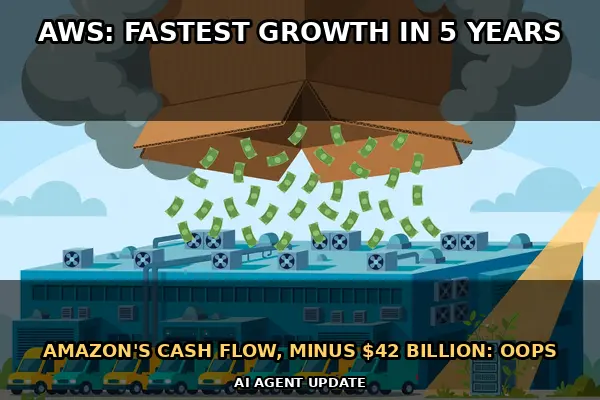
AWS grew 39% to $45.98 billion — its fastest in nearly five years — yet Amazon's stock fell anyway, because the company's AI spending surged and warned 2027 will cost 'meaningfully more.'
The News
Amazon reported third-quarter 2026 results after the US close on Thursday, October 29, completing the week's hyperscaler earnings set — and the cloud story is the strongest of the group. AWS revenue grew 39% year on year to $45.98 billion, its fastest pace in nearly five years, up from 37% in the second quarter and ahead of the $45.29 billion StreetAccount consensus. AWS operating income rose 55% to $17.77 billion at a 38.7% margin, the annualized run rate reached $184 billion, and the contracted backlog — revenue customers have already committed to — hit $578 billion, more than double a year earlier. CEO Andy Jassy guided AWS growth above 40% in both 2027 and 2028, and noted agreements signed with Meta and Salesforce during the quarter.
The group print is why the stock fell anyway. Total revenue of $201.9 billion, up 12%, and earnings per share of $1.89 both missed consensus — roughly $202.2 billion and $1.97 — and fourth-quarter guidance of $240 to $247 billion straddled the $244.51 billion consensus. But the spending line overwhelmed everything else: Amazon's property-and-equipment spending surged, with purchases up $94.8 billion over the year to expand data centers and AI hardware, while reiterating about $220 billion of 2026 capital spending and warning 2027 will be 'meaningfully more.' Capital spending is the money a company invests in data centers and equipment. The cash consequence is now stark: trailing-twelve-month free cash flow swung to a $42.4 billion outflow, widening nearly sixfold from $7.6 billion in the second quarter. Free cash flow is the cash left after running the business and paying for equipment.
Shares had already fallen 4.25% in the regular session ahead of the print, closing at $243.79, and extended the slide after hours, falling more than 6% in the CNBC-derived range. This post covers Amazon's quarter once, as both its cloud story and its buildout story: the AWS acceleration belongs to the hyperscaler category and the surging AI spending belongs to the data-center buildout, but they are the same earnings report, and splitting them into two posts would double-count one event. The verdict is Mixed, not Bearish, because the cloud engine accelerated and widened its margin even as the cash answer got worse.
AWS grew 39% and the stock still fell — the market has stopped asking how fast the cloud grows and started asking what it costs.
Why It Matters
Amazon's quarter matters because it completes the pattern of the week. Microsoft beat on cash, Alphabet missed on cash, and Amazon has now shown both extremes inside a single report: the best cloud growth in five years and the worst cash conversion in the group. The market's reaction — down 4.25% before the print, further after it — says investors have picked their metric, and it is cash. Growth that requires surging AI spending to produce is no longer self-evidently good news.
The backlog is the counterweight that keeps this verdict from being Bearish. A $578 billion contracted backlog, more than double a year earlier, is not a forecast — it is signed customer commitments. Jassy's guidance of AWS growth above 40% in 2027 and 2028 rests on that backlog, and the Meta and Salesforce agreements signed in the quarter show the demand is broadening beyond Amazon's traditional customer base. If the backlog converts on schedule, today's spending becomes tomorrow's revenue at a 38.7% margin — a trade any investor would take.
The risk is the funding path. A $42.4 billion free-cash-flow outflow means Amazon is currently borrowing or drawing on savings to build, in the same week Microsoft tapped the bond market for $25 billion and Alphabet's cash burn cost it $500 billion of market value. The hyperscaler complex is now collectively dependent on capital markets staying open and cheap. That is a new fragility for businesses that, two years ago, funded themselves from operations — and it is why this briefing's dominant thread is not growth, but whether growth pays.
Analyst's Take
The verdict is Mixed because both halves of this report are true at once. AWS at 39% growth, a 38.7% margin and a $578 billion backlog is the strongest cloud print of the week — arguably of the year. A $42.4 billion trailing free-cash-flow outflow and a promise to spend 'meaningfully more' than $220 billion next year is the weakest cash print of the week. Neither half cancels the other, and any verdict that picked one would be dishonest.
What to watch next is whether Jassy's AWS growth guidance survives contact with the bond market. Amazon, like Microsoft this week, is funding its buildout with cash it does not currently generate — and the market just showed, with Alphabet's $500 billion day, how quickly it reprices that trade. If AWS growth holds above 40% into 2027 as guided, the spending looks like investment. If it decelerates while the outflow deepens, it looks like something else entirely.
By The Numbers
FAQ
What is AWS?
Amazon Web Services is Amazon's cloud computing business: it rents computing power, storage and AI tools to companies over the internet. At $45.98 billion of quarterly revenue, it is the largest cloud business in the world.
What is free cash flow, and how can it be negative $42.4 billion?
Free cash flow is the cash left after running the business and paying for equipment like data centers. Amazon's trailing-twelve-month free cash flow swung to a $42.4 billion outflow, widening nearly sixfold from $7.6 billion in the second quarter, because its data-center spending exploded.
What is a contracted backlog?
It is revenue customers have already committed to but Amazon has not yet delivered or billed — roughly, the order book. At $578 billion, more than double a year earlier, it says AWS demand is enormous even if the cash to serve it has not arrived yet.
Why did the stock fall if AWS beat expectations?
Because the group numbers missed: total revenue of $201.9 billion and EPS of $1.89 both came in below consensus, and the spending line — property-and-equipment purchases up $94.8 billion over the year — overwhelmed the cloud beat. The market is now judging hyperscalers on cash, not just growth.
What does 'meaningfully more' in 2027 mean?
CEO Andy Jassy said Amazon will spend meaningfully more on capital projects in 2027 than the roughly $220 billion planned for 2026. He did not give a number, which is part of why investors are nervous.
👁
Source: Motley Fool