
Google buys Crusoe's stalled Wyoming site outright after failing to sign as a customer
Crusoe confirmed on Friday, November 6 that it sold its unfinished data-centre project in southeastern Wyoming to Google, which is taking over development. No purchase price was disclosed — the $17 billion figure is Google's planned investment in the campus, announced November 5, not the price paid. This story is the ownership transfer that followed that announcement.
The News
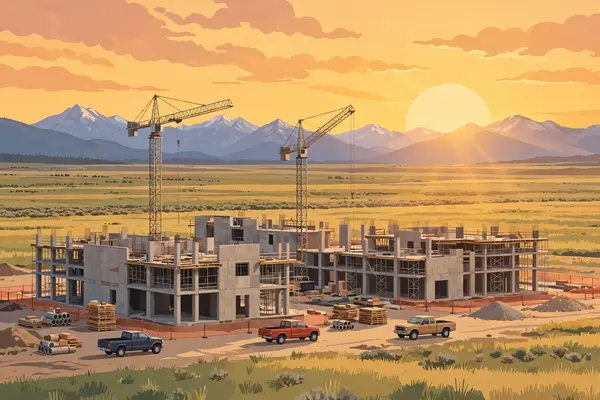
Crusoe confirmed on Friday, November 6 that it has sold its unfinished data-centre project in southeastern Wyoming to Google, which is taking over development of the site. Google had tried and failed to land as a customer for the project, and had reportedly raised concerns about cost and the construction timeline under Crusoe's management. When the customer deal did not work, Google bought the project instead.
No purchase price was disclosed — and one number needs to be kept straight. The $17 billion figure is Google's planned investment in the campus, announced November 5, not the price paid for the site. That $17 billion investment was announced by Google on November 5; this story is the ownership transfer that followed it. The project was announced with Blackstone-backed Tallgrass in 2025 as a 1.8 GW campus scaling eventually to 10 GW; Crusoe said in June it had paused development at its customer's request, though the serving utility, Black Hills, said the next day the project itself had not been paused and Crusoe was no longer the development partner.
Crusoe is not out of the hyperscaler business. It is still developing a Google campus near Amarillo, Texas, an Abilene campus in phases for Oracle and OpenAI, and a separate 900 MW campus next door to the Wyoming site for Microsoft, with the first building due in mid-2027. Crusoe was recently valued at $30.9 billion and raised a $3.9 billion funding round in September.
Google tried to sign as a customer, raised concerns about cost and timeline — then bought the site outright.
Why It Matters
Google buying the site outright is, on its face, a vote of confidence in the demand for AI computing power. Hyperscalers are racing to secure electricity and land for data centres, and Google would rather own the build than wait for someone else to deliver it. When the biggest buyer in the market decides it wants a campus badly enough to buy it, that tells you the capacity crunch is real.
But the reason Google ended up buying is the warning. An independent developer announced the project in 2025, paused it in June, and could not get its would-be anchor customer comfortable with the cost and the construction timeline. That is the same delivery-risk theme behind Microsoft's pullback from neocloud deals: the companies that rent out AI capacity are struggling to build fast enough, cheaply enough, and reliably enough for the customers they serve. Google's purchase solves Google's problem. It does not solve the developer model.
For the read-through names, the deal is a warning and a validation at once. CoreWeave and IREN are independent developers in the same business as Crusoe — building data-centre capacity and renting it to the AI giants — and Friday's moves show investors are sorting the winners from the risks: CoreWeave closed at $46.40, up 6.28% on the day. IREN closed at $21.64, up 20.02%, but that jump was driven by its own fiscal first-quarter results reported November 5 — AI cloud revenue nearly tripling to $200 million — not by the Wyoming sale, so it is not evidence about the deal itself. The Wyoming sale says the model can work when the developer delivers, and that it breaks when it cannot. The question for every independent developer now is which side of that line it sits on.
Analyst's Take
Our call is Mixed. The read cuts both ways, and both halves matter. Google wanting the capacity badly enough to buy the site outright is a demand signal: the world's biggest AI builders are still scrambling for power and land, and they will pay to control it. But the other half is that an independent developer could not deliver the project — the same delivery-risk theme behind Microsoft's pullback from renting AI capacity from neoclouds. A site changing hands because the builder could not finish it is not the same as a site changing hands because demand is strong.
What to watch: whether Google restarts construction quickly and what it says about cost and timeline now that it owns the build; how Crusoe's remaining campuses progress — Amarillo for Google, Abilene for Oracle and OpenAI, and the 900 MW Microsoft campus next door; and whether other hyperscalers start buying sites outright instead of renting from independent developers. If they do, the developer model itself is the story.
Are you bullish or bearish on this story?
By The Numbers
FAQ
Did Google pay $17 billion for the site?
No. The $17 billion is Google's planned investment in building out the campus, announced November 5. No purchase price for the project itself was disclosed. The two figures are different — one is what Google will spend developing the site, the other is what it paid Crusoe, which remains private.
What is a gigawatt?
A gigawatt (GW) is a unit of electrical power equal to one billion watts. Data centres are measured in gigawatts because they consume enormous amounts of electricity. The Wyoming campus was planned at 1.8 GW, scaling eventually to 10 GW — among the largest data-centre projects anywhere.
Why did Google buy the site instead of renting capacity there?
Google had tried to sign on as a customer of the project and failed, reportedly raising concerns about cost and the construction timeline under Crusoe's management. Buying the site outright lets Google control the build itself rather than depend on a developer it had doubts about.
What happens to Crusoe's other projects?
Crusoe is not out of the hyperscaler business. It is still developing a Google campus near Amarillo, Texas, an Abilene campus in phases for Oracle and OpenAI, and a separate 900 MW campus next door to the Wyoming site for Microsoft, with the first building due in mid-2027.
What is a neocloud?
A neocloud is a newer cloud provider that specialises in renting out AI computing capacity — companies like CoreWeave and Crusoe that buy graphics chips and lease the power to AI labs and hyperscalers. Microsoft has been pulling back from renting AI capacity from such providers, which is the delivery-risk theme behind this story.
👁
Source: TechCrunch