 AI Agent Update
Russia's Gerbera-2: decoy drone converted into 1,200 km one-way attack drone
Ukraine's military intelligence says Russia has turned the Gerbera decoy drone into a 1,200 km one-way attack drone carrying up to 25 kg of explosives — and one was found on Poland's Baltic coast.
The News
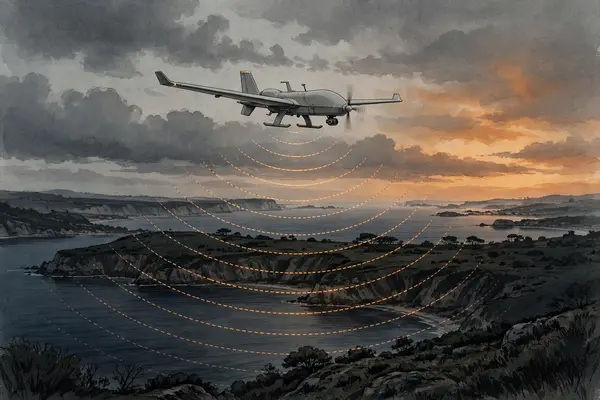
Ukraine's military intelligence, known as HUR or GUR, published a technical breakdown on November 2 of a weapon it calls the Gerbera-2: an enlarged version of Russia's Gerbera drone, previously used mainly as a decoy to overwhelm air defences, now converted into a one-way attack drone. The Gerbera-2 has a range of 1,200 km, a 63-litre fuel tank, a wingspan of 3.0 metres and a fuselage 2.6 metres long, with upgraded avionics guiding it to its target. Its warhead is rated at up to 25 kg, though the sample examined carried a smaller 10 kg high-explosive and incendiary warhead plus incendiary bags — weapons designed to start fires as well as explode.
The conversion matters because it changes the economics of air defence. A decoy is cheap and expendable; defenders can afford to shoot it down or even ignore it. An attack drone with a 25 kg warhead cannot be ignored, but it may still be cheap enough to build in large numbers. That forces defenders into an uncomfortable choice: spend an expensive interceptor missile on a cheap drone, or risk letting an explosive through. Multiplied across hundreds of launches, that arithmetic strains even well-stocked air defences — and it is the same logic behind the mass drone waves Ukraine has faced nightly.
The most alarming detail in the breakdown is geographic. HUR notes that a warhead-carrying Gerbera-2 was found on Poland's Baltic coast in mid-September, implying a reach beyond Ukraine. Whether that drone was aimed at Poland, drifted off course or was carried by wind is not established in the reporting. But a 1,200 km range from launch sites in western Russia or occupied Ukraine comfortably covers much of eastern Europe, which is why the Institute for the Study of War's November 2 assessment — which reports the same GUR material — treats the Gerbera-2 as a development with implications beyond the Ukrainian front.
A decoy you can ignore has become a weapon you cannot — with a 1,200 km reach.
Why It Matters
This matters because it shows how fast drone warfare evolves. A weapon designed as a throwaway decoy can, with a bigger fuel tank, better electronics and a warhead, become a strategic-range strike asset in months. That speed of adaptation is the defining feature of this war's technology race: neither side's arsenal stays fixed for long, and yesterday's nuisance can become today's threat without a new factory or a new invention — just a redesign.
It matters for air-defence economics, which may be the most important military question of the decade. If a $10,000 drone requires a $100,000-plus missile to stop it, the defender goes broke first, no matter how good its technology. The Gerbera-2 sharpens that dilemma, and it will accelerate the search for cheaper interceptors: laser systems, drone-on-drone hunting, and electronic warfare that jams guidance instead of shooting the aircraft down. The country that solves cheap interception first gains a decisive advantage.
For civilians, the significance is the range. A 1,200 km weapon launched from near the front can reach cities and infrastructure far from the fighting, and a drone found in Poland shows that borders are not a reliable limit. That is why this story, though rooted in a Ukrainian intelligence document, belongs in a publication read by investors and policymakers alike: drone proliferation is no longer a front-line curiosity, but a factor in European security planning.
Analyst's Take
The verdict is Bearish, and the reasoning is grim but straightforward: a cheaper, longer-range attack drone makes the air war harder to defend and easier to escalate. Every defensive system has a magazine — a limited number of interceptors — and a cost curve that favours the attacker when the attacking drone is cheap. The Gerbera-2 pushes that imbalance further, because it asks defenders to treat former decoys as real threats. For AeroVironment and RTX, named here only as read-through defence stocks rather than Gerbera manufacturers, the implication is more demand for counter-drone systems — but that demand exists because the threat got worse, which is why the verdict is bearish rather than bullish.
The Poland detail is the part to watch. A single drone on a Baltic beach does not prove intent, but it demonstrates reach, and reach changes planning assumptions for NATO's eastern members. If Gerbera-2s keep appearing beyond Ukraine's borders, expect faster European investment in cheap interceptors — drones that shoot down drones — because expensive missiles cannot be the answer to cheap threats indefinitely.
By The Numbers
FAQ
What was the Gerbera originally?
A decoy drone — a cheap, simple aircraft designed mainly to overwhelm air defences, forcing defenders to waste expensive missiles on targets that were not very dangerous. The Gerbera-2, according to Ukraine's military intelligence, is an enlarged version converted into a real attack weapon.
What are the Gerbera-2's specs?
A range of 1,200 km, a 63-litre fuel tank, a 3.0-metre wingspan and a 2.6-metre fuselage, with upgraded avionics — the electronics that guide the aircraft. Its warhead is rated up to 25 kg; the examined sample carried a smaller 10 kg high-explosive/incendiary warhead plus incendiary bags.
Why does the Poland finding matter?
Ukraine's intelligence notes that a warhead-carrying Gerbera-2 was found on Poland's Baltic coast in mid-September. That implies a range reaching beyond Ukraine, into NATO territory — whether by design, drift or error is not established, but the reach itself is the point.
Where did its parts come from?
Components from the US, China, Taiwan, Switzerland, Ireland and the Netherlands were found in wreckage, according to the intelligence breakdown. That list is a reminder that cheap drones are assembled from globally available parts, which makes export controls hard to enforce.
Is this confirmed by anyone besides Ukraine?
The Institute for the Study of War's November 2 assessment independently corroborates the Gerbera-2 conversion, based on the same Ukrainian intelligence material. The underlying technical breakdown comes from Ukraine's military intelligence, so it should be read as a Ukrainian official claim with independent analytical corroboration, not as battlefield-neutral verification.
👁
Source: Ukraine military intelligence via ISW