
ENGIE consortium reaches financial close on 900 MW Shokeir wind farm in Egypt, its largest onshore wind project
The ENGIE, Aeolus and Orascom Construction consortium reached financial close on the 900 MW Shokeir wind farm in Egypt on November 13, with about $588 million of non-recourse debt. Once running it will double the group's Egyptian wind capacity to 1.8 GW and become ENGIE's largest onshore wind farm in the world.
📊 Scorecard: our Bullish call on $ENGI.PA is scored from €25.28, the last close before it ran. Its first result comes after the next close.
The News
The ENGIE, Aeolus and Orascom Construction consortium reached financial close on November 13 on the 900 MW Shokeir wind farm in Egypt, the consortium announced. The project, also known as Gulf of Suez 3, sits near Ras Shokeir on the Gulf of Suez and will be built under a 25-year build-own-operate deal — the consortium builds it, owns it and runs it — with a power purchase agreement to sell its electricity to the Egyptian grid operator.
The ownership split is ENGIE of France with 35%, Aeolus of Japan with 40%, and Orascom Construction of Egypt with 25%. The financing is about $588 million of non-recourse debt, according to JBIC's announcement of the financing agreement signed on November 12 — JBIC itself is contributing up to $285 million of it. Non-recourse means the loans are secured against the wind farm itself rather than the parent companies — if the project failed, the lenders could claim its assets but not the sponsors' balance sheets. The lenders are JBIC, PROPARCO, FMO, Société Générale, Crédit Agricole CIB and KfW IPEX — a mix of Japanese, French, Dutch and German development and commercial banks.
Construction began in June 2026, and the timetable is now fixed. The first 300 MW phase is due to enter commissioning in January 2028, with the full 900 MW complete by summer 2028. A megawatt is a million watts, and 900 MW of wind capacity is roughly enough to power several hundred thousand homes, depending on wind conditions.
The scale is the story. Once running, Shokeir will double the consortium's wind capacity in Egypt to 1.8 GW and become ENGIE's largest onshore wind farm anywhere in the world. ENGIE closed Friday in Paris at €25.28, up 0.56%. Orascom Construction is dual-listed on the Abu Dhabi Securities Exchange (ADX: ORAS) and the Egyptian Exchange (EGX: ORAS) — its Nasdaq Dubai listing ended in September 2025, when the primary listing moved to ADX — and it closed Friday at about 54.45 dirhams (about $14.82).
The deal was confirmed by the consortium's own announcement on November 13, and the $588 million financing figure comes from JBIC's announcement of the deal, with the lender list and timetable matching across both. Financial close is the point at which all funding is signed and locked in — the moment a project moves from a plan to a funded build — and it removes the biggest remaining uncertainty for a project of this size.
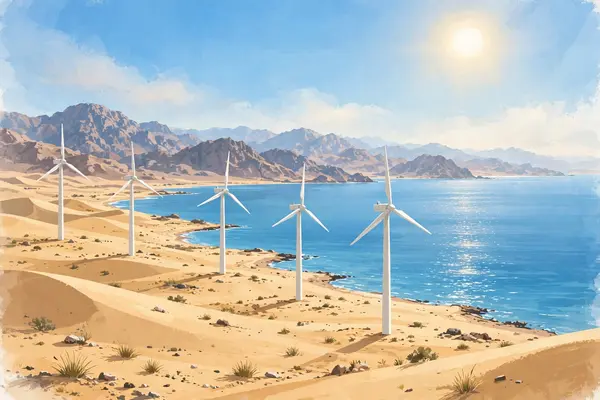
A 900 MW wind farm in the Egyptian desert, fully funded by six international lenders — the Gulf of Suez is becoming one of the world's wind corridors.
Why It Matters
Wind power in Egypt has a natural advantage: the Gulf of Suez is one of the windiest corridors on earth, with steady winds funnelling between the Red Sea hills. Shokeir sits in that corridor, which is why a 900 MW project — the size of a mid-sized gas plant — makes economic sense there. Once running it will double the consortium's Egyptian wind capacity to 1.8 GW.
Financial close matters because big energy projects die more often in the financing stage than in construction. Getting six lenders to commit $588 million on a non-recourse basis — secured only against the wind farm itself — means the project's economics, contracts and risks have all been stress-tested by banks with their own money on the line. That is a stronger signal than any press release.
For ENGIE, the project is also a statement of strategy. The French utility has been shifting investment toward renewables and away from fossil fuels, and its largest onshore wind farm in the world landing in Egypt shows where the growth is: in markets with strong wind, supportive governments and long-term power contracts. Orascom Construction, the Egyptian partner, gets a flagship project on its home turf.
The risks are real but familiar. Egypt's currency and grid have tested developers before, and a 2028 completion date leaves two years of construction risk. But with funding signed, construction already started and a 25-year contract to sell the power, the project has cleared its hardest hurdle.
Analyst's Take
Our call is Bullish. Financial close on a 900 MW wind farm, backed by six international lenders and a 25-year contract to sell the power, is the kind of concrete milestone that turns a renewable-energy pipeline into revenue. For ENGIE it is also a flagship: its largest onshore wind farm anywhere in the world, doubling the group's Egyptian wind capacity to 1.8 GW.
The lender list is the tell. Development banks like JBIC, PROPARCO and FMO do not put $588 million of non-recourse debt into a project they doubt, and the mix of Japanese, French, Dutch and German money shows the project has been vetted across several banking systems. A 25-year power purchase agreement with the Egyptian grid operator gives the consortium a long, predictable revenue stream to repay it.
The honest caveat is the timetable. First power is January 2028 and full capacity is summer 2028, so this is a 2028 earnings story, not a 2026 one — and Egypt's grid and currency have tested developers before. But the funding is signed, construction is already under way, and the risk from here is execution, not finance.
Reader poll: are you bullish or bearish on wind power? Vote: Bullish, Bearish, or Watching.
Are you bullish or bearish on this story?
By The Numbers
FAQ
What is financial close?
Financial close is the point at which all the funding for a project is signed and locked in — the loans are committed and construction can proceed with the money secured. It is the moment a project moves from a plan to a funded build.
Who is building the Shokeir wind farm?
A consortium of ENGIE of France with 35%, Aeolus of Japan with 40%, and Orascom Construction of Egypt with 25%. The farm is being built near Ras Shokeir on the Gulf of Suez under a 25-year build-own-operate deal, with a power purchase agreement — a long-term contract to sell the electricity — with the Egyptian grid operator.
When will it start generating power?
Construction began in June 2026. The first 300 MW is due to start operating in January 2028, with the full 900 MW complete by summer 2028.
Who is lending the money?
About $588 million of non-recourse debt — loans secured against the project itself rather than the parent companies — from JBIC, PROPARCO, FMO, Société Générale, Crédit Agricole CIB and KfW IPEX. Non-recourse means the lenders can only claim the project's own assets if it fails, not the sponsors' balance sheets.
How big is 900 MW?
A megawatt is a million watts. 900 MW of wind capacity is roughly enough to power several hundred thousand homes, depending on wind conditions. Once running, Shokeir will double the consortium's wind capacity in Egypt to 1.8 GW.
How did the shares react?
ENGIE closed Friday in Paris at €25.28, up 0.56%. Orascom Construction is dual-listed on the Abu Dhabi Securities Exchange (ADX: ORAS) and the Egyptian Exchange (EGX: ORAS) — its Nasdaq Dubai listing ended in September 2025, when the primary listing moved to ADX — and it closed Friday at about 54.45 dirhams (about $14.82).
👁
Source: Orascom Construction