
Hot CPI splits the chip complex: Nvidia falls 5.5% as AMD and Broadcom rally
October CPI rose 0.4% month over month versus 0.3% expected, pushing the two-year Treasury yield up 17 basis points to 4.73% and December Fed hike odds to near 100% — but the chip complex split: Nvidia fell 5.5% while Broadcom rose 3.91% and AMD gained 1.30%.
The News
October's inflation report came in hotter than expected on Tuesday, and the chip market split down the middle. Headline CPI — the Consumer Price Index, the US government's monthly measure of how much prices are rising — rose 0.4% month over month, against 0.3% expected. Core CPI, which strips out food and energy prices, rose 0.3% against 0.2% expected, its third straight monthly gain of 0.3%. The two-year Treasury yield jumped 17 basis points to 4.73% — a basis point is one-hundredth of a percentage point — and the 10-year yield rose to 4.98%. Markets now price a December Federal Reserve rate hike as near-certain.
The Philadelphia Semiconductor Index, the SOX — a basket of the biggest US chip stocks — slipped just 0.36%, but that small move hides a sharp split inside it. Nvidia fell 5.5% to $168.89, Micron fell 1.10% to $725.11, and SanDisk fell 2.99% to $859.99. On the other side, Broadcom rose 3.91% to $331.98, AMD rose 1.30% to $515.21 after touching an intraday high of $539.25, a one-month high, and TSMC gained 2.02%. The S&P 500 lost 0.38% and the Nasdaq 0.74%.
The rotation out of Nvidia into AMD and Broadcom extended a second session. On Monday, AMD had risen 13.26% and Broadcom 8.78% while Nvidia fell 4.27%; on Tuesday the same pattern repeated, with money moving from the stock at the centre of the week's bad news toward its rivals. The split is not about the chips themselves — it is about which company investors want to own while Nvidia's board probe, the export-control debate and the inflation report all hang over the market at once.
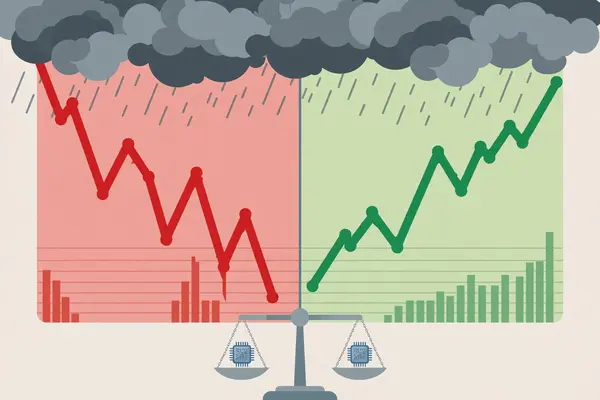
Hot inflation split the chip trade in two — Nvidia down, its rivals up.
Why It Matters
The split matters because it shows the market is no longer treating AI chips as one trade. For most of the year, Nvidia, AMD, Broadcom and TSMC rose and fell together — a rising tide for the whole complex. On Tuesday they went in opposite directions on the same news, and the dividing line was not the inflation report itself but which company the news was about. Nvidia carried the week's scandals; AMD and Broadcom did not. That is a market making distinctions, and distinctions are what turn a rotation into a trend.
The inflation report matters on its own terms too. Three straight months of core CPI at 0.3% is a pattern, not a blip, and it is why the market now prices a December rate hike as near-certain. Higher rates are the classic enemy of expensive growth stocks, because they raise the cost of borrowing and make future profits worth less today. The 10-year yield at 4.98% is the price of that worry. But the chip split says the worry is not evenly spread: investors are still willing to pay up for AMD at a one-month high, just not for Nvidia at the centre of a board probe.
The rotation is the third thing to watch, because it has now lasted two sessions and survived a hot inflation print. On Monday the move could have been a one-day reaction to Nvidia's fall; on Tuesday it repeated under worse macro news, which suggests it is a decision rather than a reflex. The question is whether it is a decision about Nvidia specifically — its governance, its China exposure, its valuation — or the start of a broader re-rating in which the market stops paying a premium for the AI leader and starts paying it for the challengers. November 17, when Nvidia reports, is the first real test.
Analyst's Take
Our call is Mixed. The inflation report is genuinely bad news for the whole market — a hotter CPI, a near-certain December hike, and yields at 4.98% on the 10-year are the backdrop against which every stock is now judged. But the chip complex refused to fall together. The rotation into AMD and Broadcom, now two sessions old, says investors are not abandoning AI chips — they are abandoning one AI chip company, at least for now.
What to watch: Nvidia's earnings on November 17 and the December Fed meeting. If Nvidia's numbers are strong, the rotation could reverse as fast as it started. If the Fed hikes and Nvidia's review drags on, the split could harden into a lasting re-rating of the whole complex.
Are you bullish or bearish on this story?
By The Numbers
FAQ
What is CPI?
CPI, the Consumer Price Index, is the US government's monthly measure of how much prices are rising for ordinary goods and services. October's headline figure rose 0.4% from September, against 0.3% expected, and core CPI — which strips out food and energy — rose 0.3% against 0.2% expected, its third straight 0.3% monthly gain.
What is a basis point?
A basis point is one-hundredth of a percentage point. The two-year Treasury yield rose 17 basis points, from about 4.56% to 4.73%, and the 10-year yield rose to 4.98%. When yields rise, borrowing gets more expensive — and growth stocks usually fall.
Why did Nvidia fall while AMD and Broadcom rose?
The rotation out of Nvidia into AMD and Broadcom, already visible on Monday when AMD rose 13.26% and Broadcom 8.78%, extended for a second session. Investors are moving money from the stock at the centre of the week's bad news toward its rivals, which are seen as the next beneficiaries of AI chip demand.
What is the Philadelphia Semiconductor Index?
The Philadelphia Semiconductor Index, known as the SOX, is a basket of the biggest US chip stocks. It slipped just 0.36% on Tuesday — a small move that hides the sharp split inside it between Nvidia and memory on one side and AMD, Broadcom and TSMC on the other.
What happens next?
Markets now price a December Fed rate hike as near-certain. The next test is Nvidia's earnings on November 17, and the December Fed meeting itself, where the hike would actually be decided.
👁
Source: Seoul Economic Daily