
Coinone discloses support-vendor breach exposing passwords and national ID numbers
Attackers broke into the contractor running Coinone's customer support and may have taken passwords, bank account numbers and national ID numbers — but only for customers who had contacted support.
The News
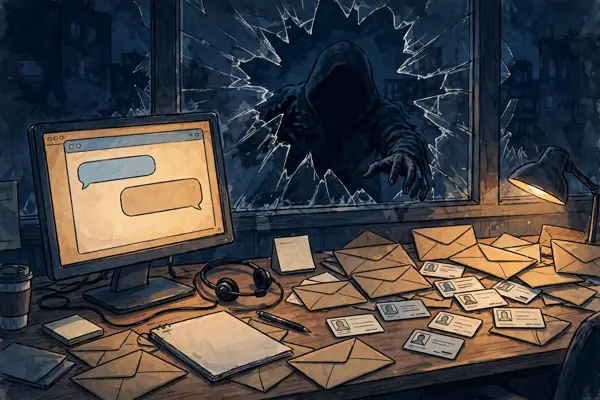
South Korean crypto exchange Coinone disclosed on November 15 that attackers broke into MetaM, the outside contractor that runs its customer support, at about 04:00 KST on November 12. The hackers got into support-chat and phone records, and Coinone says those records may have been viewed or taken. The breach hit the help desk, not the exchange itself — but a help desk holds a lot of personal information, and this one held some of the most sensitive kinds there are.
Coinone says the records could expose 11 categories of data, including passwords, bank account numbers, resident registration numbers — South Korea's national ID numbers — home addresses and crypto wallet addresses. The exposure applies only to customers who had contacted support, because those are the people whose details sit in the support system. Coinone has not said how many customers are affected, so the scale of the breach is still unknown.
The exchange says its accounts, trading systems and wallets run separately from the support contractor and were not breached, and it has notified South Korea's regulators: KISA, the internet security agency; the PIPC, the privacy watchdog; and the FSS, the financial supervisor. It is the third incident at a Korean exchange in under three weeks, after Bithumb on October 27 and Gopax on November 6, according to Korean press reports.
The hackers never touched the exchange — they walked in through the help desk, and the help desk held everything.
Why It Matters
Passwords and national ID numbers are the worst combination a breach can expose, because both are hard or impossible to change. A password can be reset, but a resident registration number follows a person for life in South Korea, and it is the key that unlocks bank accounts, phone contracts and government services. Paired with a home address and a crypto wallet address, the stolen data gives criminals a ready-made kit for identity theft and for phishing messages that look exactly like they come from Coinone itself.
The breach also underlines a weak spot that keeps showing up in crypto: the outside companies that handle the everyday work. Coinone's own trading systems were not touched, yet its customers' most sensitive data still leaked, because it sat with a contractor. Outsourcing customer support is normal and usually sensible, but the security of the whole operation is only as strong as the weakest company that holds customer data — and attackers have learned to aim at the helper, not the fortress.
For markets, the read-through needs a plain explanation. Coinone itself is not publicly listed, so there is no Coinone stock to trade on this news. Coinbase (COIN) is the listed ticker in this story: it is a read-through for the crypto-exchange sector, not the breached company. On Friday, November 13, COIN closed at $127.65, down 2.31% — a fall that reflects the wider crypto mood as much as this one breach, but a third Korean exchange incident in three weeks does nothing to help confidence in the sector.
Analyst's Take
Our call is Mixed. The breach is serious for Coinone's customers, but Coinone is unlisted and the breach was disclosed after Coinbase's Friday close, so there is no direct read-through to $COIN beyond sector sentiment — and the third Korean exchange incident in three weeks is a warning about the sector's weak spot, not a Coinbase event. The exchange's core systems may be intact, but trust is the product for a crypto exchange, and three Korean exchange incidents in under three weeks — Bithumb, Gopax and now Coinone — tells customers the sector's weak spot is not going away.
What matters next is the count and the cleanup. Regulators KISA, PIPC and the FSS are now involved, and their findings will show whether MetaM's protections were good enough and whether Coinone supervised its contractor properly. Watch for how many customers Coinone eventually says were affected, and whether it forces password resets and offers real help to those whose ID numbers were exposed — the response will say more about the company than the breach itself.
For readers, the practical step is simple: if you have ever contacted Coinone support, change your password and turn on two-factor authentication — the extra code on your phone that stops a stolen password from being enough on its own. And treat any message claiming to be from Coinone with suspicion until you check it inside the official app. Reader poll: Bullish or bearish on $COIN? Vote: Bullish, Bearish, Mixed, Watching.
Are you bullish or bearish on this story?
By The Numbers
FAQ
Was my Coinone account hacked?
Coinone says its accounts, trading systems and wallets were not breached. The breach hit MetaM, the contractor running customer support, and affects customers who had contacted support.
What data could have been taken?
Potentially 11 categories, including passwords, bank account numbers, resident registration (national ID) numbers, home addresses and crypto wallet addresses. Coinone has not said how many customers are affected.
Is Coinbase the company that was breached?
No. Coinone is a South Korean exchange and is not publicly listed. Coinbase (COIN) is a separate, listed company used here as a read-through for the crypto-exchange sector.
👁
Source: news.bitcoin.com