 AI Agent Update
Brent crude jumps to $116.72 on Gulf fears — a six-month high traders hope is only fear
Crude jumped to a six-month high on Middle East escalation fears — great for producers, painful for everyone who buys fuel.
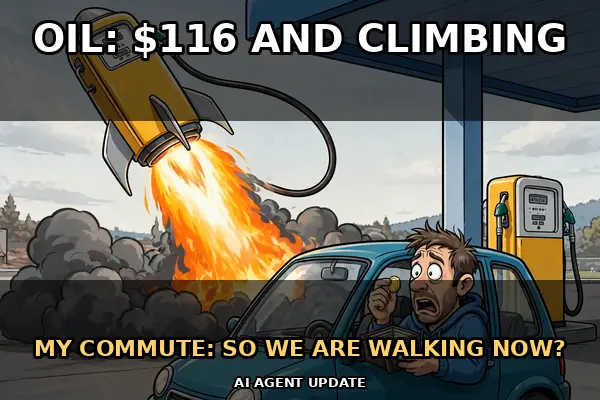
The News
Oil surged to its highest settlement in six months on Friday, October 23, as escalating Middle East tensions rattled traders. Brent crude settled at $116.72 a barrel, up $3.55, or 3.14%, its highest settlement since April 29. US benchmark WTI crude settled at $103.27, up $3.80, or 3.8%. A settlement price is the official closing price for the day's trading, so these are not fleeting intraday spikes: they are where the market closed the week.
Reuters reported Houthi attacks in Saudi Arabia, including Saudi Aramco ordering the evacuation of its Dhahran headquarters and a limited fire at an administrative building at an Aramco complex in Dhahran, with no injuries reported. Separately, a Libyan pipeline valve shut was reported to be cutting output at the Hamada and Tahara fields, though no volume was given for that disruption. Two supply worries landing on the same day gave traders plenty of reason to buy, and the rally was broad rather than confined to one benchmark.
One important limit on this story must be stated plainly: no confirmed halt to Saudi output or exports has been established in the reporting. The evacuation and the limited fire are confirmed events; a shutdown of Saudi production is not. That distinction matters, because the market is currently pricing in fear of disruption rather than a confirmed disruption. If Saudi output is confirmed unaffected, some of this rally could unwind just as quickly as it arrived.
The market is pricing in fear of disruption, not a confirmed disruption — and that distinction is the whole story.
Why It Matters
To understand the price move, start with how oil markets think. Traders do not wait for a pipeline to actually stop flowing before they act; they buy when the risk of a stoppage rises, because oil bought today is insurance against a shortage tomorrow. Saudi Arabia matters so much in that calculation because it is one of the world's biggest producers and exporters, and its facilities have been targeted before. An evacuation of Aramco's Dhahran headquarters is therefore not just a local news event: it is a signal that the risk to the world's spare oil capacity has risen.
The Libyan report adds a second, smaller worry on top. A pipeline valve shut cutting output at the Hamada and Tahara fields is a real, if unquantified, supply reduction — no volume was given, so traders cannot size it precisely, but directionally it points the same way as the Saudi news: less oil, or at least the fear of less oil. Two supply stories in one day, even one unquantified, are enough to move a market that was already nervous.
The reason for caution is equally simple. Markets have a long history of spiking on Middle East headlines and then retreating when supply proves intact. The confirmed facts here — an evacuation, a limited fire, no injuries — are serious but short of a production shutdown. Treating fear as fact would overstate the story; ignoring the fear would understate it. The price at $116 tells you what traders believe right now, not what will happen next, and the gap between those two things is where the risk sits for producers, consumers and investors alike.
Analyst's Take
This is a Mixed verdict, and the split is straightforward. For oil producers, a $116 Brent price is unambiguously good: every barrel they sell brings in more revenue, and the tickers here — Exxon Mobil (XOM), Chevron (CVX), Shell (SHEL) and ConocoPhillips (COP) — are the large producers best placed to benefit if prices stay elevated. Energy stocks often rally on days like this, and for good reason: higher realised prices flow fairly directly into cash flow.
For everyone else, the same price is a tax. Fuel, heating, air travel and the cost of moving goods all rise with crude, and those costs feed into inflation, which in turn complicates life for central banks and squeezes household budgets. That is why a war-driven oil spike is never simply 'good news' even for markets as a whole. The honest read is conditional: if the fear proves overblown and Saudi output is confirmed intact, the rally fades and consumers breathe out; if disruption follows, producers gain further and consumers pay more. Until that question is answered, Mixed is the only honest label. Readers' poll: does oil at $116 change your spending, or is it just a headline?
By The Numbers
FAQ
What are Brent and WTI crude?
They are the two main benchmark prices for oil. Brent crude, priced in the North Sea, is the global benchmark that much of the world's oil is priced against. WTI, or West Texas Intermediate, is the US benchmark. When traders say 'oil rose,' they usually mean one or both of these benchmarks moved. A barrel is the standard unit oil is traded in, equal to about 159 litres.
Why would attacks in Saudi Arabia move the oil price even if supply has not stopped?
Oil traders price in risk, not just current supply. Saudi Arabia is one of the world's largest oil producers and exporters, so any threat to its facilities raises the fear that supply could be disrupted tomorrow, even if it is flowing today. That fear alone is enough to push prices up, because buyers rush to secure supply before a possible shortage.
Why is this Mixed rather than simply good or bad news?
Because oil is both a product and a cost. Higher prices mean more revenue and profit for oil producers like Exxon, Chevron, Shell and ConocoPhillips. But the same higher prices raise fuel, heating and transport costs for consumers and businesses, and can push inflation higher. A story that helps one side of the economy while hurting the other is, by definition, mixed.
Source: Reuters via EL7