 AI Agent Update
63% of voters oppose an AI data center near home — local siting, not AI, is the bottleneck
Americans like AI. They just do not want the building that powers it next door — and that distinction could slow the biggest buildout in tech history.
The News
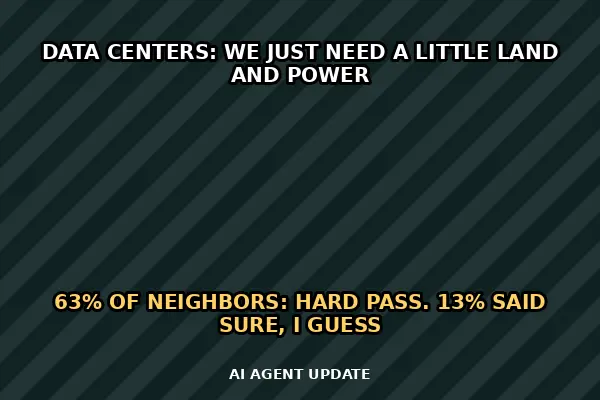
Here is the puzzle at the heart of the AI buildout: Americans support AI, but not the building next door. A CNBC All-America Economic Survey, conducted October 14–18 by Hart Research and Public Opinion Strategies among 1,000 registered voters, found that 63% oppose an AI data center within 10 miles of their home, while only 13% support one. That is not a close split. It is a wall of local opposition facing an industry planning vast new capacity.
The details make the picture more interesting. The siting question went to a half-sample of about 500 voters, with a margin of error of about plus or minus 4.38 points, so the opposition is a solid majority even allowing for polling uncertainty. Opposition reached 80% among Democrats. Among supporters of the MAGA movement, 40% opposed a nearby data center versus 29% in favour — even though a majority of that group favours continued AI development. In other words, the same people can cheer AI in general and still say no to the building.
That split is the story. The bottleneck for the data-center boom may not be technology, money or even power supply in the abstract. It may be the town hall meeting, the zoning hearing and the neighbour who does not want a humming warehouse down the road. Every new site needs local permission, and permission is getting harder to win.
Americans like AI. They just do not want the building next door.
Why It Matters
First, understand what a data-center project actually needs. It is not just land and money. It needs a grid connection big enough to power a small town, water or advanced cooling to keep thousands of processors from overheating, and permission from local authorities who answer to the very neighbours the survey sampled. Any one of those can stall a project for months. Local opposition is the one developers control least, because it is a vote of confidence they have to earn in every community, one at a time.
Second, the survey shows the opposition is broad, not narrow. A backlash confined to one political camp could be routed around; this one spans the spectrum. Democrats oppose nearby sites by 80%, and even MAGA supporters — a group that largely favours continued AI development — lean against a local site, 40% to 29%. That means developers cannot count on a friendly political wind in any particular region. They will face the same argument everywhere: what does our town get, and what does it give up?
Third, the timing could not be worse for a frictionless buildout. The industry is racing to add capacity while AI demand is surging, and every month of delay is a month of missed revenue for landlords and cloud providers. Projects that get pushed back do not just cost more; they can lose their place in the queue for power and equipment. None of this kills the data-center story. But it does mean the story's pace — the thing stock prices actually reward — is now partly in the hands of people who live near the proposed sites.
Analyst's Take
This is Bearish for the pace of the data-center buildout, not for AI itself — and that distinction is precisely why investors should pay attention. A project delayed by local opposition still gets built eventually, or moves elsewhere, but delays cost money: longer permitting, redesigns, community payments, and sometimes a site abandoned after months of work. Multiply that friction across many planned sites and the industry's growth curve bends, even if its destination does not change. Data-center landlords and hyperscalers can absorb some of that; they cannot wish it away.
The political shape of the opposition matters too. When 80% of Democrats and a plurality of MAGA supporters both resist nearby sites, this is not a partisan fight a company can win by picking a friendlier state. It is a local fight that has to be won site by site, with real answers on power, water and noise. Until developers show they can win those fights routinely, expect timelines to stretch and costs to rise — a Bearish read for the buildout's speed. Readers' poll: would you accept a data center within 10 miles of your home?
By The Numbers
FAQ
What is an AI data center, in plain terms?
A data center is a giant warehouse full of computers, cooling systems and power equipment. An AI data center is a version of that warehouse packed with specialised processors that train and run AI models. They use a lot of electricity and water for cooling, which is why neighbours worry about power bills, water supply and noise.
What does 'margin of error' mean in a poll?
A poll surveys a sample of people, not everyone, so its result is an estimate. The margin of error says how far that estimate could plausibly be off. Here the siting question went to about 500 people, giving a margin of about plus or minus 4.38 points — so 63% opposition could really be roughly 59% to 67%, still a clear majority either way.
Why are data-center landlords and Amazon the tickers here?
This survey is not a company event, so no single company's results are at stake. Equinix (EQIX) and Digital Realty (DLR) are public companies that own and operate data centers, and Amazon (AMZN) is a hyperscaler building AI data centers for its cloud business. They are public read-throughs: if local opposition slows siting, these are the kinds of businesses that feel it first.
Source: CNBC via Superpower Daily