
Boston Dynamics puts Atlas on scooter wheels — a 360° spinning jump, not a product
The electric humanoid swapped its feet for off-the-shelf scooter rims and landed a 360-degree spinning jump on its first hardware attempt. Boston Dynamics is explicit: this is a research testbed, not a product.
📊 Scorecard: our Bullish call on $005380.KS is a miss so far: from ₩275,000 to ₩272,500 at the latest close (-0.9%). Against QQQ the call is wrong: the stock is 0.2 points behind the index.
The News
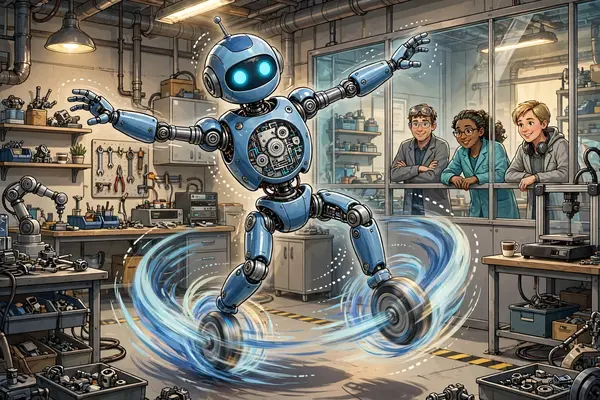
Boston Dynamics released a video on November 9 of its electric Atlas humanoid with its feet swapped for off-the-shelf scooter rims — and the robot did a 360-degree spinning jump. The clip also shows sideways dashes, glides and single-wheel balancing, all on wheels bought from a scooter shop. The 360-degree jump landed on the first hardware attempt, which is the detail that matters: the software worked the first time it met the real world.
The point of the experiment is control, not locomotion. A whole-body reinforcement-learning policy — software trained by trial and error in simulation — drives Atlas's real actuators at the edge of their performance envelopes. Reinforcement learning means the software learns by trying things in a virtual world, getting rewarded for what works and penalized for what does not, until it finds a policy — a set of rules — that works. Atlas's policy was trained in Google DeepMind's MuJoCo physics simulator, adapted from Atlas's existing reinforcement-learning frameworks, and then run on the real robot — according to Boston Dynamics' blog post on the experiment (the cited Korea JoongAng Daily article confirms only that Atlas trained 'through repeated practice in a virtual simulation'). The wheels force the policy to handle balance and momentum in ways walking never does, which is exactly the stress test the engineers wanted.
The hardware change was almost nothing. The only new hardware was a single custom adapter mounting an off-the-shelf scooter rim onto Atlas's existing ankle actuator — everything else is the same Atlas. And Boston Dynamics is explicit about what this is not: 'A wheeled Atlas isn't a product. It's a research testbed,' controls engineer Andy Wu wrote in the company blog post. The next step is a policy robust to failed actuators — software that keeps the robot upright even when a motor fails — and Atlas testing at Hyundai facilities is also expanding, according to The Robot Report.
The robot did a spinning jump on scooter wheels — and the engineers say the jump is not the point.
Why It Matters
Humanoid robots fail in the real world more often than in the lab, and the gap between simulation and reality is the reason. Training software in a physics simulator is cheap and safe — you can crash a virtual robot a million times — but the real robot has friction, wear and motors that do not behave exactly like the model. When a policy trained in MuJoCo lands a 360-degree jump on scooter wheels on its first hardware attempt, that gap is closing. The wheels are the hard part: they remove the stable footing that walking provides and force the software to manage balance, spin and momentum all at once.
The business read is through Hyundai Motor Group, Boston Dynamics' parent and the story's only ticker. Hyundai is expanding Atlas testing at its own facilities, which is where a humanoid earns its keep — moving parts, handling materials, working alongside people. A research testbed does not generate revenue, and Boston Dynamics said so plainly. But every control result like this one is a step toward a robot that can be trusted in a factory, and Hyundai owns both the robot and the factories. That vertical integration is the bullish case: the customer and the manufacturer are the same company.
Analyst's Take
Our call is Bullish. The jump is fun to watch, but the real signal is that the software worked on the first hardware attempt. Simulation-to-real transfer — training in a virtual world and having it work on a real robot — is the hardest problem in humanoid robotics, and a first-try landing on an unstable platform like scooter wheels says Atlas's control stack is maturing fast. The next step, a policy that survives failed actuators, is the one that matters for real deployment: a robot that falls over when a motor fails cannot work in a factory. Hyundai Motor Group — Hyundai Motor holds about 28% of Boston Dynamics, with Kia, Mobis, Glovis and the Group chair holding the rest — is expanding Atlas testing at its own facilities. For Hyundai Motor Company itself, the read-through is indirect: Boston Dynamics is a small, pre-revenue part of a large automaker, so this demo is a technology signal, not a near-term earnings driver.
What to watch: whether the failed-actuator policy arrives, and what Hyundai does with it. A research video is not revenue, and Boston Dynamics said so itself. But every control breakthrough like this one shortens the distance between a demo and a deployment, and Hyundai is the company best placed to give Atlas a job — in its own factories first. Watch for Atlas appearing in Hyundai facility testing in a working role, not a video role. That is the moment this story stops being a demo and starts being a business.
Are you bullish or bearish on this story?
By The Numbers
FAQ
What did Atlas actually do?
Boston Dynamics released a video November 9 of its electric Atlas humanoid with its feet swapped for off-the-shelf scooter rims, performing a 360-degree spinning jump, sideways dashes, glides and single-wheel balancing.
Is a wheeled Atlas a product?
No. Boston Dynamics is explicit: 'A wheeled Atlas isn't a product. It's a research testbed,' controls engineer Andy Wu wrote in the company blog post. The point of the experiment is control, not locomotion.
Why put a robot on scooter wheels?
To test control at the edge of the hardware's limits. A whole-body reinforcement-learning policy — software trained by trial and error in simulation — drives the real actuators, and the wheels force the policy to handle balance and momentum in ways walking never does.
What is MuJoCo?
A physics simulator from Google DeepMind, used to train robot control software in a virtual world before it runs on real hardware. Atlas's policy was trained in MuJoCo, adapted from Atlas's existing reinforcement-learning frameworks.
What hardware was changed?
Almost none. The only new hardware was a single custom adapter mounting the rim to Atlas's existing ankle actuator. The 360-degree jump landed on the first hardware attempt.
What comes next?
A policy robust to failed actuators — software that keeps the robot upright even when a motor fails — and Atlas testing at Hyundai facilities is also expanding, according to The Robot Report.
👁
Source: Korea JoongAng Daily