
ASELSAN says its EJDERHA microwave system disabled 51 drones at once in a single test
ASELSAN says its EJDERHA system knocked 51 drones out of the sky at once in a test staged for the company's 51st anniversary. The company calls it a world first, but neither the claim nor the test result has been independently verified.
📊 Scorecard: our Bullish call on $ASELS.IS is scored from 345.50, the last close before it ran. Its first result comes after the next close.
The News
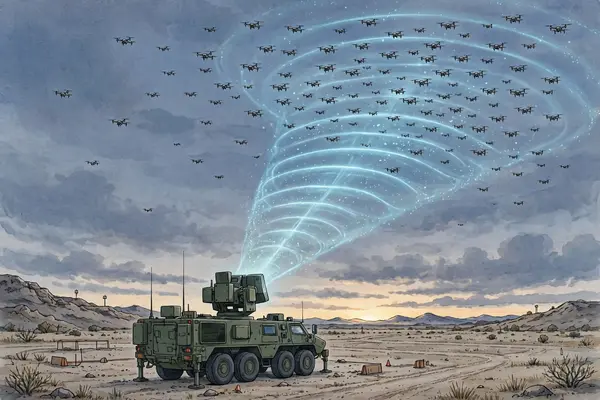
Turkish defence company ASELSAN says its EJDERHA counter-drone system disabled 51 drones launched at the same time, within seconds, in a test at its Gölbek test centre on Sunday, November 15. The test was staged to mark the company's 51st anniversary, with one drone for each year. EJDERHA is a high-power electromagnetic system, which means it uses focused energy, rather than bullets or missiles, to knock drones out of the sky.
In a first phase of the test, two wired drones were neutralised at about 1,000 metres. Wired drones are controlled through a physical cable rather than by radio signals, which makes them harder to jam, so stopping them is a meaningful part of the demonstration. General Manager Ahmet Akyol called the result a world first and said the system is in serial production, meaning it is being built in quantity rather than as a one-off prototype.
Two important caveats come with the announcement. Neither the world-first claim nor the test result has been independently verified, so everything about the system's performance in this story is ASELSAN's own account, not a confirmed result from an outside tester. The company also did not disclose the system's range, the types of drones used, its power output, any customers, or what it costs. Those gaps matter, because a staged test against the company's own drones is not the same as stopping a real attack.
General Manager Ahmet Akyol called the test a world first, ASELSAN said.
Why It Matters
Drone swarms have become one of the hardest problems in modern defence. A single drone is cheap and easy to shoot down, but dozens arriving at once can overwhelm guns and missiles, because each interceptor costs far more than the drone it destroys. A system that uses electromagnetic energy instead of ammunition could change that maths entirely, since firing it costs little and it never runs out of bullets in the usual sense.
The test was also a showcase for Turkey's defence industry, which has grown from a local supplier into an exporter in less than a decade. Turkish drones are already sold around the world, and a counter-drone system from the same industry would complete the picture: Turkey selling both the drones and the shield against them. For ASELSAN, one of the country's biggest defence companies, a working swarm defence would open a new export market on top of its existing business.
The verification gap is the part investors should not skip past. Defence companies have a long history of impressive test announcements that later turned out to be staged under friendly conditions, against slow or cooperative targets. That does not mean ASELSAN's claim is false, but it does mean the claim is unproven. The difference between a real product and a good demonstration is independent testing, and that has not happened yet. Until it does, the share price rise is a bet on the claim, not a verdict on the system.
Analyst's Take
Our call is Bullish. Even with the verification caveat, this is a strong signal about where ASELSAN is heading. Drone swarms are one of the fastest-growing threats in modern warfare, and a system that can stop 51 at once, if the claim holds up, would be a serious product. The company says EJDERHA is already in serial production, which means it is ready to sell, not stuck in a laboratory. ASELS shares were up 3.69% at 358.25 Turkish lira in Monday trading in Istanbul.
The honest version of this story is that investors are buying a company claim, not a confirmed fact. ASELSAN staged the test itself, chose the drones, and reported the result itself, with no outside tester confirming it. The missing details, range, drone types, power output, customers and cost, are exactly the details a buyer would ask for before signing a contract. Until an independent test or a real customer order appears, the 51-drone figure should be treated as a company claim, and this story says so plainly.
Still, the direction of travel is clear. Turkey's defence industry has grown quickly, and counter-drone systems are in demand from armies that watched cheap drones destroy expensive equipment in Ukraine and elsewhere. A system that works against swarms, rather than one drone at a time, is what buyers now want. If ASELSAN can prove EJDERHA in front of independent testers or foreign customers, this test will look like a turning point. If it cannot, it will look like an anniversary show. Reader poll: Bullish or bearish on $ASELS? Vote: Bullish, Bearish, Mixed, Wait for proof.
Are you bullish or bearish on this story?
By The Numbers
FAQ
What is EJDERHA?
A high-power electromagnetic counter-drone system built by Turkish defence company ASELSAN. It uses focused energy, rather than bullets or missiles, to disable drones in the air.
How many drones did it disable?
ASELSAN says 51 drones launched at the same time were disabled within seconds. Two wired drones were neutralised at about 1,000 metres in a first phase.
Has the test been independently verified?
No. Neither the world-first claim nor the test result has been independently verified, and ASELSAN did not disclose range, drone types, power output, customers or cost.
👁
Source: Defense and Tech