
Anthropic moves Claude Managed Agents inside the firewall in private beta
Anthropic opened a private beta on November 12 for self-hosted Claude Managed Agents, letting enterprises run the whole service — the agent harness, sandboxes, credentials and session history — on their own cloud or on-premises systems. The model itself stays put: every model call still goes to a provider the customer picks, with Anthropic as the default.
📊 Scorecard: our Bullish call on $AMZN is scored from $267.44, the last close before it ran. Its first result comes after the next close.
The News
Anthropic announced on November 12 a private beta of self-hosted Claude Managed Agents, a version of its service for long-running AI agents that enterprises can run entirely on their own cloud or on-premises infrastructure. Managed Agents is built for agents that work through bug backlogs, fix builds, test releases and triage alerts over hours rather than minutes. Until now the service ran on Anthropic's own systems; this beta moves the whole thing — the agent harness, the sandboxes, the credentials and the session history — behind the customer's own perimeter.
The customer runs three pieces. The cma-server serves the Managed Agents API, runs the agent loop and stores agents, sessions and history. A PostgreSQL 16-or-later database holds that history, and workers run the agents' shell and file tools inside sandboxes the customer controls. The model itself does not move home: every model call still goes to an inference provider the customer picks — Anthropic by default, or Amazon Bedrock, Google Cloud, Microsoft Foundry or the customer's own gateway. Anthropic says it has no remote access to a customer's self-hosted server or its logs.
The hosted service launched in beta in April 2026 and gained self-hosted sandboxes in May, so this is the next step in a sequence Anthropic has been building all year. There are limits. Access is only through an Anthropic account team for eligible organisations, there is no public pricing and no general-availability date. Scheduled deployments, dreams and webhooks are unavailable on the self-hosted server, and web search and web fetch stay off until explicitly enabled. The development Docker Compose setup is not for production — Anthropic recommends Helm tooling for a production deployment.
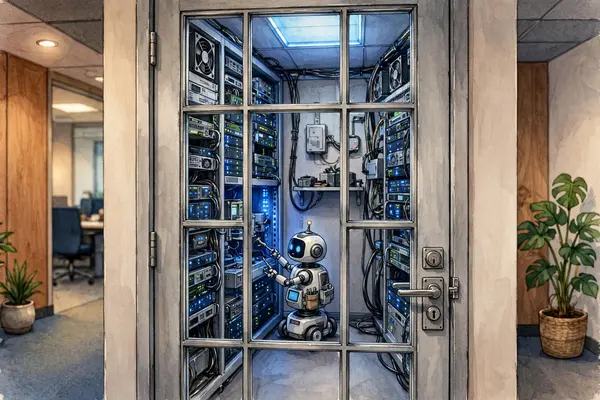
The agent moves inside the customer's walls; the model stays where the computing lives.
Why It Matters
The reason this matters is control. Many large companies want AI agents that can work through real backlogs, but they will not let the agent's working memory — its session history, its credentials, the sandboxes where it runs code — live on somebody else's servers. A bank, a hospital or a defence contractor has rules about where data can sit, and 'in the cloud, on Anthropic's systems' can be a deal-breaker. Self-hosting removes that objection: the agent works inside the customer's own walls.
The design is a compromise, and it is worth understanding. The agent's brain — the model — still lives outside, reached over the network through a provider the customer chooses. What moves home is everything around the brain: the harness that runs the agent, the sandboxes where it executes commands, the credentials it uses and the history of what it did. That split is what makes the offer work for regulated industries: the sensitive state stays inside, while the heavy computing still happens at a big provider. 'Inference provider' just means the service that actually runs the model and returns its answers.
For the cloud providers named as read-throughs, this is a small but real tailwind. Anthropic is a private company, so there is no Anthropic stock to buy; the listed read-through is the providers that host the model calls. If a customer picks Amazon Bedrock, Google Cloud or Microsoft Foundry, that provider earns the inference work — the metered computing behind every agent step. A self-hosted deployment does not create new model demand by itself, but it removes a barrier that was keeping some enterprises from using Claude agents at all, which means more agent workloads flowing to those providers over time.
The limits matter too. A private beta open only to eligible organisations, with no price and no general-availability date, is a controlled test, not a product launch. And the missing features — no scheduled deployments, no dreams, no webhooks, web search off by default — mean the self-hosted version is not yet the full service. Enterprises that need those features will wait; the ones that need the perimeter more than the features will go first.
Analyst's Take
Our call is Bullish. Anthropic is removing the single biggest objection regulated enterprises have to long-running agents — that the agent's working state lives outside their walls — while keeping the model where it belongs, at a provider built to run it. The April beta, the May sandboxes and now the full self-hosted service show a deliberate sequence, and each step widens the set of companies that can say yes. The read-through for Amazon, Google and Microsoft is modest but positive: more enterprises able to use Claude agents means more inference work for the providers they pick.
What to watch: who gets into the beta and how quickly Anthropic closes the feature gap. The first sign of real traction will be eligible organisations moving production workloads behind their own perimeter, and a general-availability date with public pricing would turn a controlled test into a product. Until then, the missing features — scheduled deployments, dreams, webhooks — are the reason to stay measured: this is a strong direction, not yet a finished offer.
Are you bullish or bearish on this story?
By The Numbers
FAQ
What is Claude Managed Agents?
It is Anthropic's service for long-running AI agents that work through bug backlogs, fix builds, test releases and triage alerts over hours. The self-hosted version lets enterprises run the whole service on their own cloud or on-premises systems.
What does the customer actually run?
Three pieces: the cma-server, which serves the Managed Agents API, runs the agent loop and stores agents, sessions and history; a PostgreSQL 16-or-later database; and workers that run the agents' shell and file tools inside customer sandboxes.
Does the AI model move onto the customer's servers?
No. Every model call still goes to an inference provider the customer picks — Anthropic by default, or Amazon Bedrock, Google Cloud, Microsoft Foundry or the customer's own gateway.
Can Anthropic see what happens on a self-hosted server?
Anthropic says it has no remote access to a customer's self-hosted server or its logs.
What is missing from the self-hosted version?
Scheduled deployments, dreams and webhooks are unavailable, and web search and web fetch stay off until explicitly enabled. Access is only through Anthropic's account team for eligible organisations, with no public pricing and no general-availability date.
👁
Source: Help Net Security