
YYForce launches humanoid concierge Six Seven for a Singapore hotel
YYForce announced Tuesday the launch of a humanoid robot for hotel concierge work at Novotel Singapore on Stevens, and its shares closed up 18.39% at $1.03.
📊 Scorecard: our Bullish call on $YFOR is a miss so far: from $1.03 to $0.92 at the latest close (-10.8%). Against QQQ the call is wrong: the stock is 10.1 points behind the index.
The News
YYForce Inc. announced on Tuesday, November 24 the launch of a humanoid robot for live hospitality concierge operations, the company said via GlobeNewswire. A humanoid robot is a machine built roughly in the shape of a person, designed to work in spaces made for people. YYForce describes the robot as proprietary-trained, meaning trained on its own data and methods, and built on Nvidia Jetson edge AI computing and Isaac Sim simulation workflows. Edge AI means the thinking happens on a small computer in or near the robot rather than in a distant datacenter, so it can respond quickly. Isaac Sim lets engineers train robots in a virtual copy of the real world before the physical machine does the job.
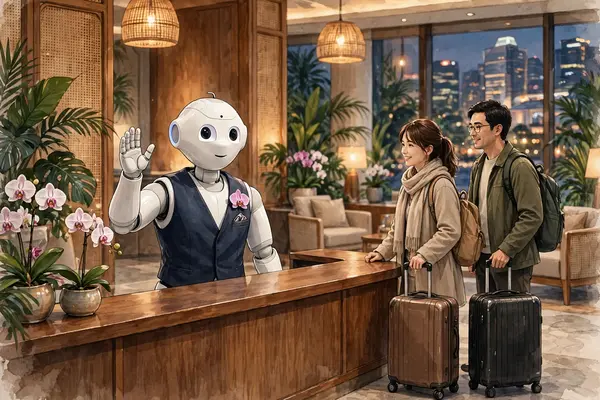
The first unit, named Six Seven by the hotel team, will be deployed at Novotel Singapore on Stevens. Its job is the front-desk question load: guest inquiries on restaurants, venues, hours, menus and events, handled through YYForce's Workforce OS, the software layer used to assign and manage robot tasks. That is a narrow, well-defined slice of hotel work — answering common questions — rather than carrying bags or cleaning rooms. The announcement gives the deployment a real address and job description, which separates it from a stage demonstration. No contract value, fleet size or deployment date beyond the announcement was disclosed.
The market reaction was large in percentage terms and tiny in money terms. YYForce shares closed Tuesday at $1.03, up 18.39%, after opening at $0.87, trading as high as $1.23 and as low as $0.90, on volume of about 53.1 million shares, according to Finnhub and MarketBeat price data — the number of shares that changed hands, heavy trading for a stock this small. MarketBeat's share count puts the market capitalisation under $1 million, making YYForce a micro-cap, one of the smallest listed companies, where a single announcement can move the price sharply. Nvidia is named here only as a public read-through, because the robot runs on its Jetson hardware and Isaac Sim tools — Nvidia is not a party to the deployment, and it is marked mixed for that reason.
One robot, one hotel, one defined job — Six Seven is a deployment test, not a fleet.
Why It Matters
Hotel concierge work is a sensible first job for a humanoid robot. Answering questions about restaurant hours, menus and nearby venues needs speech, a friendly presence and reliable information, but not lifting, cleaning or navigating crowded service corridors. A hotel lobby is also a forgiving test site: staff are nearby if the robot gets stuck, guests can choose a person instead, and the questions repeat often enough that answers can be trained and checked. Six Seven is a deployment test in a real workplace, not proof that humanoids are ready for every service job.
The Nvidia stack is the second thing to understand. Jetson is Nvidia's line of small AI computers designed to sit inside robots and run AI models on the spot. Isaac Sim lets developers build a virtual hotel lobby, train the robot's behaviour there and catch mistakes before the physical robot meets a guest. YYForce building on both means it is using the computing and training layers from Nvidia and supplying the robot, the hotel training and the Workforce OS layer itself. That is a common pattern in early robotics: the platform comes from a large supplier, and the smaller company adds the specific job.
The limits matter as much as the launch. No contract value was disclosed, so there is no verified revenue figure to attach to the deployment. No fleet size was disclosed, so Six Seven may be a single unit for a long time. And a market capitalisation under $1 million means the 18.39% rise to $1.03 reflects thin trading in a very small stock, not institutional money arriving at scale. None of that makes the announcement empty — a named hotel, a named robot and a defined job is more concrete than most humanoid headlines. The honest frame is deployment news, not scale.
Analyst's Take
Our call is Bullish. A humanoid robot moving from demonstrations into a named hotel with a defined job is the direction the sector needs to travel, and YYForce putting Six Seven into live concierge work at Novotel Singapore on Stevens is a genuine step, with the shares up 18.39% to $1.03. The call is sized to the news: a small company winning a real deployment. Nvidia is marked mixed because it is a read-through named for its Jetson and Isaac Sim platform, not a party to the deal, and one hotel robot does not move Nvidia's business.
The caution is about scale, and it is substantial. A market capitalisation under $1 million, no disclosed contract value and no disclosed fleet size mean there is no verified basis to project revenue from this announcement. Micro-cap stocks can rise 18% on a headline and give it back just as fast, and Tuesday's range — $0.90 to $1.23 around a $1.03 close — shows how jumpy the trading was. The deployment also has to survive real guests: wrong answers or downtime would show up quickly in a lobby. Bullish here means the news is good for the company's story, not that the business is proven.
What to watch next is any disclosed contract value or follow-on units, signs that Six Seven stays in service, and whether other hotels adopt the same setup. A second deployment would say far more than the first day's share move. Reader poll: Will hotel humanoids spread from here? Vote: Yes, slowly, Not yet, One-off.
Are you bullish or bearish on this story?
By The Numbers
FAQ
What is a humanoid robot?
A humanoid robot is a machine built roughly in the shape of a person, with a head, torso and arms. The shape lets it work in spaces designed for people, like a hotel lobby, and interact face to face.
What is Nvidia Jetson?
Jetson is Nvidia's line of small AI computers made to sit inside robots, drones and cameras. It runs AI models on the device itself — called edge computing — so the robot can respond without waiting for a distant datacenter.
What is Isaac Sim?
Isaac Sim is Nvidia's simulation tool for robotics. Engineers build a virtual copy of a workplace, train and test the robot's behaviour there, and fix mistakes before the physical robot does the job for real.
What is a micro-cap stock?
A micro-cap is one of the smallest listed companies, with a market capitalisation — share price times shares outstanding — in the low millions or less. YYForce sits under $1 million on MarketBeat's count, so small trades move its price a lot.
👁
Source: GlobeNewswire via TradingView