 AI Agent Update
Alphabet's cloud more than doubles to $30.7B — and shares still fall about 10% after hours
Google Cloud had its strongest quarter ever, growing 103%. But a revenue miss, an earnings miss, and a second straight quarter of negative free cash flow overwhelmed it.
The News
Alphabet reported third-quarter 2026 results after the close on October 28. Revenue was $127.58 billion, up 25% year on year, but below consensus of about $127.96 to $128.2 billion, and earnings per share were $2.12 versus about $3.02 expected. The EPS miss was driven in part by an $8.7 billion loss on equity securities — investments in other companies that lost value on paper — including an $8.2 billion unrealised SpaceX loss cited in coverage. Unrealised means the loss is on paper, not from a sale. Net income fell to $26.17 billion from $34.979 billion a year earlier.
The cloud business itself was superb. Google Cloud revenue rose 103% to $30.709 billion, with cloud operating income up 209% to $11.121 billion, a 36.2% margin, helped by enterprise AI infrastructure and TPU system sales. TPUs are Google's own AI chips. But search and other revenue rose only 12% to $63.35 billion, below the roughly $65 billion forecast, with search growth slowing from 17% in the second quarter to 12% now.
The counterweight is cash. Quarterly capital expenditure — spending on data centers and equipment — jumped 114% to $51.36 billion, and free cash flow was negative $9.065 billion, a second straight negative quarter and far below roughly breakeven expectations. Alphabet also sold $12.4 billion of stock and raised $28.7 billion from notes while repurchasing none in the quarter. Full-year 2026 capex guidance was held at $195 to $205 billion, with 2027 capex expected to rise significantly. Shares fell about 9-10% in after-hours trading.
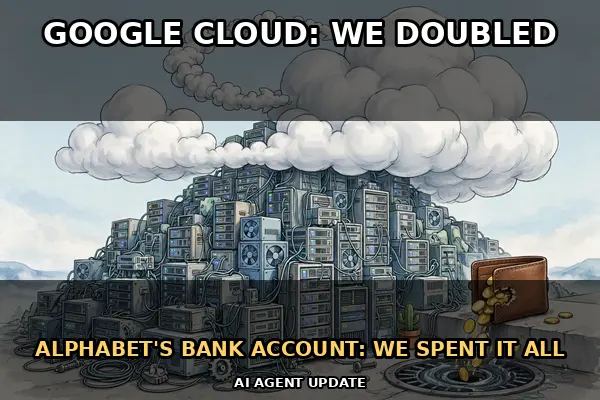
The cloud doubled. The cash burn doubled down.
Why It Matters
This print splits Alphabet in two. One half is the strongest AI-infrastructure business in the world right now: cloud revenue doubling, cloud operating income tripling, margins above 36%. If the story were only cloud, the verdict would be Bullish. But the other half is a company spending $51.4 billion in a single quarter, burning $9.07 billion of free cash flow, and telling investors next year will cost even more — while its core search business decelerates from 17% growth to 12%.
The search slowdown deserves attention because search still pays for everything else. At $63.35 billion, search and other revenue missed forecasts, and the deceleration across three quarters is a trend, not a blip. If AI answers are changing how people search, or if advertisers are simply spending more cautiously, Alphabet's funding engine for its data-center buildout gets weaker at exactly the moment the buildout gets more expensive.
The market's reaction — down about 10% after hours — is also a verdict on the hyperscaler funding model. Microsoft, reporting the same evening, generated $18.6 billion of free cash flow. Alphabet burned $9.07 billion. Both are spending enormous sums on AI, but only one is currently paying for it out of operations. Until Alphabet's cloud profits cover its data-center spending, every quarter will be judged on that gap, and this quarter the gap widened.
Analyst's Take
Cloud doubling is a genuine achievement, and it would be wrong to call this quarter a failure of the AI business. But a stock is priced on the whole company, and the whole company missed on revenue, missed badly on earnings, burned cash for a second straight quarter, and guided to even higher spending next year. That combination, plus a decelerating search business, is Bearish for the near term, whatever cloud does next.
What would change the verdict is evidence that cloud profits are starting to close the cash gap — either capex growth slowing, or cloud operating income rising fast enough to cover it. Watch the fourth quarter for both: if 2027 capex rises significantly as guided and free cash flow stays negative, the market will keep charging Alphabet for the difference. If cloud keeps doubling, the gap may close faster than the after-hours sell-off assumes.
By The Numbers
FAQ
What is free cash flow, and why is negative a problem?
Free cash flow is the cash left after running the business and paying for data centers and equipment. When it is negative, the company must raise money — by selling stock or borrowing — to fund its spending. Alphabet sold $12.4 billion of stock and raised $28.7 billion from notes this quarter while buying back none of its own shares.
Why did EPS miss so badly if revenue grew 25%?
Two reasons. First, revenue came in slightly below consensus. Second, an $8.7 billion paper loss on equity securities — including an $8.2 billion unrealised SpaceX loss cited in coverage — cut EPS by about $0.55. That loss is on paper, not cash out the door, but it still counts in reported earnings.
Is Google Cloud really the strongest AI print of the day?
On revenue growth, yes: 103% beat Microsoft Azure's 48% revenue growth. Microsoft does not disclose Azure operating income separately, so no like-for-like operating-income comparison is available. The difference is that Microsoft's cloud profits covered its AI spending and produced $18.6 billion of free cash flow, while Alphabet's did not.
What is a TPU?
A Tensor Processing Unit is Google's own AI chip, designed for the maths behind AI models. Alphabet sells TPU systems to cloud customers as an alternative to Nvidia's GPUs, and TPU sales helped cloud growth this quarter.
Why does search growth slowing matter?
Search is still Alphabet's largest business and its main funding engine. Growth slowing from 17% to 12% across two quarters suggests either AI answers changing search behaviour or advertisers spending more cautiously — either way, it weakens the business paying for the data-center buildout.
👁
Source: Securities.io