
SpaceX plans $74 billion of AI supercomputing campuses in Texas and Arizona
SpaceX plans to spend more than $74 billion on two AI supercomputing campuses in Arizona and Texas — but neither project is approved yet, and SpaceX named no chip supplier, making Nvidia a read-through, not a contract.
📊 Scorecard: our Bullish call on $NVDA is scored from $162.85, the last close before it ran. Its first result comes after the next close.
The News
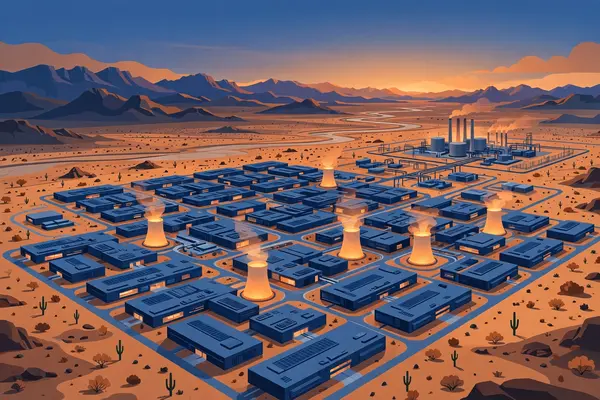
SpaceX announced on Thursday, November 12, that it plans to invest more than $74 billion in two AI supercomputing campuses: about $50 billion in Cochise County, Arizona, and more than $24 billion at its Starbase site in South Texas. A supercomputing campus is a cluster of buildings packed with the powerful chips that train and run artificial intelligence — and $74 billion would rank among the largest private data-centre investments ever announced.
The Arizona campus would span about 747 acres with up to nine computing buildings, and its electricity demand could reach 6 GW at full build. That 6 GW figure is the nameplate maximum in the county application — the most the site could ever draw, not what it uses today — and the campus would draw at least in part on grid power from local cooperatives. SpaceX says the site would create about 5,500 construction jobs and 1,000 permanent jobs.
The Texas site covers 444 acres at Starbase, where SpaceX would generate its own electricity from a gas-fired power plant that it would build, own and operate. The site has already generated more than 3,000 construction jobs, with more than 500 permanent jobs once operating. Neither project is approved: the Starbase tax abatement and the Cochise County zoning both go to votes on December 9, with local opposition already organised, and no construction start date has been given.
Bloomberg reported, citing a person familiar with the matter, that Anthropic is SpaceX's largest customer, and Anthropic's amended share-offering filing from November 10 lists computing agreements with SpaceX.AI LLC worth up to $120.5 billion, running into 2029 — but either side may cancel each agreement on 90 days' notice once initial non-cancelable periods end in January and March 2027, so the $120.5 billion is a ceiling, not a guaranteed commitment. SpaceX named no chip supplier, so there is no Nvidia contract here — but Nvidia's GPUs power most AI supercomputing campuses, which makes $NVDA the public read-through on a $74 billion buildout of exactly that kind of capacity.
Seventy-four billion dollars, two states, zero approvals yet — the ambition is real, the timeline is not.
Why It Matters
The first thing to understand is the scale. Seventy-four billion dollars is not a single data centre — it is two industrial-scale campuses, with nine computing buildings in Arizona alone and a dedicated power plant in Texas. When a company talks about 6 GW of electricity demand, it is talking about power on the scale of a small city's grid, which is why the Arizona project leans on local cooperatives and the Texas project builds its own gas plant. Power, not chips, is now the binding constraint on the AI buildout, and SpaceX's plan is shaped around that fact.
The second thing is the customer behind it. Anthropic's filing lists up to $120.5 billion of computing agreements with SpaceX.AI LLC — a number bigger than the campus investment itself. That tells you the demand side of this story is not hypothetical: the largest customer has already signed paperwork for computing capacity worth more than the campuses cost to build. It also explains why SpaceX, a rocket company, is building AI campuses at all — it already sells computing to the AI labs, and owning the campuses turns a customer relationship into infrastructure it controls.
The third thing is the risk, and it is binary. Both projects face votes on December 9, and local opposition is already organised. A zoning denial in Arizona or a failed tax vote in Texas would stall or shrink a project that has no construction start date even in the best case. Announced investment is not committed spending: until the votes pass and ground breaks, the $74 billion is a plan, not a purchase order. That is the honest frame for the Bullish call — the ambition and the customer demand are real, but the approvals are not yet in hand.
Analyst's Take
Our call is Bullish. A $74 billion plan from a company whose largest customer has signed computing agreements worth up to $120.5 billion is a demand signal, not a press-release fantasy — though those agreements can be cancelled on 90 days' notice from early 2027, so the demand is real but not locked in — and every campus of this kind runs on GPUs, which is why Nvidia is the read-through. The December 9 votes are the near-term test: approval in both places turns a plan into a construction programme, and the market will price that in quickly.
What to watch: the two December 9 votes, any sign of a construction start date, and whether SpaceX names a chip supplier or a second big customer. The caveat is the approval risk above — if either vote fails, the headline number shrinks fast. But a plan this large, backed by a customer this committed, is the kind of demand that eventually becomes chip orders.
Reader poll: Bullish, Bearish, or Too early to tell — where do you stand on $NVDA?
Are you bullish or bearish on this story?
By The Numbers
FAQ
What is an AI supercomputing campus?
A cluster of buildings filled with powerful chips — mostly GPUs — that train AI models and run them for users. The buildings need enormous amounts of electricity and cooling, which is why the campuses are planned on hundreds of acres with their own power arrangements.
Is the $74 billion already committed?
No. It is an announced plan for two projects that are not yet approved. The Starbase tax abatement and the Cochise County zoning both go to votes on December 9, and no construction start date has been given. Until approvals land, the figure is a plan, not spending.
Why is Nvidia the ticker if SpaceX named no supplier?
Because Nvidia is a read-through, not a contract. SpaceX named no chip supplier, but Nvidia's GPUs power most AI supercomputing campuses, so a $74 billion buildout of that kind of capacity is good news for Nvidia's chip demand. If SpaceX buys from someone else, the read-through breaks — that is the risk in the call.
What is the $120.5 billion Anthropic figure?
Anthropic's amended share-offering filing from November 10 lists computing agreements with SpaceX.AI LLC worth up to $120.5 billion, with terms running into 2029. Bloomberg reported, citing a person familiar with the matter, that Anthropic is SpaceX's largest customer. It shows the demand behind the campuses is large — but the agreements can be cancelled on 90 days' notice from early 2027, so the $120.5 billion is a ceiling, not a locked-in commitment.
👁
Source: Bisnow