
Nvidia expands Samsung Electro-Mechanics substrate deal; shares jump 7.43%
Interim CEO Colette Kress said on Nvidia's earnings call that the company signed a new substrate contract with Samsung Electro-Mechanics, whose shares rose 7.43% to ₩810,000 on Wednesday.
📊 Scorecard: our Bullish call on $009150.KS is scored from ₩810,000, the last close before it ran. Its first result comes after the next close.
The News
On Nvidia's third-quarter earnings call, interim chief executive Colette Kress said the company had signed a new substrate contract with Samsung Electro-Mechanics, alongside new substrate contracts with Taiwan's Kinsus and a packaging contract with SPIL. Samsung Electro-Mechanics shares surged 7.43% to ₩810,000 on Wednesday, making it one of the day's biggest movers in Seoul.
Nvidia said on November 17 it had amended its substrate supply agreement with Samsung Electro-Mechanics to improve operational capabilities at its Sejong and Busan plants and support increased production of Nvidia AI platforms, and is considering additional funding for those plants. That amendment and funding detail is reported by a single chain, Edaily via aistockwire — the core of this story is the contract disclosure on the call and the share move.
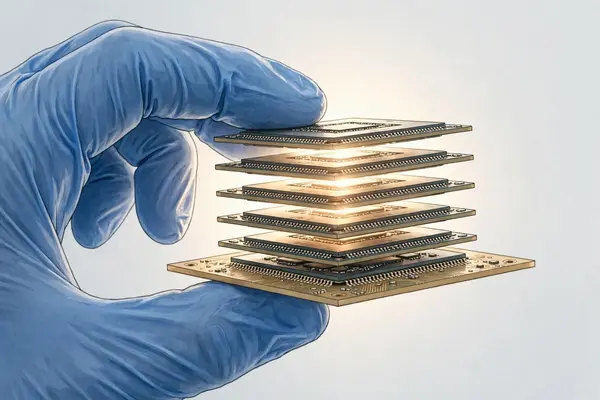
Substrates are the packaging layer that HBM memory stacks sit on, and they have become a bottleneck for AI accelerator supply. AI accelerators keep getting bigger and more complex, with more memory stacks to connect, so the substrate layer has to keep up. Nvidia said in October it plans to raise total substrate capacity 2.5 times over three years with Samsung Electro-Mechanics, Japan's Ibiden and Taiwan's Unimicron.
The least glamorous layer of the AI stack just got its own headline.
Why It Matters
Substrates sound boring, but they are the floor the whole AI chip stands on. HBM memory stacks — the layered memory that feeds AI processors — sit on a substrate, and the substrate carries every electrical connection between the chips. If substrate supply runs short, finished AI chips cannot be built, no matter how many processors and memory chips exist.
That is why a contract disclosure moved the stock 7.43%. Samsung Electro-Mechanics is the electronics-components arm of the Samsung group, and it is a relatively small supplier next to its parent Samsung Electronics, which closed Wednesday at ₩194,700, up 2.31%. For the smaller company, a single Nvidia contract is a much bigger deal than for the parent. The market is pricing in years of orders, not one quarter.
Nvidia's plan to raise total substrate capacity 2.5 times over three years, with Samsung Electro-Mechanics, Ibiden and Unimicron, shows the company expects the bottleneck to last. It is buying capacity ahead of demand, the same way it is buying memory — and spreading the work across three suppliers so no single factory can hold up production. Nvidia is not the only buyer competing for substrate capacity either: every AI chipmaker needs the same packaging layers, which is why capacity booked years ahead is worth announcing.
Analyst's Take
Our call is Bullish. A 7.43% jump on a single contract disclosure tells you how tight substrate supply is: when the world's biggest AI chipmaker names a new supplier on its earnings call, the market treats it as a multi-year revenue line, not a one-off order. Samsung Electro-Mechanics just went from a component maker to a named partner in the AI supply chain.
The caution is that the amendment and funding detail comes from a single reporting chain, and capacity takes time to build — a 2.5-times expansion over three years is a plan, not a factory. The three-year capacity plan was announced in October, before this contract, so Wednesday's news is the plan turning into named orders. The contract itself is confirmed by the call, but the extra funding for Sejong and Busan is reported, not confirmed.
Watch for the funding decision and for orders from the other named partners, Kinsus and SPIL. If Nvidia starts spreading substrate work across all three, the bottleneck is easing; if Samsung Electro-Mechanics keeps getting the headlines, it is the preferred supplier. If the funding decision lands, Sejong and Busan become the physical proof. Reader poll: Bullish or bearish on 009150.KS? Vote: Bullish, Bearish, Mixed.
Are you bullish or bearish on this story?
By The Numbers
FAQ
What is a substrate?
A substrate is the flat base layer that memory chips and processors sit on inside a finished AI chip package. It carries the electrical connections between the chips — without it, the stacked memory cannot talk to the processor.
What is HBM?
HBM stands for high-bandwidth memory — memory chips stacked in layers and placed right next to an AI processor so data moves between them very fast. The stacks sit on a substrate, which is why substrate capacity can limit how many AI chips get built.
What is advanced packaging?
Advanced packaging is the step where separate chips — processors, memory stacks and substrates — are assembled into one finished unit. It is the final, fiddly stage of chipmaking, and it has become a bottleneck as AI chips get bigger and more complex.
👁
Source: Seoul Economic Daily