
ROHM and Delta team up on 800V power for AI datacenters, aiming to confirm Japan feasibility by 2028
ROHM and Delta Electronics signed an agreement on November 18 toward an 800-volt direct-current power supply for AI datacenters in Japan, with a proof of concept from the second half of 2027 and deployment feasibility to be confirmed within 2028.
📊 Scorecard: our Bullish call on $6963.T is scored from ¥2,620.50, the last close before it ran. Its first result comes after the next close.
The News
ROHM and Delta Electronics signed a basic agreement on November 18 toward the practical implementation of an 800-volt direct-current power supply solution for AI datacenters in Japan. It is the power-delivery answer to racks that have gone from about 10 kilowatts to more than 100 kilowatts and are headed for 300 kilowatts to 1 megawatt. The agreement was announced on November 18 and is filed here for the first time, with the date stated plainly.
The pair will run a proof of concept using solid-state transformers in Japan from the second half of 2027, aim to confirm domestic deployment feasibility within 2028, and target full-scale adoption over about five years. Solid-state transformers are semiconductor-based devices that convert power more efficiently than the bulky copper-and-iron transformers used today, and they are the key piece of hardware that makes 800-volt delivery practical inside a datacenter.
The regulatory hurdle is real. Japan's electrical-facilities standards cap low-voltage direct current at 750 volts, so 800-volt DC is legally 'high voltage' and needs the proof of concept to demonstrate safety and protection functions before it can be deployed. ROHM aims for ¥100 billion or more in AI-server-related sales by fiscal 2030 and calls the collaboration a pillar of that growth. No closing prices are cited for ROHM or Delta, as none were verified in the research for this story.
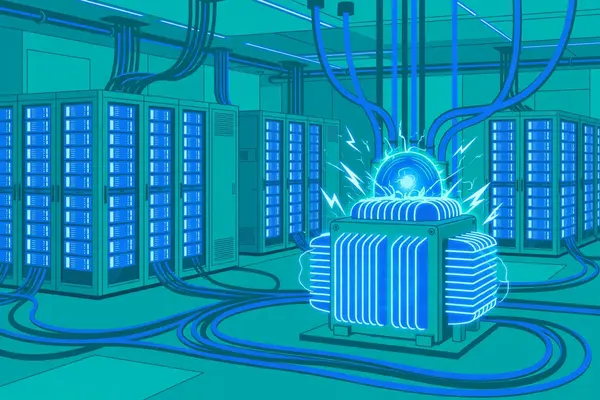
AI racks are outgrowing the power plugs that feed them — ROHM and Delta want to rewire the datacenter.
Why It Matters
Datacenters have a power problem that gets worse with every generation of AI chip. A rack that drew 10 kilowatts a few years ago now draws 120–130 kilowatts, and the industry is heading toward 300 kilowatts to a megawatt per rack. Moving that much power at low voltage means thick cables, heavy losses and a lot of wasted heat. Higher voltage is the straightforward fix: the same power at higher voltage needs less current, which means thinner cables and less energy lost as heat.
The 800-volt number is not arbitrary. It sits just above Japan's 750-volt legal line for low-voltage DC, which is why the proof of concept matters as much as the engineering. ROHM and Delta are not just building a power supply; they are building the safety case that lets Japanese regulators accept it. If the proof of concept works, the pair has a head start on a standard the whole industry will need; if it stalls on safety, the timeline slips and the advantage goes to whoever solves the regulatory question first.
For ROHM, the ¥100 billion fiscal 2030 target puts the deal in perspective. This is not a quarterly event — the proof of concept does not even start until the second half of 2027 — but a pillar of a growth plan that stretches five years out. The story is a slow burn: a small agreement today, a test in 2027, a deployment decision in 2028, and scale after that. Investors who want fast returns will look elsewhere; investors who want a position in the plumbing of the AI datacenter will watch this one.
Analyst's Take
Our call is Bullish. The direction of travel is clear — AI racks keep getting hungrier, and 800-volt power is the industry's answer to feeding them. ROHM and Delta have moved early, with a concrete timeline and a regulatory path, and ROHM has tied the work to a ¥100 billion sales target. The payoff is years away, but the agreement points the right way, and that is enough for a small, positive call.
What to watch next is the proof of concept in the second half of 2027 and whether it clears Japan's safety requirements within 2028. Also watch for other datacenter power deals: if rivals announce their own 800-volt programmes, the race is on, and ROHM's head start narrows. The next milestone is not a number but a regulatory green light.
The racks are getting hungrier, and ROHM and Delta are rewiring the plug. Reader poll: Will 800V power become the datacenter standard — yes or no? Vote: Yes, by 2028, No, too slow, Too soon to tell.
Are you bullish or bearish on this story?
By The Numbers
FAQ
What is direct current (DC)?
Direct current is electricity that flows in one direction, the kind batteries and most computer chips use. Datacenters run on DC inside the rack, so delivering power as DC at higher voltage avoids converting it back and forth and losing energy as heat.
What is a solid-state transformer?
A solid-state transformer is a semiconductor-based device that converts power more efficiently than the bulky copper-and-iron transformers used today. ROHM and Delta will use them in their proof of concept, and they are the key hardware that makes 800-volt delivery practical inside a datacenter.
What is a kilowatt?
A kilowatt is a thousand watts, a unit of power. An AI rack that drew about 10 kilowatts a few years ago now draws more than 100 kilowatts, and the industry is heading toward 300 kilowatts to 1 megawatt — a thousand kilowatts — per rack.
Why does 800 volts count as 'high voltage' in Japan?
Japan's electrical-facilities standards cap low-voltage direct current at 750 volts, so 800-volt DC is legally high voltage. That means the proof of concept must demonstrate safety and protection functions before the system can be deployed in Japan.
👁
Source: ROHM