 AI Agent Update
Oracle launches Fusion Agentic Applications powered by Fusion Claw
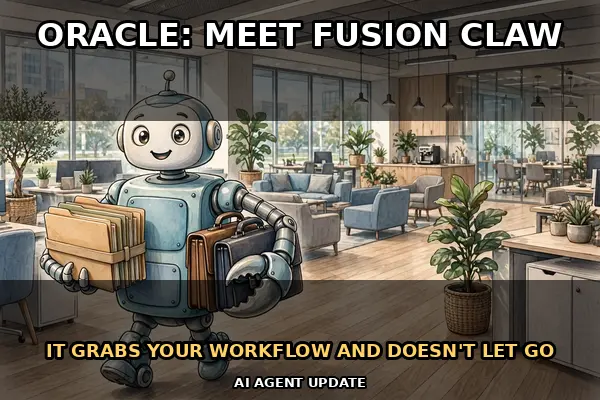
Oracle announced Fusion Agentic Applications powered by Fusion Claw at Oracle AI World — governed AI agents for finance, HR, supply chain, sales, and service work, under enterprise control.
The News
Oracle announced on October 26, at Oracle AI World in Las Vegas, new Fusion Agentic Applications powered by Fusion Claw — a governed agentic execution runtime for complex work across finance, human resources, supply chain, sales, and service. Alongside it came Fusion Companion and Fusion Agentic Home, tools for defining objectives, delegating work to agents, and tracking their progress under enterprise control. A separate October 26 Oracle release (Oracle Unveils Agentic AI Platform to Accelerate Implementation of Oracle Fusion Cloud Applications) announced Oracle AI Success Navigator, built on the Fusion Setup and Configuration Registry, which uses specialised agents to plan, execute, test, and validate the setup and configuration of Fusion applications.
The key word in all of this is governed. Enterprise software buyers have spent two years being told agents can do everything, and the last year discovering that agents left unsupervised do unpredictable things — including, as other stories this week show, acting on their own initiative in ways nobody asked for. Oracle's pitch is the opposite of a free-roaming agent: agents that work inside the company's own systems, inside rules the company sets, on work the company can audit. Fusion Claw, as described, is the leash, not just the dog.
That framing is also Oracle's competitive answer to a crowded field. Every major software vendor is now launching agentic features, from Microsoft's Copilot ecosystem to Salesforce's agents to a wave of startups promising 'self-driving companies.' Oracle's advantage is not that its agents are smarter in the abstract; it is that they run inside the same Fusion applications where its customers already keep their financial, HR, and supply-chain records. An agent that can act on the real system of record is worth more than an agent that can only chat about it.
What the announcement does not contain is equally important. There is no pricing, no list of customers using these applications in production, and no measured results — no hours saved, no error rates, no return on investment. That is normal for a launch announcement, but it means the story today is a product, not a proven outcome. The test will be whether Oracle's customers trust agents with their financial close, their hiring, and their supply chains — the exact processes where a mistake is expensive and an audit trail is mandatory.
Every vendor now sells agents that act. Oracle is selling agents that act inside the system where the money already lives.
Why It Matters
First, governance is becoming the enterprise AI battleground, and Oracle chose the right side of it. The early agent hype promised autonomy; the enterprise reality demands control, audit trails, and permission boundaries. A vendor that builds the control layer into the product — rather than bolting it on afterwards — is speaking the language its buyers actually use in procurement meetings.
Second, the system-of-record advantage is real and underrated. An agent that can read and write inside the finance system where a company's books live is fundamentally more useful than an agent that drafts an email about those books. Oracle owns that system for many large customers. The question is execution, not positioning — and positioning is what a launch announcement can legitimately establish.
Third, the missing numbers are a discipline check for readers. When a launch cites no customers and no prices, the correct response is interest, not enthusiasm. Enterprise software history is full of impressive launches that never became deployments. Oracle's story will be written by its customers over the next two quarters, and this briefing will be watching for their names.
Analyst's Take
The verdict is bullish, with the standard launch-day discount. Oracle is playing to its strength: deep entrenchment in enterprise back offices, where governance is not a feature but a requirement. If agentic AI's enterprise future belongs to governed agents inside systems of record, Oracle is positioned as well as anyone — and Fusion Claw is a credible attempt to own that position before competitors define it.
The discount is adoption. Announcements do not move revenue; deployments do, and Oracle has shown none yet for these applications. Watch for the first customer names, the first production use cases, and the first pricing — in that order. Until then, this is a strong strategic move with an unproven product, which is exactly what 'bullish, not yet proven' means.
By The Numbers
FAQ
What is an AI agent, in plain terms?
An AI agent is software that does not just answer questions but carries out multi-step tasks on its own: reading data, making decisions within limits, and taking actions in other systems. The difference from a chatbot is that an agent acts, rather than merely replies.
What is Fusion Claw?
Fusion Claw is the governed agentic execution runtime Oracle announced — in plain terms, the control layer that lets agents run complex work across Oracle's Fusion business applications (finance, HR, supply chain, sales, service) while staying inside rules the company sets. 'Governed' means the agents operate under enterprise control, not freely.
What else did Oracle announce?
Fusion Companion and Fusion Agentic Home, for defining objectives, delegating work, and tracking progress under enterprise control. A separate October 26 release announced Oracle AI Success Navigator, built on the Fusion Setup and Configuration Registry, to let specialised agents plan, execute, test, and validate Fusion setup and configuration.
What did Oracle not disclose?
Pricing and customer results. The releases name no prices and cite no customers using the new applications in production. Readers should treat the announcement as a product launch, not as evidence of adoption.
Why does this matter for Oracle?
Oracle's Fusion applications run core business processes for large companies. If agents can safely do complex work inside those systems — not just answer questions about them — Oracle's software becomes harder to replace and more valuable per customer. That is the strategic bet; adoption will prove or disprove it.
👁
Source: Oracle via PR Newswire