 AI Agent Update
Anthropic files for a Nasdaq IPO as ANT — $16.3B of revenue, an $80.7B headline loss
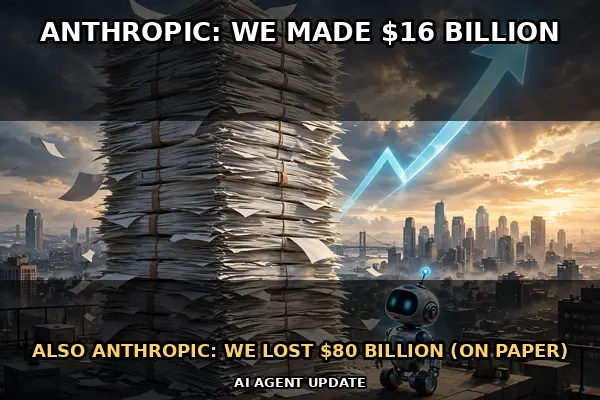
Anthropic filed to list on the Nasdaq as ANT, revealing $16.29 billion of first-half revenue — and an $80.75 billion headline loss that is mostly an accounting entry, not cash out the door.
The News
Anthropic, the company behind the Claude chatbot, filed its S-1 publicly on October 26, applying to list its Class A shares on the Nasdaq Global Select Market under the ticker ANT. The filing does not yet set how many shares will be sold or at what price, so there is no trading date yet — but the document itself is the starting gun for one of the most watched stock market debuts in AI.
The headline numbers look contradictory, and both are real. Revenue for the first half of 2026 was $16.286 billion, up from $1.163 billion in the same period a year earlier — roughly fourteen times as much. Reuters reported that second-quarter revenue alone grew 1,368% from a year earlier. That is the kind of growth that makes investors pay attention.
The net loss for the same six months was $80.748 billion, a figure that would sink almost any company if it were cash. It mostly is not. Of that total, $72.388 billion was non-cash fair-value losses on convertible notes, derivatives, and SAFEs — contracts that convert into shares — whose accounting value rises as the company's own value rises. Strip those out and the picture changes: the operating loss, which reflects the everyday business, narrowed to $693 million from $2.135 billion a year earlier.
The filing also reads like a warning label. Anthropic told investors there is no assurance that Samsung, SK hynix, and Micron can deliver the high-bandwidth memory it needs on time, even as those suppliers add capacity, and that shortages could get worse if big customers lock up a supplier's output in advance. It flagged the concentration of advanced chipmaking in Taiwan as a supply risk. And it warned, in its own words as reported by Reuters, that advanced AI could pose catastrophic or existential risks. Some investors are now discussing a valuation around $1.5 trillion, down from around $2 trillion talked about a week earlier, according to Reuters — a reminder that even a filing this strong does not set a price.
Fourteen times the revenue, an $80 billion paper loss — this filing is a Rorschach test, and what you see depends on whether you read past the first page.
Why It Matters
First, this filing turns a private-company story into public evidence. Until now, Anthropic's scale was mostly talked about in leaks and funding headlines. An S-1 is audited, legal, and detailed: $16 billion of half-year revenue is a fact investors, competitors, and suppliers can all build plans around. That is why markets reacted the same day — Seoul Economic Daily tied the October 26 chip rebound and the next session's Seoul rally to the filing — the filing confirmed the AI demand story in a form nobody can dismiss as hype.
Second, the filing explains why the AI hardware trade is so tight. High-bandwidth memory — HBM for short — is the special fast memory stacked right next to AI chips so they can be fed data quickly enough. There are only three serious makers of it in the world: Samsung, SK hynix, and Micron. When Anthropic says it cannot be sure they can deliver enough, that is not a footnote; it is the bottleneck for every frontier lab, and it is why memory stocks moved so sharply in Seoul the next day.
Third, the loss deserves a plain-language translation because it will be misunderstood everywhere. A net loss counts everything, including paper revaluations. An operating loss counts the business itself: what it earned minus what it spent running. Anthropic's business loss shrank by two-thirds in a year. That does not make it profitable, but it does mean the scary headline number and the real business trend point in opposite directions — and readers should know which one to weight.
Analyst's Take
The honest read is mixed, and that is the verdict here. On the demand side, this is the strongest evidence yet that frontier AI labs can grow revenue at a pace few companies in history have matched — $16 billion in six months, with operating losses shrinking fast. That demand is the backdrop for the market reaction Seoul Economic Daily reported: the Philadelphia Semiconductor Index jumped 2.82% on October 26, with Micron up 3.0%, AMD 2.8% and Nvidia 2.4%, and Samsung and SK hynix rallied in Seoul the next session. A filing like this does not just describe Anthropic's business; it validates the whole AI infrastructure trade.
On the risk side, the filing is unusually blunt about how fragile that growth could be. If three memory suppliers cannot deliver enough high-bandwidth memory, or if Taiwan's chipmaking concentration becomes a real disruption rather than a disclosed risk, Anthropic's growth story hits a physical wall. And the safety warning is not boilerplate decoration: it is the company telling future shareholders, in a legal document, that its own technology carries risks at a societal scale. Investors who ignore that paragraph have not read the filing.
For readers, the practical point is timing. Nothing trades yet, and no price exists to judge. The numbers to watch next are the share count and price range when they appear, and then whether the first earnings report as a public company shows the operating loss continuing to narrow. Until then, treat the $80 billion loss as mostly accounting, the $16 billion revenue as genuinely remarkable, and the valuation chatter as just that — chatter.
By The Numbers
FAQ
What is an S-1 filing?
An S-1 is the long document a company files with the US Securities and Exchange Commission (SEC) — the government agency that oversees public stock markets — before it sells shares to the public for the first time. It lays out the company's finances, risks, and business in detail so investors can judge it.
Why is the loss so much bigger than the revenue?
Most of the $80.75 billion loss is a non-cash accounting charge: $72.39 billion of losses on the paper value of convertible notes, derivatives, and SAFEs — investment contracts that turn into shares later. When a private company's value rises, the accounting value of those contracts rises too, and that shows up as a loss even though no cash left the bank. The operating loss — revenue minus the everyday costs of running the business — was $693 million.
When will Anthropic shares actually trade?
Not yet known. The filing does not set a share count or a price range, and no trading date has been announced. ANT is the proposed ticker — the short code shares would trade under — once the listing is complete.
What did the filing warn about?
Two kinds of warnings matter most. First, supply: Anthropic said there is no assurance Samsung, SK hynix, and Micron can deliver the high-bandwidth memory (HBM) — the fast memory stacked beside AI chips — it needs on time, and that most advanced chipmaking capacity sits in Taiwan. Second, safety: the filing warns that advanced AI could pose catastrophic or existential risks — in plain terms, risks big enough to harm society at large.
Is Anthropic profitable?
No, not yet on the measures in the filing. Revenue grew enormously, but the company still lost money on its operations in the first half of 2026, just much less than the $2.14 billion operating loss a year earlier.
👁
Source: Reuters via Virginia Business