
Oracle says its $300B OpenAI deal is fully funded — the stock hits a new 52-week low close anyway
Oracle said on Friday that its $300 billion OpenAI infrastructure deal is fully funded after its final capital raise — but the stock fell 8.48% to a new 52-week low close of $101.19 the same day.
The News
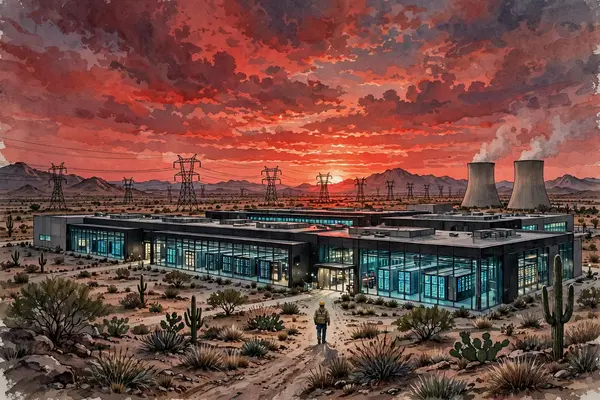
Oracle pushed back on Friday against doubts about how it will pay for its AI buildout, saying its infrastructure contract with OpenAI is fully funded following a final capital raise earlier this month. "The financing we outlined at Oracle Investor Day, including vendor financing, is in place. Any further private discussions with vendors are just additional options," Oracle said in a post on X, calling itself the first hyperscaler fully funded for the current investment cycle. The deal is a five-year, $300 billion computing-capacity agreement with OpenAI, with 4.5 gigawatts of additional US datacenter capacity on top of the initial Stargate site in Abilene, Texas. A gigawatt is a billion watts — enough electricity to power roughly a million homes.
The November capital raise was about $20 billion: roughly $10 billion of stock, priced at $116 a share, and about $10 billion of debt. Oracle also capped additional capital-markets fundraising for fiscal 2027 through 2030 at $20 billion, split evenly between equity and debt, excluding refinancing — the replacement of old debt with new debt. On execution, Oracle said construction at Abilene, where OpenAI's GPT-6 Astra was trained, is nearly complete; the next gigawatt-scale campus in Shackelford County, Texas is fully permitted; and handover of Nvidia's Vera Rubin racks is on track to begin in the coming weeks.
The market was unmoved. Oracle shares fell 8.48% on Friday to $101.19 — a new 52-week low close, with an intraday low of $100.25 — on 47.8 million shares. The stock is down 19.3% over five sessions and 48% so far this year. After hours it bounced about 2% to roughly $103.29. Oracle still expects positive free cash flow — the cash left after operations and capital spending — in the second half of fiscal 2028, and targets more than $30 billion of free cash flow in fiscal 2029.
Oracle says the $300 billion deal is fully funded. The stock's new 52-week low the same day is the market's answer.
Why It Matters
The funding claim matters because it was the central objection to Oracle's AI bet. Critics have asked for months how a company of Oracle's size pays for a $300 billion computing deal, and the company has now answered in its own words: the financing outlined at Investor Day, including vendor financing, is in place, and further fundraising through fiscal 2030 is capped at $20 billion. If the claim holds, the debt question that has hung over the stock gets smaller.
The stock's reaction matters just as much. A new 52-week low close on the day of the announcement is not a vote of confidence — it says investors either do not believe the claim, or believe the funding was never the real problem. Oracle is down 19.3% in five sessions and 48% this year, a slide that started long before Friday and reflects a deeper doubt: whether the AI buildout, funded or not, will earn its return.
The execution details are the bridge between the two. Abilene is nearly complete, Shackelford County is fully permitted, and Nvidia's Vera Rubin racks are due to start arriving in weeks — that is real progress on real buildings. But the cash-flow payoff Oracle promises does not arrive until the second half of fiscal 2028 at the earliest. Until then, the company is asking investors to trust a multi-year plan while the stock keeps making new lows.
Analyst's Take
Our call is Mixed. Oracle's statement is real news — a company telling the market its biggest contract is funded, with a $20 billion raise behind it — the November raise used the $20 billion allowance in full, $10 billion of stock at $116 plus $10 billion of notes, after the cap was set on October 28 — and a cap on further fundraising — but the stock's answer was a new 52-week low close on the same day. When a company says it is fully funded and investors sell anyway, the two sides are pricing different risks, and a mixed verdict is the honest way to hold both.
What to watch next is the execution Oracle pointed to: whether the Vera Rubin rack handover begins in the coming weeks as promised, and whether the Shackelford County campus moves from permitted to built. The longer test is the cash-flow promise — positive free cash flow in the second half of fiscal 2028 and more than $30 billion in fiscal 2029 — which is still years away and depends on the buildout paying for itself.
For now, the plain fact is that "fully funded" is Oracle's own claim about its own financing, not an independent endorsement, and the market treated it that way. The funding question may be answered; the question of whether the $300 billion bet earns its return is not. Reader poll: Who is right on $ORCL — Oracle or the market? Vote: Believe Oracle, Believe the market, Wait and see.
Are you bullish or bearish on this story?
By The Numbers
FAQ
What is a hyperscaler?
A hyperscaler is a very large cloud company that runs giant datacenters and rents computing power to others. Oracle, Amazon, Microsoft and Google are hyperscalers; the term describes the scale of their infrastructure, not a specific product.
What is vendor financing?
Vendor financing is when the supplier of equipment — in this case the companies selling Oracle its datacenter gear — helps fund the purchase, often by lending money or accepting delayed payment. Oracle said the financing it outlined at its Investor Day, including vendor financing, is in place.
What is free cash flow?
Free cash flow is the cash a company has left after paying for its day-to-day operations and its capital spending, like building datacenters. It is the money available to pay down debt, pay dividends or invest further. Oracle says it still expects positive free cash flow in the second half of fiscal 2028.
What is a 52-week low?
A 52-week low is the lowest price a stock has traded at in the past year. Oracle's $101.19 close on Friday was a new 52-week low close, meaning the stock had not closed that cheaply in at least twelve months.
👁
Source: Reuters via LA Post