
NextDC raises FY27 guidance but M3 contracts stay excluded as 30 MW alert rule surfaces
NextDC lifted its fiscal 2027 revenue and earnings guidance at its annual meeting on Friday — but the upgrade excludes its stalled Melbourne M3 contracts entirely, and newly disclosed documents show Victoria has required a ministerial alert for datacenter grid connections over 30 MW since March.
The News
NextDC raised its fiscal 2027 guidance ahead of its annual general meeting on Friday, November 20 — net revenue to A$485 million–A$500 million, with the floor up A$10 million, and underlying EBITDA to A$260 million–A$275 million, from A$245 million–A$265 million. EBITDA is earnings before interest, tax, depreciation and amortisation, a rough measure of operating profit. But the upgrade excludes the affected M3 Melbourne customer contracts entirely, including capacity already billing, because the company says it cannot yet reliably estimate their fiscal 2027 contribution.
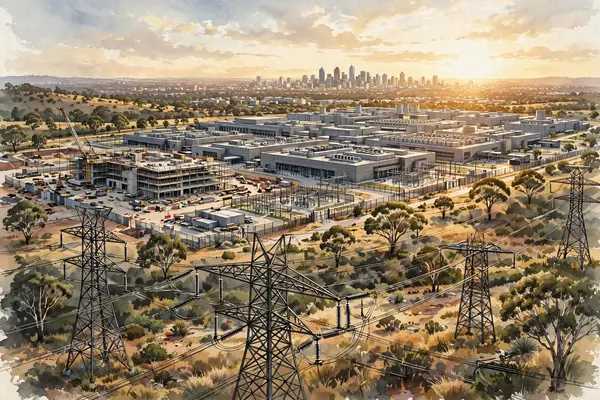
The M3 campus in West Footscray is a 225 MW site. Distributor Jemena suspended parts of the 66 kV line upgrade supplying it in September, citing safety and site-access problems after community opposition, and has told NextDC it does not expect to restart before February 2027, with the next increase in grid supply now expected in the 2028 financial year. The October 21 guidance cut that followed — revenue down to A$475 million–A$500 million from A$615 million–A$640 million, EBITDA to A$245 million–A$265 million from A$385 million–A$410 million — erased about A$3.1 billion of market value in a day, with shares closing 41.7% lower.
At the annual meeting, chief executive Craig Scroggie agreed to forego bonuses worth up to A$7.5 million, shareholders delivered a second strike against executive pay, and the board took pay cuts; the company also vowed it will no longer pursue new developments near homes. Capital expenditure guidance is unchanged at A$4.5 billion–A$5.0 billion, prioritised to contracted capacity, with uncontracted developments and new land acquisitions on hold. NextDC shares were trading 5% lower at A$9.21 at the time of the AAP report, before the Australian close.
NextDC raised its guidance — and left its biggest problem, the M3 campus, out of the numbers entirely.
Why It Matters
This matters because the guidance raise and the M3 exclusion tell two different stories at once. The raise says the rest of NextDC's business is performing well enough to lift the outlook. The exclusion says the company's biggest problem — a 225 MW campus that cannot get enough grid power — is still unresolved, and management cannot even estimate what those contracts will contribute next year. Both facts are true, and neither cancels the other.
The grid problem is the deeper story. A datacenter is only as useful as the electricity feeding it, and Jemena's suspension of the power-line upgrade, now not expected to restart before February 2027, pushes the next increase in grid supply into the 2028 financial year. That is a long wait for customers who signed up for capacity at M3, and it explains why the October guidance cut wiped A$3.1 billion off the company's value in a day.
Separately, The Age published on Saturday, November 21, internal Victorian government documents obtained under freedom-of-information law, a week before the state votes on November 28. A March 2026 briefing from the Department of Energy, Environment and Climate Action warned then-energy minister Lily D'Ambrosio that a plan to attract up to A$25 billion of datacenter investment could trigger a "step change" in electricity demand and posed a "major structural challenge" to the state's electricity system. D'Ambrosio approved a rule requiring Victoria's five power distributors — AusNet, CitiPower, Jemena, Powercor and United Energy — to alert her before offering a grid connection to any project exceeding 30 megawatts. The rule dates to March 2026; the November 21 event is its disclosure, not its creation.
Analyst's Take
Our call is Mixed. A guidance raise is good news, and the pay forfeits and the vow to stop building near homes show a board responding to shareholders. But a raise that excludes the troubled M3 contracts entirely is a raise with a hole in it, and the newly disclosed 30 MW alert rule shows the state government has been worried about datacenter power demand since March.
What to watch next is Jemena's February 2027 restart date and whether the next grid supply increase arrives in the 2028 financial year as now expected. Also watch the November 28 Victorian state vote, which gives the FOI disclosure its political timing, and whether other distributors' projects trip the 30 MW alert rule now that it is public.
For investors, NextDC is a story of a healthy core business wrapped around one unresolved site. The guidance raise says the core is fine; the M3 exclusion says the site is not. Until M3's power is restored, the company's outlook comes with an asterisk the size of a 225 MW campus. Reader poll: Will NextDC's M3 site get power back on schedule? Vote: Yes, by February, No, slips again, Grid stays the limit.
Are you bullish or bearish on this story?
By The Numbers
FAQ
What is guidance?
Guidance is a company's own forecast of its future revenue and profit. When a company raises guidance, it is saying it now expects to do better than it previously forecast.
What is a grid connection?
A grid connection is the link between a building and the electricity network that supplies its power. A datacenter needs a very large connection, and the distributor must build or upgrade power lines to provide it.
What is a second strike?
In Australia, shareholders vote on executive pay each year. A second strike means they voted against the pay report two years running, which can trigger a vote to spill — remove — the board.
What does MW mean?
MW stands for megawatt, a unit of electrical power. A 225 MW datacenter campus uses as much power as a small city, which is why grid supply is the constraint.
👁
Source: AAP; The Age (FOI documents and 30 MW alert rule)