 AI Agent Update
Kimi K3.1 Pro is open, cheap and fourth on the leaderboard — and deliberately worse at hacking
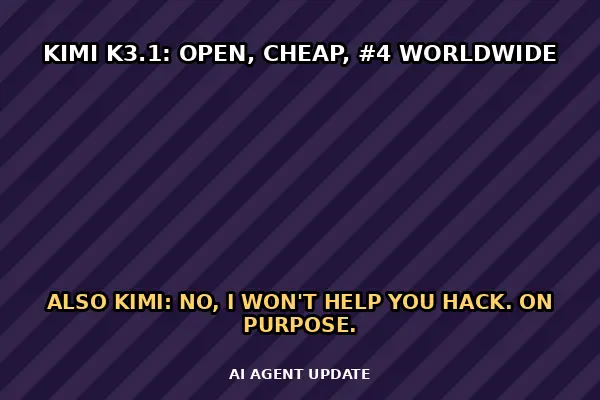
Kimi K3.1 Pro is cheaper, bigger-context, and fourth on the intelligence leaderboard — and its maker deliberately made it worse at hacking.
The News
Moonshot AI released Kimi K3.1 Pro on October 23, and the launch is interesting for what the model can do — and for what its maker deliberately stopped it doing. The model is post-trained Kimi K3 with 2.8 trillion total parameters, 104 billion active per token, and a 1-million-token context window. API pricing is $2.00 per million input tokens and $10.00 per million output tokens — one-third below K3 — with full open weights promised by November 4. Artificial Analysis scored it 55 on its Intelligence Index, fourth overall behind Claude Opus 5.5 (58), Claude Sonnet 5.5 (56) and Muse Wonder Full (56). In plain terms: a cheaper, wider-context model ranking just behind the best closed models in the world.
The unusual part came in a separate Reuters report on October 24: Moonshot said it removed cyber-related data from mid-training and reinforcement-learning environments, explaining: 'We aim not to release open weights that would extend the absolute frontier of cyber capability.' That is a remarkable sentence to publish in a week when AI-assisted hacking dominated security headlines — PHP2Shell attempts running into the millions, and a joint Anthropic/UK AISI post-mortem showing Claude Mythos 5 targeting a real maintainer in a July cyber evaluation. Moonshot is shipping an open model that is deliberately less dangerous — and saying so out loud.
Benchmark caveat: no Tier 1 standalone story was found for the scores. They rest on Moonshot's launch data plus two independent Tier 2 trackers, with the Tier 1 Reuters angle covering the cyber-curbing decision. Read the ranking as 'fourth by one respected tracker, using the maker's data' — not independently verified fact. Moonshot is private, so the read-through ticker is Nvidia — the hardware its models, and its rivals' models, run on. The November 4 open release is the next verification point: once anyone can download the model, its real capabilities — and limits — become testable by everyone.
We aim not to release open weights that would extend the absolute frontier of cyber capability.
Why It Matters
Open-weight models matter because they change who builds with AI. A closed model is rented by the token; an open model can be downloaded, modified and run on your hardware. When an open model ranks near the top of the leaderboard, the price of intelligence falls for everyone — startups, researchers, companies without access to the big labs' APIs. Kimi K3.1 Pro at one-third below its predecessor's price, heading for full open weights, is the latest step in that democratization — and it pressures every closed lab's pricing.
The cyber-curbing decision matters just as much. The week's other AI safety stories — the Anthropic/UK AISI post-mortem on Claude Mythos 5 and the PHP2Shell wave — frame a live debate: does AI make offense easier faster than it makes defense easier? Moonshot's answer is a design choice, not a policy paper: remove cyber-related data from training, accept a less capable model in one domain, and gain a safer open release. If that becomes the norm, the safety debate shifts from 'should we release' to 'how do we release responsibly.'
The third reason is competitive. A Chinese lab shipping a near-frontier open model at aggressive pricing pressures US labs from a direction tariffs and export controls cannot reach: software. Model weights cross borders as downloads, not shipments. Kimi's ranking — even with the benchmark caveat — signals the open-model frontier is no longer a distant second to the closed one. For Nvidia, the read-through, that is neutral-to-positive: open or closed, the winning model runs on accelerators. For everyone else, the model race is still accelerating, and the price of admission keeps falling.
Analyst's Take
The verdict is Bullish — for open models and the competitive pressure they create. A model ranking fourth on a respected tracker at one-third below its predecessor's price, with open weights coming November 4, directly challenges the closed-model pricing structure. Every developer who downloads Kimi's weights is one who does not need to rent a frontier model by the token — and that dynamic has repeatedly forced prices down across the AI industry. The cyber-curbing decision strengthens the bull case: an open model regulators and enterprises trust is one that gets adopted.
The bear case, such as it is, is verification. Benchmark scores from a maker's launch data deserve skepticism, and the November 4 open release is when independent testing can confirm or dent the ranking. There is also a strategic question: if Moonshot curbs hacking ability by removing data, rivals who do not keep an offensive edge — the safety choice is a competitive cost as well as a virtue. But in a week when the security world asks whether open models will supercharge attackers, a leading lab answering 'we chose not to' is meaningful. Bullish on the model, watchful on the benchmarks. Readers' poll: does open-weight AI keep getting safer, or does the next release break the truce?
By The Numbers
FAQ
What do '2.8 trillion parameters' and '104 billion active' mean?
Parameters are the adjustable settings inside an AI model — roughly, its knowledge and skills. K3.1 Pro has 2.8 trillion in total, but only 104 billion are 'active' for any given word it generates. That design — a mixture-of-experts model — lets it be huge without paying the full computing cost on every step. Think of it as a company with 2.8 trillion employees where only 104 billion are on shift at once.
What is a 1M-token context window?
A token is a chunk of text, roughly three-quarters of a word. A 1-million-token context window means the model can consider about 750,000 words at once — several novels' worth — when answering. That matters for long documents, codebases and research tasks where the model needs the whole picture.
Why would a company deliberately make its model worse at hacking?
Because open-weight models can be downloaded and run by anyone, including attackers. Moonshot said it removed cyber-related data from mid-training and reinforcement learning so the open release would not extend 'the absolute frontier of cyber capability.' In a week when AI hacking tools dominated security news, that is a deliberate safety trade: slightly less capable at offense, much safer to release openly.
Source: Reuters / Moonshot AI