 AI Agent Update
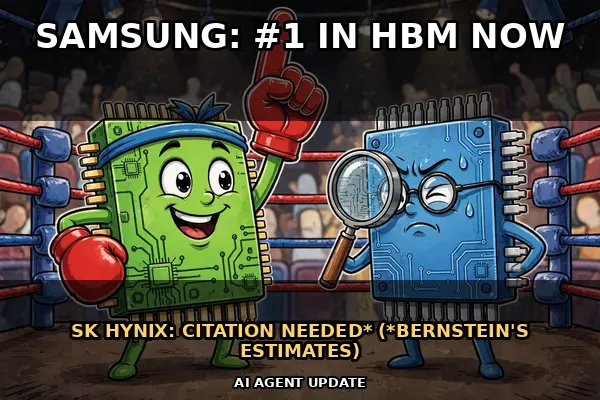
Samsung just took the HBM crown from SK hynix — in Bernstein's estimates, at least
Bernstein's estimates put Samsung ahead of SK hynix in AI memory revenue for the first time this cycle — but these are estimates, not results.
The News
Samsung has taken the lead in AI memory revenue — on paper. Bernstein estimates published October 22 put Samsung's third-quarter 2026 HBM revenue at $8.7 billion, up 33% quarter-on-quarter, against $7.6 billion for SK hynix, up 11%. If confirmed, it would be the first time in the current AI cycle that Samsung has outsold its Korean rival in the memory that matters most to AI accelerators. The numbers come from Bernstein's regression model applied to July–September export data, not company-reported HBM revenue — and that distinction matters: Samsung's figure was about 10% below Bernstein's own earlier forecast, while SK hynix came in line.
The backdrop is a memory market that rebounded unevenly on October 23 from the October 22 rout. SK hynix closed in Seoul at 1,277,000 won, up 4.42% from 1,223,000 won, after falling over 5% early in the session. Samsung closed at 215,500 won, up just 0.47% — the smallest gain in the memory watchlist. In the US, Micron closed at $877.55, up 2.46% from $856.49, while SanDisk fell 1.82% to $1,238.03 even as its peers bounced. The divergence is the story inside the story: the market is separating HBM winners, with long-term AI contracts, from spot-market NAND sellers exposed to daily price swings.
The wider export data backs the idea that Korea's chip machine is running hot. A Reuters poll of 16 economists put South Korea's third-quarter growth at a median 0.7%, up from 0.6% in the second quarter, with September exports up 84% year-on-year to a record $120.9 billion — led by a 262.8% surge in chip exports to $60.3 billion. Semiconductors were nearly half of everything shipped. Economists flagged that the boom has not spread widely to domestic demand, but for memory investors the export surge is the macro anchor: the world's AI builders are buying these chips as fast as they can be made.
The crown changed hands in a spreadsheet first. The earnings calls will decide whether it stays there.
Why It Matters
HBM is the choke point of the AI buildout, which is why a revenue-lead change matters more than a normal market-share shuffle. AI accelerators from Nvidia and others need HBM stacked beside the processor — without it, the world's fastest chip starves for data. Only Samsung, SK hynix and Micron can supply it at scale, and demand has outrun supply for more than a year. When the leader changes in a three-player market with a structural shortage, it signals something about yields, capacity and customer qualification — the factory work that decides who gets the next billion dollars of orders.
The second reason this matters is what it says about Samsung's comeback. SK hynix has spent the AI cycle as the presumed HBM king, and its stock trades on that presumption. Samsung overtaking it — even in estimates — challenges the narrative driving both stocks. Samsung's muted October 23 reaction, up just 0.47% against SK hynix's 4.42%, suggests the market has not yet bought the changing of the guard. That gap between estimate and share price is the next move: either the estimates are confirmed and Samsung's stock catches up, or they are not and SK hynix's rebound extends.
The third reason is the read-through to everyone else. HBM strength supports the whole AI hardware chain — Nvidia's accelerators need it, TSMC's packaging lines attach it, and Micron's HBM ramp is its key growth story. A $60.3 billion month of Korean chip exports, nearly half of the country's total shipments, is the macro version of the same message: the AI memory supercycle is not a stock-market story but a shipping story, measured in containers leaving Busan.
Analyst's Take
The verdict is Bullish, with an asterisk the size of the estimate itself. A Samsung HBM lead, if confirmed on October 29, would mark a genuine changing of the guard: SK hynix has owned the HBM narrative since the AI boom began, and Samsung taking the crown would validate years of catch-up. For the memory complex, the read is positive — HBM revenue growing 33% and 11% quarter-on-quarter at the top two suppliers is not a market in trouble, whatever October 22's selloff suggested. The October 23 rebound, led by SK hynix's 4.42% jump, suggests the market agrees.
But keep the asterisk in view. These are modelled estimates, and Samsung's came in below Bernstein's own forecast — a reminder that even the model-builders are surprised by the pace. Confirmation comes fast: SK hynix reports October 28, Samsung holds its earnings call October 29 at 10:00 a.m. Korean time, and SanDisk reports October 29 after the US close. Three prints in two days will settle whether this lead is real and whether the NAND side — where SanDisk fell while others rose — is a warning or a footnote. Until then, Bullish on the direction, cautious on the precision. Readers' poll: does Samsung hold the HBM lead when real results land?
By The Numbers
FAQ
What is HBM, and why does this revenue race matter?
HBM stands for high-bandwidth memory — special memory chips stacked vertically and bolted right next to AI processors so they can feed data fast enough to keep up. Every advanced AI chip needs it, and only three companies make it at scale: Samsung, SK hynix and Micron. Whoever leads in HBM revenue is, in effect, winning the most valuable corner of the memory market.
If these are estimates, why should I trust them?
You should treat them as a well-informed guess, not a result. Bernstein built the numbers from a regression model applied to July–September export data, and Samsung's figure came in about 10% below Bernstein's own earlier forecast while SK hynix matched its forecast. The real numbers arrive with Samsung's full Q3 results on October 29 and SK hynix's on October 28 — those will confirm or correct this story.
What does this mean for Micron?
Micron is the third HBM maker and the one most exposed to the US market. It rebounded 2.46% on October 23 to $877.55, but it is still well below its $1,255 52-week high. A Samsung lead does not hurt Micron directly — HBM demand is bigger than any one supplier's capacity — but it sharpens the question of who gets the next round of AI accelerator orders.
Source: East Asia Brief / Bernstein estimates