 AI Agent Update
GitHub turns Copilot into an agentic software delivery system — agents opened 40%+ of September's pull requests
At Universe 2026, GitHub stopped describing Copilot as an autocomplete assistant and started describing it as a delivery system — with a generally available model router, a credits-based price, and 4 million new CPU cores to keep up.
The News
At Universe 2026 on October 28, GitHub repositioned Copilot from an autocomplete assistant to what it calls an agentic software delivery system, built around three ideas: velocity, intelligence and quality. The pitch is that developers set direction while agents implement and verify changes. That is a meaningful shift in framing: Copilot is no longer presented as a tool that helps a programmer type faster, but as a system that delivers finished software work, with the human in a directing role rather than a typing one.
The centrepiece is Copilot Fusion, now generally available after a preview under the name HydraFusion. Fusion is a model router: it evaluates reasoning, code generation, debugging and tool use, then routes each task across models, with Standard, High and Max effort presets. GitHub's company-reported benchmarks put Fusion Max within two points of Opus 5.5 Max on the Artificial Analysis index at about half the API cost and 40% less time per task. Those figures are company-reported, not externally verified, and should be read as GitHub's claims, not independent results. GitHub also announced the Copilot app, Copilot Projects for cross-repository parallel work, Copilot Connectors built on the MCP protocol, and Copilot Automations.
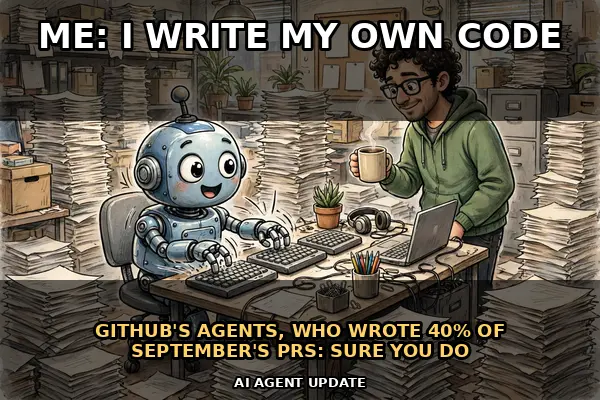
The scale numbers explain why GitHub is rebuilding its platform around agents. Octoverse data — GitHub's own annual report on how its platform is used — says agents opened more than 40% of pull requests in September, up from 17% in March, producing about 110 million pull requests and 7.4 billion commits in the month. A pull request is a proposed change to a codebase, submitted for review before it is merged. That volume stressed the platform and contributed to earlier outages, GitHub says, so it added 4 million CPU cores, 160 petabytes of storage and 50 terabits per second of network capacity, and extended Copilot to all GitHub Enterprise users on a credits-based, pay-per-AI-task model.
Agents opened 40% of September's pull requests — the autocomplete era is over.
Why It Matters
The 40% figure is the most important number in enterprise AI this week, because it is not a forecast — it is a count of what already happened. If agents opened more than 40% of September's pull requests on the world's largest code platform, then agentic software development is not an emerging trend; it is the current workflow for a large share of professional programmers. The jump from 17% in March to over 40% in September, in six months, is the adoption curve every other enterprise AI vendor wishes it had.
Fusion's routing idea matters because it solves the practical problem of model choice. Different models are better at reasoning, at writing code, at debugging and at using tools, and no single model wins on all four. A router that evaluates the task and picks the right model — or the right effort level — is how enterprises get frontier performance without paying frontier prices for every task. GitHub's claim of near-Opus performance at half the API cost and 40% less time, if it holds up independently, is exactly the efficiency gain that makes agentic development affordable at scale.
The credits-based pricing change is the business model catching up with the technology. Charging per AI task, rather than per seat, aligns what customers pay with what they actually use — and it lets GitHub monetise the agent volume directly. Combined with 4 million new CPU cores, it shows a platform rebuilding itself for a world where agents, not humans, are the primary producers of code. That is also why this story is distinct from Microsoft's Copilot Harness announcement at the same event: the Harness is the orchestration engine for enterprise developers, while Fusion is the product developers themselves use.
Analyst's Take
GitHub just told the software industry that the agent era is not coming — it is here, it opened 40% of last month's pull requests, and the platform has been rebuilt to handle it. The verdict is Bullish, for GitHub's parent Microsoft as the listed ticker, and for the agentic software thesis generally. The Fusion benchmarks need independent verification, and the outage history shows the platform strain is real, but the direction is unmistakable.
What to watch is whether the 40% keeps climbing and whether the credits model changes how teams buy Copilot. If agent-opened pull requests pass half of all pull requests, the conversation shifts from whether agents write code to how humans review it — a quality and governance question, not a capability one. GitHub's framing of velocity, intelligence and quality suggests it knows that shift is next. The code is being written by agents now; the review process is the new bottleneck.
By The Numbers
FAQ
What is a pull request?
A proposed change to a codebase, submitted for review before it is merged into the main code. When agents open 40% of pull requests, it means agents are proposing nearly half of all code changes on GitHub.
What is Copilot Fusion?
A model router, now generally available, that evaluates a task's reasoning, code generation, debugging and tool-use demands and routes it to the best model, with Standard, High and Max effort presets. It was previously previewed under the name HydraFusion.
Are the Fusion benchmark claims verified?
No. GitHub's claims — within two points of Opus 5.5 Max at about half the API cost and 40% less time per task — are company-reported, not externally verified. They should be read as GitHub's claims until independent benchmarks confirm them.
What does credits-based pricing mean?
Instead of paying per user seat, GitHub Enterprise customers now pay per AI task, using credits. It ties cost to actual agent usage, which matters now that agents, not humans, generate much of the work.
Is this the same as Microsoft's Copilot Harness?
No, though both were announced at Universe 2026. The Harness is the orchestration engine now in public preview for enterprise developers through the Foundry Agent Service. Fusion is the developer-facing product that routes coding tasks across models.
👁
Source: The Register