
79% of companies run AI agents, but only 15% link AI spend to profit
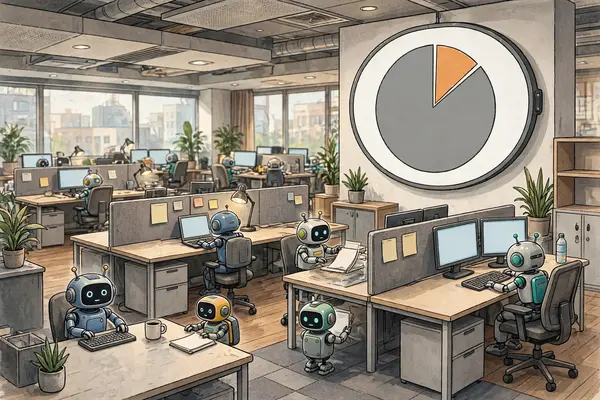
Genpact's report 'Autonomy in Practice', released November 12 and based on a survey of more than 2,000 enterprise executives, found 79% of enterprises have AI agents in production — but only 20% use them broadly and consistently across functions, and only 15% have fully tied AI investment to profit-and-loss outcomes.
The News
Genpact released a report on November 12, 'Autonomy in Practice', based on a survey of more than 2,000 enterprise executives across 17 industries and 14 business functions at companies with $1 billion to more than $50 billion in revenue, plus in-depth interviews. The headline gap is stark: 79% of surveyed enterprises have AI agents in production, but only 20% use them broadly and consistently across functions, and only 15% have fully tied AI investment to profit-and-loss outcomes.
The results are thinner than the adoption numbers suggest. On average, 49% of funded AI initiatives met value expectations over the preceding 24 months — meaning roughly half did not. Among respondents running agents, 92% maintained or expanded their human workforce, which cuts against the idea that agents are mainly replacing people. Genpact says AI leads or entirely handles 40% of decisions, more than twice the share a year earlier.
Genpact classes 17% of respondents as 'AI Leaders' — companies further along in building what it calls 'Agentic Operations', in which humans and agents run as a single workforce. The findings are self-reported survey data, with percentages rounded, and the report is Genpact's own research rather than an independent measurement of outcomes — so the numbers describe what executives say is happening, not what an outside auditor verified.
Agents are everywhere. The profit is not — yet.
Why It Matters
The gap between 79% and 15% is the whole story. Having an AI agent 'in production' can mean a single chatbot answering customer questions, or a pilot running in one department. Using agents broadly across functions — the 20% figure — is a much higher bar, and tying AI spending to profit and loss is higher still: it means a company can show, in its accounts, that the money it spent on AI came back as profit. Most companies, according to this survey, cannot yet do that.
The 49% figure is the one to sit with. If only about half of funded AI projects met the value their sponsors expected over the past two years, then the other half fell short — wasted money, unfinished rollouts, or benefits that never showed up in the numbers. That is not a failure of the technology so much as a failure of follow-through: buying the tool is the easy part, and changing how work actually gets done is the hard part.
The jobs number is the surprise that runs against the usual fear. Among companies running agents, 92% kept their workforce the same size or grew it. Agents, at least so far, look more like assistants that take on routine decisions — Genpact says AI now leads or entirely handles 40% of decisions, more than twice the share a year earlier — than like replacements for whole teams. The people stay; the mix of work changes.
For investors, the read-through is about who sells the picks and shovels. Genpact itself is a services company — ticker G — that makes money helping enterprises put agents into production, so a world where 79% have agents but only 15% can prove the payoff is a world with a lot of consulting work left to sell. The risk for the whole AI trade is the other side of the same coin: if the payoff gap does not close, enthusiasm for AI spending could cool.
Analyst's Take
Our call is Mixed. The 79% adoption figure says agents are real and everywhere, and 92% of companies running them kept or grew their workforce — but only 15% can tie AI spending to profit, and only 49% of funded projects met expectations. That is a market still proving its value, not one that has proven it.
What to watch: whether the 17% of 'AI Leaders' keep pulling away from the rest, whether the share tying AI to profit climbs above 15% in the next survey round, and whether the 40% of decisions AI now handles keeps rising without the workforce cuts that would follow if agents truly replaced people.
Are you bullish or bearish on this story?
By The Numbers
FAQ
What is an AI agent?
Software that can carry out multi-step tasks on its own — gathering information, making decisions and taking actions — rather than just answering one question at a time like a chatbot.
What does 'in production' mean?
The agent is live and doing real work, not just being tested. Genpact found 79% of surveyed enterprises have at least one agent in production — but only 20% use them broadly across functions.
What does tying AI to P&L mean?
P&L is profit and loss — a company's accounts. Tying AI investment to P&L means being able to show, in those accounts, that the money spent on AI came back as profit. Only 15% of surveyed companies say they can do that.
Are AI agents replacing workers?
Not according to this survey: among companies running agents, 92% maintained or expanded their human workforce. Agents are mostly taking on routine decisions so far, not whole jobs.
How reliable are these numbers?
They are self-reported survey data from more than 2,000 executives, with percentages rounded, and the report is Genpact's own research — not an independent measurement. Treat them as what executives say, not as audited fact.
👁
Source: Genpact via PR Newswire