
Fermi lands a $200M hyperscaler prepayment — and loses its only tenant the same day
Fermi America said an undisclosed investment-grade hyperscaler signed a $200 million prepayment and a $15 million early construction agreement for an initial 600 MW at Project Matador near Amarillo, Texas, beginning in 2027. The same release disclosed that Fermi and TensorWave terminated their August lease for 222 MW, leaving Fermi with zero signed leases.
The News
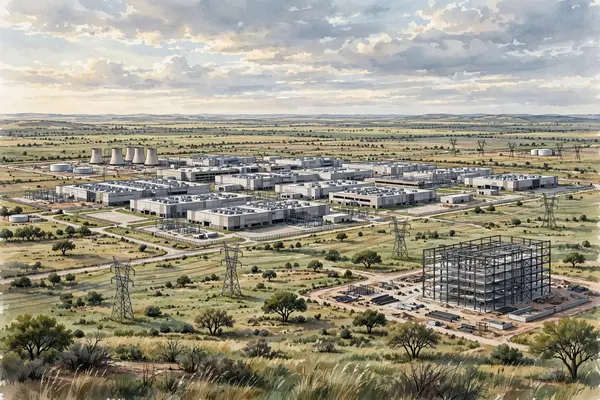
Fermi Inc., known as Fermi America, announced on November 12 that an undisclosed investment-grade hyperscaler has signed a $200 million prepayment agreement and a $15 million early construction and site development agreement to advance an initial 600 MW of power capacity at Project Matador, its private-grid data-centre campus near Amarillo, Texas, beginning in 2027. A $90 million structural steel and building materials purchase is still being finalised. Management targets initial power in late Q2 or early Q3 2027.
The money is real, but it is not a lease. No lease has been signed — the customer is funding ahead of a definitive long-term lease — so the $200 million is upfront funding, not contracted revenue. And the same release carried bad news: Fermi's first announced tenant is gone. Fermi and TensorWave terminated the Data Center Lease and Services Agreement signed in August, a 222 MW deal valued at about $6.5 billion over 15 years that never took effect — its closing conditions, including project financing, were never met — and the AMD credit support agreement tied to it is also terminated, leaving Fermi with zero signed leases.
The financials underline how early this story still is. The third quarter showed a net loss of $141.6 million on no revenue, with $315.5 million of cash and restricted cash against $958.4 million of debt. (The $346.8 million loss in the release covers the period from the company's inception in January 2025 through September 2025, so it is not a like-for-like quarterly comparison.) Shares rose 13.81% on Thursday to $2.06, up $0.25 from the previous close of $1.81, on volume of about 86.7 million shares — the market cheering the hyperscaler's money while looking past the empty lease book.
Two hundred million dollars in, and not a single signed lease left.
Why It Matters
The distinction between a prepayment and a lease is the whole story. A lease is a signed contract to rent space and power for years — it is revenue a company can count on. A prepayment is money paid before that contract exists. Fermi has the money, which is good, but it does not have the contract, which is what turns a construction site into a business. Investors who treat the $200 million as contracted revenue will be disappointed; investors who treat it as a down payment on a deal that still needs signing will read it right.
The TensorWave termination is the other half of the picture. Fermi's first announced tenant was a 222 MW deal worth about $6.5 billion over 15 years, with credit support from AMD — a serious-sounding commitment. That deal is now gone, along with the AMD support, and Fermi is back to zero signed leases. Losing your only tenant on the same day you announce a new customer is not a coincidence to ignore: it says the old deal was fragile, and it raises the question of how solid the new one is before a lease is signed.
The balance sheet explains why the prepayment matters so much. Fermi lost $141.6 million in the third quarter on no revenue at all, and it holds $315.5 million of cash and restricted cash against $958.4 million of debt. That is a company spending heavily to build something that does not yet earn money. The $200 million helps, but it does not fix the gap — it buys time for the project to become real. The 13.81% jump in the shares to $2.06 says the market is willing to give it that time, for now.
The hyperscaler's identity matters, even though it is undisclosed. Fermi describes the customer as investment-grade, meaning a large company with a strong credit rating — the kind of tenant that can actually pay for 600 MW of power. That is a better signal than a lease with a small, unproven customer. But an unnamed customer is also a customer that has not put its name on the project, and until the definitive lease is signed, the validation is partial. The steel purchase still being finalised is the same story in miniature: real progress, not yet finished.
Analyst's Take
Our call is Mixed. A $200 million prepayment from an investment-grade hyperscaler is a genuine vote of confidence — large cloud companies do not wire that kind of money into a project they do not believe in. But it is not a lease, and on the same day Fermi lost the only lease it had, the 222 MW TensorWave deal worth about $6.5 billion over 15 years. One customer arriving with cash and another leaving with nothing signed is a wash, and the balance sheet — $315.5 million of cash against $958.4 million of debt, on no revenue — says the company is still a long way from a working business.
What to watch: whether the prepayment converts into a signed long-term lease, and whether the $90 million steel and materials purchase closes. A signed lease turns the hyperscaler's money into contracted revenue and gives the story a foundation. Without one, Fermi is a construction project funded by hope and one upfront payment — and the next tenant, not the last one, is what matters.
Are you bullish or bearish on this story?
By The Numbers
FAQ
What is the difference between a prepayment and a lease?
A prepayment is money paid upfront before a deal is final. A lease is a signed, binding contract to rent space and power for a set period. Fermi's hyperscaler has paid $200 million and signed a $15 million early construction agreement, but no lease has been signed — the customer is funding ahead of a definitive long-term lease that does not yet exist, so the money is not contracted revenue.
What is Project Matador?
Project Matador is Fermi's private-grid data-centre campus near Amarillo, Texas. A private grid means Fermi builds its own power supply rather than relying on the public electricity network. The hyperscaler deal covers an initial 600 MW of power capacity there, beginning in 2027, with initial power targeted for late Q2 or early Q3 2027.
Why did Fermi shares rise if it lost its only tenant?
The market read the $200 million prepayment as validation: an unnamed but investment-grade hyperscaler — a large, financially strong cloud company — is willing to put real money into the project before a lease exists. That is a stronger signal than the terminated TensorWave lease, which was with a smaller customer. Shares rose 13.81% to $2.06, up $0.25 from the previous close of $1.81, on volume of about 86.7 million.
What is Fermi's financial position?
Fermi reported a third-quarter net loss of $141.6 million on no revenue. It held $315.5 million of cash and restricted cash against $958.4 million of debt. The $346.8 million loss figure covers the period from the company's inception in January 2025 through September 2025, so it is not a year-earlier quarterly comparison. In plain terms, the company is spending heavily to build before it earns anything, and the $200 million prepayment helps, but it does not close the gap between cash and debt.
What happens next for Fermi?
Two things: the $90 million structural steel and building materials purchase still being finalised, and whether the hyperscaler prepayment converts into a signed long-term lease. Until a lease is signed, Fermi has zero signed leases, and the story rests on a customer that has paid upfront but has not yet committed to rent the space.
👁
Source: ACCESS Newswire