
FCC votes 3-0 to open dedicated drone spectrum; AURA qualifies for nationwide licence
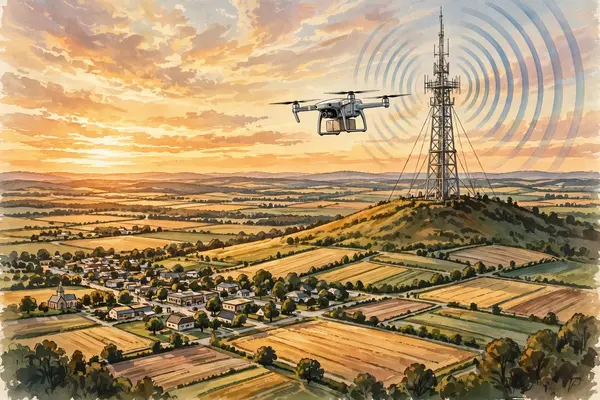
The Federal Communications Commission voted 3-0 on Thursday, November 19, to adopt its Unleashing American Drone Dominance spectrum order, opening the 450 MHz aviation band to dedicated flight-control data links for drones and electric air taxis.
📊 Scorecard: our Bullish call on $AVAV is scored from $86.79, the last close before it ran. Its first result comes after the next close.
The News
The Federal Communications Commission voted 3-0 on Thursday, November 19, to adopt its Unleashing American Drone Dominance spectrum order (FCC 26-81), opening the 450 MHz aviation band to dedicated flight-control data links for drones and electric air taxis. The vote replaces site-by-site ground-station licences with a single nationwide licence.
AURA Network Systems, which holds all 54 existing ground stations in the band and says it has invested more than $100 million since 2021, is the only company that qualifies for the nationwide licence and will not have to pay for the expanded rights. But it must hit build-out targets — keeping its 25,000-foot coverage across the contiguous US and Hawaii and choosing one of two lower-altitude paths: 5,000-foot coverage over 50% of that area by year four and 90% by year eight, or 400-foot coverage over 35% by year four and 70% by year eight — or the licence terminates if the eight-year targets are missed.
The order also opens the 24.45-24.65 GHz band to ground-based radar that detects and tracks drones near airports, borders, prisons and stadiums, and updates power rules in the 800 MHz air-ground band used for in-flight broadband. The rules authorise spectrum use for detection gear only — they grant no power to disable, intercept or destroy drones — and most of the rules take effect 30 days after publication in the Federal Register.
One vote, one nationwide licence — and the biggest bottleneck for American drones is gone.
Why It Matters
The vote matters because spectrum is the bottleneck for drones. A drone needs a reliable radio link to its operator to fly safely beyond the operator's line of sight, and until now American drone operators had to apply for a licence for each ground station, one site at a time. A single nationwide licence in the 450 MHz band gives AURA, the only company that qualifies, a national network for flight-control data links — the kind of infrastructure that makes large-scale commercial drone flights possible.
It matters because of the build-out targets. AURA will not have to pay for the expanded rights, but it must deliver coverage at 25,000 feet across the contiguous US and Hawaii, plus lower-altitude coverage at 5,000 feet or 400 feet on a four- and eight-year schedule, or the licence terminates after eight years. That is a real deadline: the licence is a reward for building a network, not a gift, and AURA says it has already invested more than $100 million since 2021.
It also matters for the wider drone sector. AURA is private, so there is no listed stock to buy in the company that won the licence. AeroVironment, which closed Friday at $86.79, down 9.51%, and Kratos, which closed at $26.89, down 9.31%, are public drone makers used here as read-throughs — their shares show how investors value American drone companies as the FCC clears the way for bigger commercial drone operations, and the 24 GHz detection band opens a second market in drone-detection radar.
Analyst's Take
Our call is Bullish. The FCC's unanimous vote on November 19 to open dedicated drone spectrum, with a nationwide 450 MHz licence for AURA, removes the biggest regulatory bottleneck for American commercial drones — the site-by-site licensing that made national drone operations impractical. AeroVironment and Kratos are used here as public drone read-throughs, since AURA is private.
What to watch next is the final order text, which the FCC had not released as of November 20, so the build-out figures in this post come from the October 29 draft. The draft made 400-foot coverage optional, and whether the final order keeps that is unconfirmed — a detail that matters for how much of the country AURA must actually cover. Also watch the Federal Register publication, since the rules take effect 30 days after that.
For investors, the read-through is the American drone sector, not a single licence. AURA is the only company that qualifies for the nationwide licence, but the order also opens the 24 GHz band to drone-detection radar and updates the 800 MHz band for in-flight broadband, which widens the market for drone and detection companies alike. The rules grant no power to disable or destroy drones — they are about spectrum and detection, not enforcement. Reader poll: Will drone spectrum unlock commercial drones — yes or no? Vote: Yes, it will, No, not yet, Too early to tell.
Are you bullish or bearish on this story?
By The Numbers
FAQ
What is spectrum?
Spectrum is the range of radio frequencies used to send signals through the air — for mobile phones, Wi-Fi, television and, now, drones. The FCC decides who can use which frequencies in the United States, and it has now set aside the 450 MHz band for drone flight-control links.
What is a nationwide licence?
A nationwide licence is a single permission to operate across the whole country, instead of a separate licence for each ground station. Before this order, drone operators needed a licence for each site; AURA will now hold one licence covering the contiguous US and Hawaii.
What is AURA?
AURA Network Systems is a private American company that builds the radio network drones use for flight control. It holds all 54 existing ground stations in the 450 MHz band and is the only company that qualifies for the nationwide licence under the FCC's order. Because it is private, its shares cannot be bought on the stock market.
What is a read-through?
A read-through is a listed company used as a stand-in for a story it is not directly part of. AURA is private, so AeroVironment and Kratos — public drone makers — are used here to show how the market might react to the FCC opening dedicated drone spectrum.
👁
Source: DroneLife