
Cheyenne Light files agreements to build grid for three Microsoft datacenters
Cheyenne Light filed agreements at the Federal Energy Regulatory Commission to build power infrastructure for three planned Microsoft datacenters in Wyoming, with Microsoft paying through contribution-in-aid-of-construction payments — filed agreements, not approvals.
The News
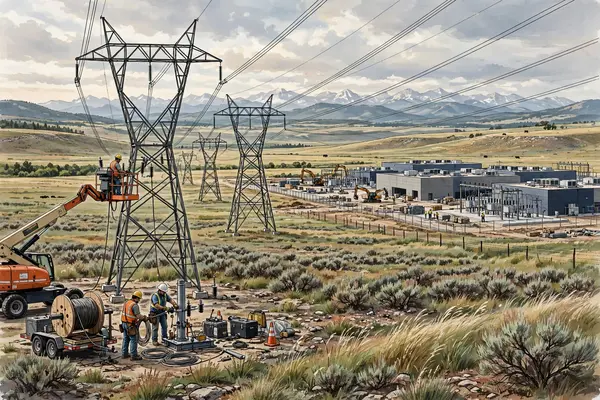
Cheyenne Light, Fuel and Power Co. has entered agreements to build distribution and transmission infrastructure to serve three Microsoft datacenters planned for Wyoming, the company said in a filing at the Federal Energy Regulatory Commission, known as FERC. Distribution lines carry power locally to customers, while transmission lines move large amounts of power over longer distances. Together they are the grid connection a datacenter needs before it can switch on. The filing was reported on Wednesday, November 25.
The redacted agreements require Microsoft to pay for the infrastructure through contribution-in-aid-of-construction payments. That term means the customer pays upfront toward the cost of building the lines and equipment needed to serve it, rather than the utility spreading that cost across all its customers. Cheyenne Light says it does not believe FERC has jurisdiction over the retail agreements — jurisdiction means legal authority to regulate them — but filed them out of an abundance of caution. In plain words, the utility filed paperwork it thinks may not be required, to avoid any later dispute about whether it should have filed.
The filing sits inside a larger build-out. Cheyenne Light is executing a 3-GW datacenter pipeline, including 600 MW of Microsoft and Meta projects. A gigawatt is 1,000 megawatts, a measure of power capacity, so 3-GW describes the scale of datacenter demand the utility is preparing to serve. It plans to recover the costs of two proposed transmission projects totaling $686 million through a tariff designed to insulate retail customers. A tariff here is the approved pricing structure for recovering costs, and insulating retail customers means shielding households and small businesses from paying for datacenter-driven upgrades. Wyoming regulators are expected to decide on the tariff by mid-2027. Microsoft shares closed Wednesday at $489.93, down 1.25%.
Microsoft pays for its own grid connection in Wyoming — but the agreements were filed in redacted form, and the tariff decision is still ahead.
Why It Matters
This matters because power, not land or servers, is now the bottleneck for new datacenters. A datacenter cannot run without a grid connection sized for constant, heavy electricity use, and building that connection takes years of permits, equipment and construction. A utility filing agreements for three Microsoft campuses in Wyoming is a concrete step toward power delivery, and the contribution-in-aid-of-construction structure answers the question every nearby resident asks: who pays? Under these agreements, Microsoft pays toward the infrastructure built to serve it.
The tariff detail matters for the same reason. Two proposed transmission projects totaling $686 million are large enough that, if their costs were spread across ordinary customers, local bills could rise. Cheyenne Light says its tariff is designed to insulate retail customers from those costs, with a Wyoming decision expected by mid-2027. Until regulators decide, that protection is a proposal, not a guarantee. The 3-GW pipeline figure, including 600 MW of Microsoft and Meta projects, also shows Wyoming is being prepared as a datacenter hub well beyond these three campuses.
The limits of the filing are just as important. The agreements were filed in redacted form, so no reader can yet judge from them how big each campus is or when it might open, and Wyoming regulators are expected to decide on the transmission tariff by mid-2027. Filed agreements are not approvals. The utility's own statement that it doubts FERC jurisdiction adds another layer of process: the federal filing may turn out to be precautionary, while the binding decisions happen at the state level.
Analyst's Take
Our call is Mixed. Three planned Microsoft datacenters gaining filed grid agreements, with Microsoft paying through contribution-in-aid-of-construction, is real progress toward power in Wyoming, and a $686 million transmission plan with retail-customer protection addresses the cost question directly. Microsoft's Wednesday close at $489.93, down 1.25%, reflects the broader session rather than this filing, which is a long-term infrastructure step, not near-term earnings news.
The caution is that almost everything that determines value is still undecided. The agreements were filed in redacted form, the Wyoming tariff decision is not expected until mid-2027, and the utility itself questions whether FERC has jurisdiction. A filing made out of caution can still stall at any of those gates, so no power delivery is promised yet.
What to watch is the Wyoming tariff decision by mid-2027 and any unredacted figures for campus size and timing. Approvals that keep the $686 million cost recovery off retail customers would make this a model other datacenter states copy. Reader poll: Will $MSFT Wyoming campuses get power on time? Vote: Yes, Delayed, Blocked.
Are you bullish or bearish on this story?
By The Numbers
FAQ
What is contribution-in-aid-of-construction?
It means the customer pays upfront toward the cost of building the power lines and equipment needed to serve it. Under the filed agreements, Microsoft pays this way for infrastructure serving its three planned Wyoming datacenters.
What is FERC jurisdiction?
Jurisdiction means legal authority to regulate something. Cheyenne Light says it does not believe the Federal Energy Regulatory Commission has jurisdiction over these retail agreements, but filed them out of caution anyway.
What is a tariff in this story?
A tariff is the approved pricing structure a utility uses to recover its costs. Cheyenne Light plans to recover $686 million for two transmission projects through a tariff designed to insulate retail customers, with a Wyoming decision expected by mid-2027.
Does this filing approve construction?
No. Filed agreements are not approvals, and the agreements were filed in redacted form, so no power delivery is promised yet.
👁
Source: Utility Dive and FERC docket ER27-634