
BNY and Microsoft say AI agents just negotiated their first Treasury trade
BNY and Microsoft completed what the companies bill as the first AI-agent negotiation of a US Treasury bill trade on November 17, with human traders reviewing and approving the terms before execution.
📊 Scorecard: our Bullish call on $BNY is scored from $149.79, the last close before it ran. Its first result comes after the next close.
The News
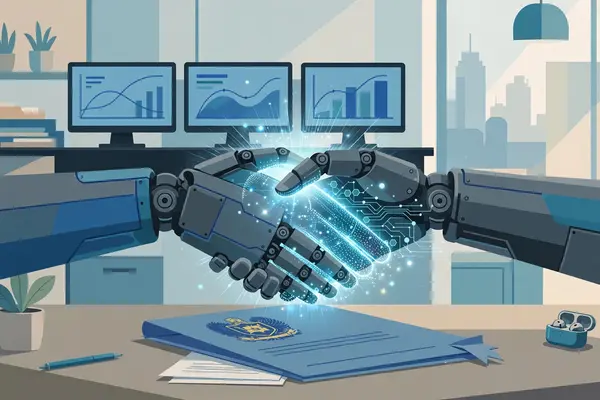
BNY and Microsoft completed what the companies bill as the first AI-agent negotiation of a US Treasury bill trade on November 17. Microsoft Treasury gave its agent trading instructions and connected to BNY through a secure agent gateway, and BNY's dealer agent haggled over the price within preset limits. The negotiation ran on BNY's new Agentic Negotiation Protocol, or ANP, a patent-pending control layer that checks which agents are allowed to take part and confirms both sides have read the same terms before anything is accepted.
The agents did not execute the trade. Human traders at both firms reviewed and approved the terms before execution, and the agents could not execute on their own. No trade size, maturity, yield or price was disclosed. That makes this a working proof of concept — evidence that the negotiation can happen — not proof that agents trade better than people. The distinction matters, because a demo with no numbers cannot tell you whether the price was good.
BNY plans to keep testing ANP and extend it to repo and other contractual negotiations. The scale of the institution behind the test is large: BNY oversees $63.4 trillion in assets under custody and/or administration as of September 30, 2026. BNY's global head of markets, Laide Majiyagbe, told Bloomberg: 'We are not suggesting high-touch goes away.'
"We are not suggesting high-touch goes away." — Laide Majiyagbe, BNY global head of markets, quoted in Bloomberg
Why It Matters
A Treasury bill is a short-term loan to the US government, and the market for them is one of the largest and most liquid in the world. Trades are usually negotiated by people, over the phone or on screens, and the price is haggled over in small increments. Getting two software agents to do that haggling — with limits, identity checks and a shared record of the terms — is a real technical step, because a mistake in this market is expensive and instant.
The control layer is the actual product here, not the trade. ANP's job is to answer the questions that stop banks from letting agents trade: is this agent who it says it is, is it allowed to do this, and did both sides agree to the same terms? Without those answers, an agent negotiation is a liability, not a feature. BNY is patenting the layer because the layer, not the single trade, is what other banks would need to buy.
For Bank of New York Mellon (BNY) and Microsoft (MSFT), the trade is a first-mover claim, and the roles matter: Microsoft's Treasury team is the customer, and its agent is the one that asked for the trade. If ANP works across repo and foreign exchange as BNY plans, the same plumbing could carry a large share of institutional trading — but only if regulators and risk officers accept agents as counterparties, which they have not yet done.
Analyst's Take
Our call is Bullish. This is the first time two named institutions have put agents on opposite sides of a real Treasury negotiation and had the trade complete, with humans still holding the execution key. That is a genuine milestone for agentic finance, and it is the kind of proof point that turns a research project into a product roadmap.
The limits are plain, and they should stay in the story. No size, no price, no yield — so nobody can say whether the agent got a good deal. The humans approved the terms, so the agents negotiated but did not decide. And the next steps — repo, FX, collateral — are plans, not results. A proof of concept is worth celebrating, but it is not a revenue line.
For readers, the thing to watch is the extension. If BNY runs a second trade with a disclosed size, or moves ANP into repo, the story upgrades from demo to business. Until then, this is a well-built door — the question is whether anyone walks through it. Reader poll: Will agents trade bonds next year? Vote: Yes, No, Too early.
Are you bullish or bearish on this story?
By The Numbers
FAQ
What is a Treasury bill?
A Treasury bill, or T-bill, is a short-term loan to the US government, usually lasting from a few weeks to a year. Investors buy them for safety — the US government is considered the most reliable borrower in the world — and the market for them is one of the largest in existence.
What is an AI agent?
An AI agent is software that can carry out a task on its own — reading instructions, making decisions within limits it was given, and taking actions — rather than just answering questions. Here, one agent asked for a trade and another haggled over the price, each inside rules set by humans.
What does it mean that the agents 'negotiated' but did not execute?
Negotiating means agreeing on the terms of the trade, such as the price. Executing means actually completing the trade and moving the money. The agents worked out the terms, but human traders at both firms reviewed and approved them before the trade was executed — the agents could not finish the deal on their own.
👁
Source: Bloomberg