
Axon bets another $1.2B on Skydio — then misses earnings and cuts guidance
Axon announced on November 5 that it will invest another $1.2 billion in drone maker Skydio — the largest investment in Axon's history — taking its stake to 37% and becoming Skydio's exclusive public-safety distributor in the US and Canada. The same release missed earnings and cut guidance, and shares slumped about 14% in extended trading. This announcement came after the close on November 5 and was missed by yesterday's run; it is filed here as a catch-up.
The News
Axon Enterprise announced on November 5, after the market close, that it will invest an additional $1.2 billion in drone maker Skydio — the largest investment in Axon's history — taking its fully diluted ownership to 37% at a $5.2 billion pre-money valuation, and becoming Skydio's exclusive public-safety distributor in the US and Canada. The deal is roughly 60% cash and 40% stock, funded in part by $1.15 billion of convertible notes issued in the quarter, and is expected to close across the fourth quarter of 2026 and the first quarter of 2027. This announcement came after the close on November 5 and was missed by yesterday's run — it is filed here as a catch-up, not a November 6–7 event.
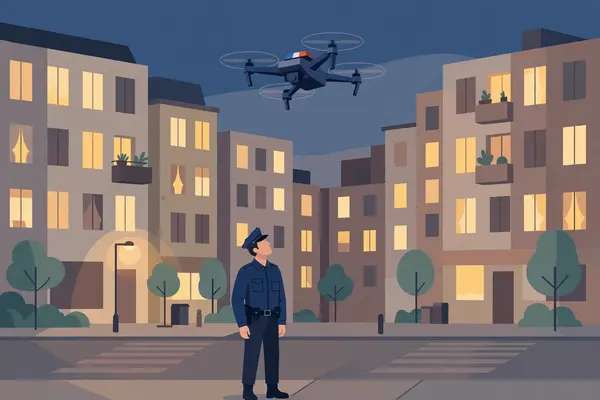
The commercial case is the drone-as-first-responder market. Skydio serves more than 1,500 public-safety customers and expects roughly $1 billion in bookings this fiscal year; Axon puts the US and Canadian drone-as-first-responder market at about $13 billion. The idea is simple: a drone flies to an emergency scene ahead of officers and gives them a live view before they arrive, and Axon — which already sells body cameras and Tasers to the same police departments — can now sell them the drones too.
The same release cut the other way. Third-quarter revenue was $909 million, up 28%, but adjusted earnings per share of $1.72 missed the $1.88 consensus compiled by LSEG — and Axon trimmed full-year 2026 revenue growth to about 30%, from 32–34%, because three Federal Dedrone deployments worth about $130 million of revenue and $200 million of bookings may not land this year. Full-year free cash flow guidance — the cash a company generates after paying for its operations and equipment — was cut to $350–400 million from $450 million. Shares slumped about 14% to $329 in extended trading. Axon says it will now include such timing-sensitive federal deals in guidance only once it is confident they will ship.
The biggest public-safety drone bet ever made, announced on the same day the earnings missed and the guidance came down.
Why It Matters
This matters because it is the biggest bet yet on drones becoming standard police equipment. A drone that reaches an emergency scene before officers do changes how a department responds — and Axon, which already equips those departments with cameras and Tasers, is now the only seller of Skydio drones to American and Canadian police. The $13 billion market figure is Axon's own estimate, but the direction is clear: public-safety drones are moving from experiment to procurement, and the largest player just bought the leading position.
It matters as a caution, too. A company does not cut its full-year growth forecast from 32–34% to about 30% and its free cash flow guidance by roughly $75 million because everything is going to plan. The three delayed federal deployments — $130 million of revenue, $200 million of bookings — show that selling to the federal government moves on the government's timetable, not the company's. Investors punished the stock about 14% in extended trading not because the Skydio deal is bad, but because the earnings underneath it were worse than expected. The bet and the miss arrived in the same envelope, and the market read the miss first.
Analyst's Take
Our call is Mixed, because this is two stories in one release and they point in opposite directions. The Skydio bet is genuinely big: $1.2 billion, a 37% stake, exclusive distribution to more than 1,500 public-safety customers, and a $13 billion market that Axon is now positioned to lead. If drones-as-first-responders become standard equipment for police departments the way body cameras did, Axon just bought the leading position. But the market did not cheer it, because the same release told investors the core business is slipping — an earnings miss, a guidance cut, and $130 million of federal revenue that may not arrive this year.
What to watch is whether the guidance cut is a one-off timing problem or a sign that Axon's federal business is harder to predict than investors thought. Axon's own fix — only counting timing-sensitive federal deals once it is confident they will ship — is the right medicine, but it is also an admission that the old guidance was optimistic. The Skydio deal closes across the next two quarters, so the bet will take time to show up in results; the guidance cut is already here. For now, the drone story is the future and the earnings story is the present, and the present won the trading session.
Are you bullish or bearish on this story?
By The Numbers
FAQ
What is Skydio, in plain terms?
Skydio is an American drone maker focused on public safety — police, fire and emergency services. Its drones are used as "first responders": a drone flies to an emergency scene ahead of officers to give them a live view before they arrive.
What does "exclusive public-safety distributor" mean?
It means Axon becomes the only company selling Skydio drones to police and other public-safety agencies in the US and Canada. Axon already sells body cameras and Tasers to those same agencies, so it can bundle drones with its existing products.
What is a convertible note?
It is a loan that can later be turned into shares. Axon issued $1.15 billion of zero-coupon convertible notes due 2031, priced on September 15, to help pay for the Skydio investment — borrowing now, with the lender able to convert the debt into Axon stock later.
Why did Axon cut its guidance?
Because three Federal Dedrone deployments — worth about $130 million of revenue and $200 million of bookings — may not land this year. Axon says it will now only count such timing-sensitive federal deals in its guidance once it is confident they will ship.
What is a pre-money valuation?
It is what a company is worth before new investment money is added. Skydio's $5.2 billion pre-money valuation is the value placed on the company before Axon's $1.2 billion goes in.
👁
Source: Reuters / Axon Q3 2026 shareholder letter (PR Newswire) / Axon–Skydio release (PR Newswire)