
ASUS unveils Gallop, its first humanoid, learning to pack motherboards on the factory floor
ASUS unveiled Gallop, its first humanoid robot, in a company pressroom post on November 13, introduced by co-CEO S.Y. Hsu on CNBC. Gallop is learning a real workstation at an ASUS group electronics manufacturing plant: packing 15 motherboard accessories at about 20 seconds per board, with a target of 99.5% success within 20 seconds — the same standard ASUS holds a person to.
📊 Scorecard: our Bullish call on $2357.TW is scored from NT$882.00, the last close before it ran. Its first result comes after the next close.
The News
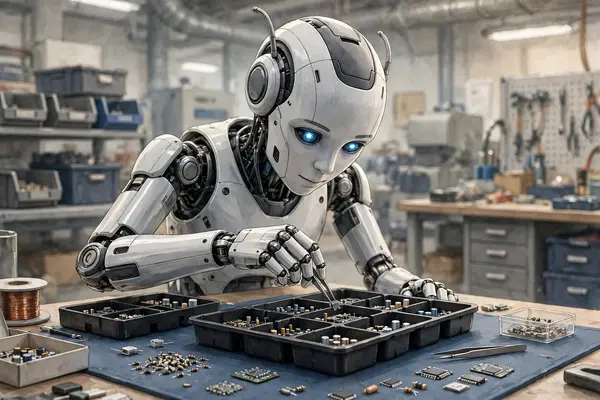
ASUS unveiled Gallop, its first humanoid robot, in a company pressroom post on November 13, 2026, introduced by co-CEO S.Y. Hsu on CNBC. Gallop is learning a real workstation at an ASUS group electronics manufacturing services plant — a factory that builds electronics for other companies — packing 15 motherboard accessories, many small and in thin clear bags, at about 20 seconds per board. The program started in early 2026, so Gallop has been in development for less than a year.
ASUS's target is 99.5% success within 20 seconds — the same standard it holds a person to. That figure is a target, not a current success rate: the company has not disclosed how often Gallop succeeds today. Gallop runs on a single Nvidia Jetson AGX Thor computer inside the robot, uses standard robotics software, and learns by watching skilled workers through head cameras, simulation variations, VR-guided practice and on-the-job feedback.
ASUS designs the body and its own dexterous hand in-house. Today Gallop works from a fixed base with two arms, with a wheeled version to follow. Customer pilots are planned for 2027, a customer showing is planned at Computex 2027, and market availability is targeted for the second half of 2028. No price, unit cost or production volume was disclosed. The first market is electronics manufacturing, with hospitals and service sites later.
Gallop is not judged against a demo — it is judged against the person doing the same job.
Why It Matters
Packing motherboard accessories is a harder job than it sounds, and that is the point. Fifteen parts per board, many of them small and sealed in thin clear bags, means the robot must see fine detail, grip gently and work fast — about 20 seconds per board. A robot that can do that job can do a large share of electronics assembly work, because the same skills — small-part handling, careful packing, steady speed — repeat across the factory.
The 99.5% target is the most honest number in the announcement, because it is framed as a target rather than a result. ASUS is saying Gallop must meet the same standard as a person doing the same job, and it is not claiming it already does. That framing protects the story from the usual humanoid hype cycle, where a demo video is mistaken for a product — and it gives investors a clear test: when ASUS starts reporting actual success rates, the number to compare against is 99.5%.
The learning method is the real technology story. Gallop learns by watching skilled workers through head cameras, then practising in simulation variations, then VR-guided practice, then on-the-job feedback. That combination — watch a person, rehearse in a virtual copy of the workstation, then improve on the real line — is how a robot can learn a job without breaking parts or stopping production. It is also why the robot needs a powerful computer on board: a single Nvidia Jetson AGX Thor does the thinking inside Gallop, rather than sending video to a server elsewhere.
The timeline is long, and that is normal for hardware. Customer pilots in 2027, a showing at Computex 2027, market availability in the second half of 2028 — that is roughly two and a half years from unveiling to sale. ASUS's first market is electronics manufacturing, its own backyard, with hospitals and service sites later. That sequencing is sensible: prove the robot where you control the factory, then take it to customers whose environments you do not control.
Analyst's Take
Our call is Bullish. ASUS is doing the unglamorous thing that makes humanoids credible: putting its robot on a real workstation, packing real parts, and grading it against the same 99.5% standard a person must meet. That is a harder test than a stage demo, and the fact that ASUS is public about the target — while honest that it is a target — reads as a company that intends to be measured. The Jetson Thor brain also ties the story to Nvidia's robotics platform, which is where the industry's compute is consolidating.
What to watch: the 2027 customer pilots and the Computex 2027 showing. Until outside customers run Gallop on their own lines, this is an in-house project at one factory group. If pilots start on schedule and the wheeled version arrives, Gallop becomes a product; if the timeline slips past 2028, it stays a research project with a good pressroom post.
Are you bullish or bearish on this story?
By The Numbers
FAQ
What is Gallop?
Gallop is ASUS's first humanoid robot — a two-armed robot learning to work at a real workstation in an ASUS group electronics manufacturing services plant, packing 15 motherboard accessories per board. EMS means electronics manufacturing services: a factory that builds electronics for other companies.
Is Gallop already hitting 99.5% success?
No — 99.5% success within 20 seconds is a target, not a current success rate. ASUS says that is the same standard it holds a person to, but the company has not disclosed what Gallop's actual success rate is today. Do not read the target as a measured result.
What computer runs Gallop?
A single Nvidia Jetson AGX Thor computer inside the robot. Jetson Thor is Nvidia's computer platform built for robots — it does the thinking on board, rather than sending data to a server elsewhere. That is why Nvidia is a read-through ticker on this story: ASUS builds the robot, Nvidia supplies its brain.
When can customers buy one?
Not soon. Customer pilots are planned for 2027, ASUS plans to show Gallop to customers at Computex 2027, and market availability is targeted for the second half of 2028. No price, unit cost or production volume has been disclosed.
What does Gallop look like today?
Today Gallop works from a fixed base with two arms, and ASUS designs the body and its own dexterous hand in-house. A wheeled version is planned to follow, so the robot can move around a factory floor instead of staying at one workstation.
👁
Source: ASUS Pressroom