
AMEA Power signs $650M deal for 500 MW Amunet II wind farm in Egypt, plus a $200M turbine factory
UAE-based renewables developer AMEA Power signed contracts on Wednesday, November 18, witnessed by Egyptian Prime Minister Mostafa Madbouly, to build its 500 MW Amunet II wind farm at Ras Shukeir for $650 million, alongside a $200 million wind turbine factory. The EPC contract went to China's PowerChina.
📊 Scorecard: our Bullish call on $601669.SS is scored from CN¥4.44, the last close before it ran. Its first result comes after the next close.
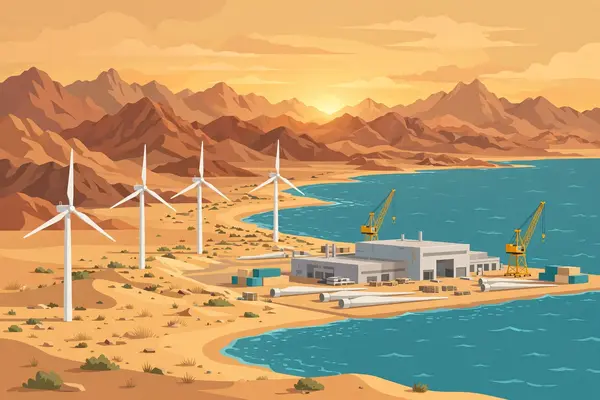
The News
UAE-based renewables developer AMEA Power signed contracts on Wednesday, November 18, witnessed by Egyptian Prime Minister Mostafa Madbouly, to build its 500 MW Amunet II wind farm at Ras Shukeir on Egypt's Red Sea coast for $650 million, alongside a $200 million wind turbine manufacturing facility in the Suez Canal Economic Zone.
The EPC contract — engineering, procurement and construction — went to China's PowerChina HuaDong Engineering Corporation (HDEC). MingYang will supply 45 turbines of 11 MW each, and AMEA and MingYang will build the factory, which will turn out 3 GW of turbines a year once both phases are running, the first in the second half of 2028 and the second by the end of 2029.
Construction began in November 2026 and commercial operation is expected in September 2028, with output above 2.3 TWh a year under a long-term power purchase agreement with the Egyptian Electricity Transmission Company, AMEA Power said in its release. AMEA's Egypt portfolio reaches about 2,500 MW of solar and wind plus 2,400 MWh of storage with Amunet II included.
A $650 million wind farm, a $200 million factory, and a Chinese builder collecting the EPC cheque.
Why It Matters
The deal matters because it is two projects, not one. A $650 million wind farm is a large order on its own, but a $200 million turbine factory in the Suez Canal Economic Zone is an investment in making wind turbines in Egypt, for Egypt and the region. A factory that will turn out 3 GW of turbines a year, once both phases are running, is industrial policy as much as it is a power project.
It matters because of who is building it. The EPC contract went to PowerChina, the Shanghai-listed Chinese engineering group, with MingYang supplying the turbines. AMEA Power itself is a private UAE-based developer, so there is no listed AMEA share to buy — PowerChina (601669.SS) is the read-through, the public company whose order book gains from this deal. That distinction matters: the farm's profits belong to AMEA, while PowerChina earns the construction contract.
It matters because the revenue is already contracted. The farm's output of more than 2.3 TWh a year will be sold under a long-term power purchase agreement with the Egyptian Electricity Transmission Company, the state grid operator — so once the farm is running, the buyer is already lined up. AMEA's Egypt portfolio reaches about 2,500 MW of solar and wind plus 2,400 MWh of storage with Amunet II, which makes this the latest step in a growing position, not a one-off.
Analyst's Take
Our call is Bullish. An $850 million combined commitment — a $650 million wind farm and a $200 million turbine factory — is a substantial vote of confidence in Egypt's wind market, and the factory is the more important half: it turns a single project into local manufacturing capacity that can supply the region. For PowerChina, the Shanghai-listed contractor holding the EPC contract, it is a concrete overseas order, which is why the stock is the read-through here.
What to watch next is execution. Construction began in November 2026 and commercial operation is expected in September 2028, with output above 2.3 TWh a year sold under a long-term power purchase agreement — so the revenue is contracted, but the farm has to be built first. The factory's two phases, the first in the second half of 2028 and the second by the end of 2029, are the longer test of whether this becomes a manufacturing hub or stays a single project.
For investors, the discipline is to remember what this ticker is and is not. PowerChina (601669.SS) is the contractor building the farm, not the developer that owns it — AMEA Power is private, so the listed exposure is through the builder's order book, not the farm's profits. No verified close for 601669.SS was in the research, so this call rests on the contract, not on the market's reaction. Reader poll: Is Egypt's wind build-out a buy signal for PowerChina — yes or no? Vote: Yes, buy the read-through, No, too indirect, Watch and wait.
Are you bullish or bearish on this story?
By The Numbers
FAQ
What is an EPC contract?
EPC stands for engineering, procurement and construction. An EPC contract is a deal where one company takes responsibility for designing a project, buying the equipment and building it, then hands over a finished, working facility. Here PowerChina has the EPC contract to build the Amunet II wind farm.
What is a power purchase agreement (PPA)?
A power purchase agreement is a long-term contract under which a buyer — usually a state grid company — agrees to buy the electricity a power plant produces, at an agreed price, for many years. It gives the plant's owner predictable revenue and makes the project bankable.
What does 'read-through' mean for a stock?
A read-through is when news about one company tells investors something about another, related company. AMEA Power is a private UAE developer with no listed shares, so the listed read-through here is PowerChina (601669.SS), the Shanghai-listed contractor building the wind farm.
What does a turbine factory making 3 GW a year mean?
It means the factory will produce wind turbines with a combined capacity of 3 gigawatts — 3,000 megawatts — per year, enough to equip several large wind farms annually. The Amunet II farm itself is 500 MW, so the factory's output is aimed at the wider Egyptian and regional market, not just this one project.
👁
Source: EnterpriseAM