
AMD and Broadcom diverge from Nvidia: up 5.3% and 3.6% as money rotates
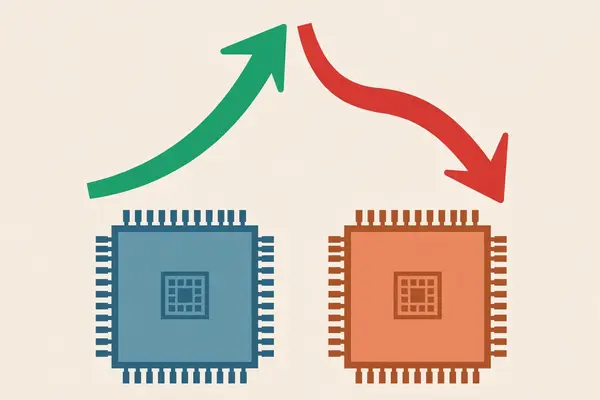
AMD jumped 5.31% to $530.14 and Broadcom gained 3.64% to $354.05 on Wednesday while Nvidia fell, as money rotated to the challengers in AI chips.
📊 Scorecard: our Bullish call on $AMD is a miss so far: from $530.14 to $489.19 at the latest close (-7.7%). Against SOXX the call is wrong: the stock is 5.0 points behind the index.
The News
Wednesday split the chip sector in the other direction from Tuesday. AMD surged 5.31% to $530.14, Broadcom gained 3.64% to $354.05, TSMC's ADR rose 0.81% to $362.62 and Astera Labs added 2.43%, while Nvidia fell 2.89% and Intel slipped 0.91% to $54.67. The PHLX Semiconductor Index edged up just 0.1% to 9,652.8 with 15 of 30 constituents up and 15 down — a flat index hiding a rotation.
Nvidia's above-consensus fourth-quarter guidance — $130 billion, plus or minus 3% — reassured investors that AI demand is intact and lifted the challengers; Korean coverage framed AMD and Broadcom as the stocks trending upward while Nvidia fell. The read: the market still believes in AI compute demand; it is repricing who captures it and at what multiple. AMD's gain came despite the stock still being down 4.1% over five sessions and 9.4% below its November 12 close of $585.30 — a rebound, not a confirmed trend recovery — and pre-market Thursday AMD was up another roughly 3.3% to about $548, a thin-volume first print.
Intel was the odd one out on the downside, slipping 0.91% while its peers rose. The split between AMD and Intel is the cleanest version of Wednesday's story: one challenger gaining on AI demand hopes, the other still waiting for its own turnaround to show up in the numbers.
The market still believes in AI compute demand. It is repricing who captures it — and on Wednesday, that was not Nvidia.
Why It Matters
The rotation matters because it answers the question Nvidia's fall left open. When the biggest AI stock drops 2.89% on a record quarter, the fear is that AI spending itself is cracking. Wednesday said the opposite: investors took Nvidia's above-consensus guidance as proof demand is intact, then bought the challengers instead. Money did not leave chips — it moved within them.
The framing from Korean coverage makes the point explicit: AMD and Broadcom were described as alternative stocks to Nvidia. That is a new role for both. AMD has spent years as the smaller rival; Broadcom sells the custom chips and networking gear that sit alongside AI accelerators. When the market starts treating them as the second way to own AI compute, their valuations get a second look — and Wednesday's moves suggest that re-rating has started.
Intel is the counterpoint that keeps the story honest. It slipped 0.91% to $54.67 while every other name in this story rose, because it has no AI accelerator business of the same scale to rotate into. A rotation rewards the companies with a credible AI story and punishes the ones without it. That is why the index was flat at 0.1% while the individual moves were large: the average hid a real reshuffling of who the market trusts to capture AI demand.
Analyst's Take
Our call is Bullish. A 5.31% jump for AMD and 3.64% for Broadcom on the same day Nvidia fell 2.89% is the market saying the AI story is bigger than one company. Nvidia's own guidance — a $130 billion fourth quarter that beat consensus — reassured investors that AI spending is not cracking, and then they bought the cheaper ways to play it. That is a healthy rotation, not a panic.
The caveats keep the call measured. AMD is still down 4.1% over five sessions and 9.4% below its November 12 close of $585.30, so Wednesday is a rebound from a sell-off, not a new high. Broadcom's gain is cleaner, but both stocks need follow-through: a second strong day, ideally with the pre-market strength in AMD holding into the regular session, would turn a bounce into a trend. Intel falling while peers rose is a reminder that not every chipmaker benefits — the rotation has losers too.
What to watch next is whether the challengers hold their gains when Nvidia stabilises. If AMD and Broadcom keep rising while Nvidia finds a floor, the market has decided the AI trade has room for more than one winner. If they give the gains back, Wednesday was a one-day trade. Reader poll: Which chip stock wins from here? Vote: AMD, Broadcom, Nvidia, TSMC.
Are you bullish or bearish on this story?
By The Numbers
FAQ
What is a rotation?
A rotation is when investors sell one group of stocks and buy another, instead of leaving the market. On Wednesday money rotated out of Nvidia and into AMD, Broadcom and TSMC, so the chip index barely moved even though individual stocks swung hard.
What is the PHLX Semiconductor Index?
The PHLX Semiconductor Index, or SOX, tracks 30 big chip companies in one number. It edged up just 0.1% to 9,652.8 on Wednesday, with 15 of its 30 stocks up and 15 down — a flat index hiding a big split underneath.
What is an ADR?
An ADR, or American Depositary Receipt, is a share of a foreign company that trades on a US exchange. TSMC's ADR lets US investors buy the Taiwanese chipmaker without trading in Taipei.
What does down over five sessions mean?
It means the stock has fallen over the last five trading days taken together. AMD is still down 4.1% over five sessions despite Wednesday's 5.31% jump, so the gain is a rebound, not a confirmed recovery.
👁
Source: TradingKey