
1Password says customer account records were stolen after employee GitHub breach; vaults not accessed
1Password disclosed on Wednesday, November 25 that an attacker who compromised an employee's corporate GitHub account downloaded some customer account records and copied source code, while the company says vault contents, passwords and vault keys were not accessed; the number of affected customers was not disclosed.
📊 Scorecard: our Bearish call on $CRWD is scored from $209.30, the last close before it ran. Its first result comes after the next close.
The News
1Password disclosed on Wednesday, November 25 that it began investigating a breach on November 19 after an employee's corporate GitHub account was compromised. GitHub is a service where software teams store and work on code, and a corporate account is the work account an employee uses there. Compromised means an attacker got control of the account. From that one account, the attacker accessed private repositories — the stored collections of a project's code and files — and pushed malicious code to backend services, the behind-the-scenes systems that run an app's core work. Malicious code is code written to do harm, such as stealing data or opening a hidden way in.
The attacker also downloaded some customer account records, copied source code — the human-readable instructions that make up 1Password's software — and accessed CI/CD systems, the automated pipeline that builds, tests and ships software updates. The data taken included names, email addresses, account and user IDs, account creation and last-sign-in times, public keys, SRP parameters, invitation, provisioning and recovery tokens, and other internal account metadata. In plain words: public keys are the shareable half of a pair of digital keys, SRP parameters are non-secret values used in secure sign-in mathematics, tokens are digital passes for joining, setting up or recovering an account, and metadata is information about an account rather than the secrets inside it.
What was not taken is the line 1Password drew most sharply. The company says customer vault contents — the stored passwords and secrets themselves — were not accessed, and neither were passwords and secrets, account recovery keys or the keys that protect vaults. A vault is the locked store where a password manager keeps a customer's passwords. 1Password has not disclosed how many customers were affected, and this post does not estimate a count. The company says the compromised GitHub account was disabled, the token revoked — cancelled so it no longer works — clean services restored, and potentially exposed infrastructure credentials rotated or revoked.
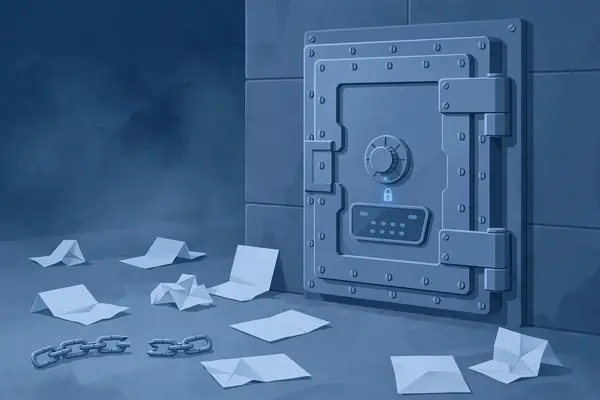
The vaults stayed sealed, but the attacker reached the code, the pipeline and customer account records.
Why It Matters
This matters because 1Password sells trust in its purest form. A password manager holds the keys to a customer's other accounts, so a breach at a password manager is judged by a stricter standard than a breach at an ordinary company. The company says the vaults themselves were not accessed, and that boundary is the most important fact in the disclosure: the stolen material is account records and other internal account metadata, not stored passwords. But an attacker reaching private code, backend services and the software-delivery pipeline is still a deep intrusion, and it started from a single employee account. 1Password says it hired independent experts to validate remediation and found no internal evidence of customer account takeovers.
The stolen account records carry their own risk even without vault contents. Names, email addresses, account IDs and sign-in times are the raw material for phishing — fake messages that use real details to look convincing — and a message that knows a customer's real account details is far more believable than a generic one. The tokens in the stolen set need care in reading: invitation, provisioning and recovery tokens are digital passes tied to joining or recovering accounts, and their presence in the taken data is why the company's response matters as much as the theft itself.
The exact customer count is the open question. 1Password has given no number, but says only a small number of users were affected and were individually notified. The investigation began on November 19 and the disclosure came on November 25, six days later.
For investors, the tickers on this post are read-throughs only. CrowdStrike (CRWD) and Palo Alto Networks (PANW) are named here only as public read-throughs for security demand — neither is involved in this breach, and 1Password is a private company with no traded shares. This post cites no share prices for either, because no verified closes for CRWD or PANW are in today's price set.
Analyst's Take
Our call is Bearish. An attacker who compromises one employee account and reaches private code, backend services, the software-delivery pipeline and customer account records has done serious damage to a company whose product is trust, even with the vaults untouched. The stolen names, emails, account IDs, sign-in times and tokens create phishing and account-recovery risks, the affected count is undisclosed, and 1Password now carries the notification, investigation and trust costs that follow a breach of this depth. The vault boundary limits the worst outcome; it does not reverse the direction.
The read-throughs cut the other way and are labelled as such. CrowdStrike and Palo Alto Networks are security vendors named only as public read-throughs for security demand — neither is involved in this breach — so their calls here are mixed rather than bearish: breach headlines support security spending in general, but this incident says nothing about either company's products. The Bearish call belongs to the breach itself, not to the read-through tickers.
What to watch next is the exact number 1Password has not given. The company says the stolen invitation, provisioning and recovery tokens cannot be used on their own — completion requires single sign-on authentication or a verification code — and it strengthened those codes to ten alphanumeric characters. Any update on how the employee account was compromised, and whether the malicious code pushed to backend services reached customers, would also matter. Reader poll: How bad is this for 1Password? Vote: Bearish, Mixed, Wait for count.
Are you bullish or bearish on this story?
By The Numbers
FAQ
What is a password manager vault?
A vault is the locked store where a password manager keeps a customer's passwords and secrets. 1Password says vault contents, passwords and secrets, recovery keys and vault-protecting keys were not accessed in this breach.
What is GitHub, and what is a repository?
GitHub is a service where software teams store and work on code. A repository is the stored collection of a project's code and files. The attacker compromised an employee's corporate GitHub account and accessed private repositories.
What is CI/CD?
CI/CD is the automated pipeline that builds, tests and ships software updates. Reaching it matters because it is the machinery that delivers code to customers. 1Password says the attacker accessed its CI/CD systems and pushed malicious code to backend services.
What does 'read-through' mean?
A read-through is a public company named because a story may affect demand for what it sells, not because it is involved. CrowdStrike (CRWD) and Palo Alto Networks (PANW) are security vendors named here only as read-throughs for security demand — neither is involved in this breach, and 1Password is private.
👁
Source: BleepingComputer