 AI Agent Update
Voters back datacenter limits across the US: 33 local measures pass or lead, Ohio leads the revolt
Voters faced 41 datacenter measures in 10 states on November 3, and by Wednesday 33 local measures restricting datacenters had passed or were leading — with only one measure going the industry's way.
The News
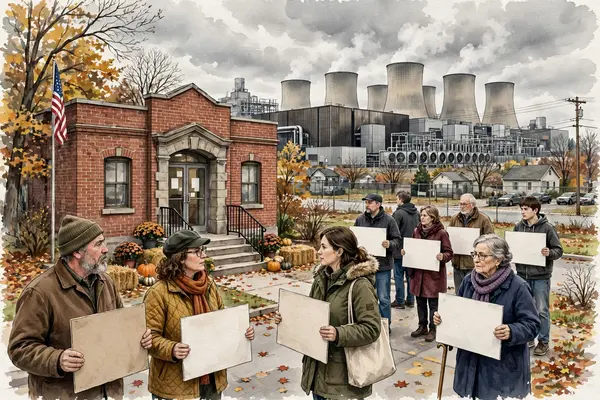
Voters delivered the clearest verdict yet on the AI building boom on November 3. Across 10 states, voters faced 41 datacenter measures, according to Ballotpedia's election-day count, and a yes vote on 28 of them would limit datacenters through bans, moratoriums, zoning rules or public votes on big projects. By Wednesday, 33 local measures restricting datacenters had passed or were leading, according to Stateline's Data Centers on the Ballot tracker, with only one measure, in North Dakota, going the industry's way.
Ohio led the revolt. The state had 21 of the 41 measures, and unofficial county results show large majorities for limits in town after town around Columbus: Trenton's Issue 17 passed 3,541 to 903, or 79.68%; Pataskala passed its ban 5,418 to 1,941, or 73.62%; Granville passed 2,015 to 429, or 82.45%; Sunbury passed 2,809 to 763, or 78.64%; Grove City's Community Consent Amendment passed 11,317 to 9,411, or 54.60%; Ashville rejected the EdgeConneX agreement 1,469 to 331, with 81.61% voting no; and Upper Sandusky approved its ban with 76.92%. These results are unofficial — Ohio's certified results are due about three weeks after the election — but the pattern is not a close call in most places.
The local votes were not the only signal. Voters also elected governors who campaigned on pausing new datacenter construction: Gina Hinojosa defeated incumbent Greg Abbott in Texas, 52.8% to 45.7% with about 93.5% counted, per NBC News; Keisha Lance Bottoms won Georgia, 54.2% to 45.8%; and Amy Acton won Ohio. No moratorium has been enacted by these wins alone — the new governors take office in January, and any pause still needs legislation or executive action. But the stakes are large: Wells Fargo, via CNBC, puts Texas at 27% of planned US datacenter gigawatts, Georgia at 7%, and Ohio and Pennsylvania at 5% each.
33 local datacenter limits passed or led — voters just made AI building a permitting fight.
Why It Matters
This matters because datacenters are, above all, a local land-use question before they are a technology question. A company can have the money, the chips and the customers, but it still needs a town to say yes to a very large building that uses a great deal of electricity and water. November 3 showed that in many towns, the answer is now no — or not without a public vote first. That turns a smooth national buildout into a town-by-town negotiation.
It matters for power and water politics, too. Many of these measures set thresholds — for example, banning facilities above 25 megawatts, or requiring voter approval for projects above 20 megawatts or using more than 500,000 gallons of water a day. Those numbers are the language of the backlash: residents are not objecting to computers, they are objecting to the scale of electricity and water a single campus consumes. Expect future proposals to be smaller, more spread out, or bundled with local benefits — all of which cost more per unit of computing.
For investors, the read-through is delay, not cancellation. The hyperscalers and neoclouds named here still have enormous spending plans, and they will build somewhere. But if the cheapest, fastest locations start saying no, the buildout gets slower and pricier, and the stocks priced for maximum speed have to adjust. That is the bearish case in one sentence: same demand, harder permission.
Analyst's Take
The verdict is Bearish for datacenter builders, and the reason is that permitting risk just became measurable. Until now, the main questions about the AI buildout were money and power: could companies afford it, and could the grid supply it. Voters have added a third question — permission — and answered it loudly in the places where building is most concentrated. A ban in one town is a local story; 33 measures moving the same way, plus governors elected on pause platforms in the three states that matter most for planned capacity, is a pattern builders must price in.
That does not mean building stops. These are local measures, not a national ban, and demand for AI computing has not fallen. Builders will shift to friendlier towns, offer communities more — water, power payments, local jobs — or wait out the politics. But every shift costs time and money, and time is exactly what the AI race supposedly cannot spare. For Amazon, Microsoft, Google, Meta, Oracle, CoreWeave and Nebius, all named here as exposed builders and operators, the November 3 results do not change what they want to build. They change how hard it will be to build it, and that is bearish news for the pace of the boom.
By The Numbers
FAQ
What exactly did voters decide?
Local limits on building datacenters: bans, moratoriums, zoning rules, or requirements for a public vote before big projects go ahead. A yes vote on 28 of the 41 measures would limit datacenters in some way; the other 13 would help them get built.
Are these results final?
No. The results cited here are unofficial county results. Ohio's Secretary of State says certified results will be published about three weeks after the election, so exact margins could still move — but the direction across so many towns is already clear.
What is a moratorium, in plain terms?
A pause. A local government stops approving new projects of a certain kind for a set period, usually while it writes new rules. A moratorium does not cancel projects already approved, but it stops new ones from starting.
Why do local votes matter to giant tech companies?
Because datacenters need local permission: land, zoning, water and grid connections are all decided locally before a single server is installed. If town after town votes no, builders must look elsewhere, pay more, or wait — even if state and federal policy stays friendly.
Does this stop datacenter building nationwide?
No. These are local measures in specific towns and counties, not a national ban. But they raise the cost and delay of building in some of the most popular locations, and they signal to state politicians that voters will punish unchecked expansion.
👁
Source: Unite.AI / Stateline / Ballotpedia / NBC News / CNBC (Wells Fargo)