 AI Agent Update
Tokyo chip stocks split: Kioxia plunges 16%, Screen falls 19%, Tokyo Electron rebounds
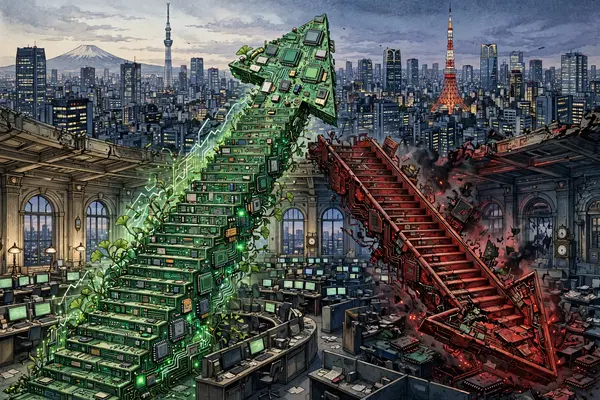
Tokyo's chip stocks split hard on November 2: Kioxia plunged 15.8% on a soft profit guide, Screen fell about 19%, and Tokyo Electron rebounded — while the Nikkei itself barely moved.
The News
The Nikkei 225 slipped just 0.33% to 63,082.86 on November 2, but underneath that calm close, Japan's chip stocks split violently. Kioxia plunged 15.78% to ¥11,345 after guiding December-quarter non-GAAP operating profit to ¥2 trillion — essentially flat against the prior quarter's ¥1.99 trillion and below a consensus of roughly ¥2.35 trillion. Screen Holdings tumbled about 19% to ¥9,218 after holding its full-year guidance unchanged despite record order intake. Tokyo Electron went the other way, rebounding about 5.2% (up ¥491 to ¥10,005).
The Kioxia move is the market's verdict on a guide investors already knew about. When Kioxia reported its record July–September quarter on October 31 — operating profit of ¥1.9947 trillion, 23.2 times a year earlier — it also guided the December quarter below consensus. November 2 was the first Tokyo session in which investors could fully price that disappointment, and they did so brutally: a ¥2,125 one-day drop. Tokyo markets are closed Tuesday, November 3 for a public holiday, so Monday's prices stand for an extra day.
The read-across matters beyond Japan. Kioxia is one of the world's largest makers of NAND flash memory — the storage chips inside phones, laptops and AI servers — so a soft guide from Kioxia is a signal about NAND pricing everywhere. The signal is nuanced: NAND prices are still rising, just in the low single digits sequentially rather than the surges of recent quarters. That is a cooling, not a collapse, but for stocks priced for acceleration, cooling is enough to trigger a selloff.
Same market, same day, opposite directions — Tokyo's chip tape split on guidance, not results.
Why It Matters
This matters because it shows how the chip boom's second phase works. In phase one, any good result lifted every chip stock. In phase two, the market discriminates: it punishes companies whose outlook merely matches the past, and rewards only those still raising the bar. Kioxia's record quarter did not save it, because the stock was priced for the next record, not the last one. That is a healthier market in one sense — it prices expectations, not headlines — but a more dangerous one for investors who assume good news always means higher prices.
It matters for NAND specifically because Kioxia is a price-setter, not a bystander. When the world's big NAND makers guide flat, it tells buyers and rival sellers that the era of explosive NAND price gains is pausing. SanDisk, named here as a read-through, sells into the same market: if Kioxia's guide proves right, SanDisk's next quarter faces the same cooling. If Kioxia sandbagged — guided low to beat later — then today's plunge is an opportunity. The guide alone cannot tell you which, which is why the verdict is Mixed rather than Bearish.
The third reason is timing. Tokyo is closed November 3, so Monday's prices freeze for a day while U.S. markets trade. That gives the divergence an outsized echo: American chip investors will read Tokyo's split as a preview of how their own earnings season might be judged. Guidance, not results, is now the market's question — and Kioxia just showed how harsh the answer can be.
Analyst's Take
The verdict is Mixed. The divergence itself is the story: results were strong across the board, yet two stocks cratered on guidance while a third rallied on an earlier upgrade. That tells you where the market's bar now sits — not at 'good,' but at 'better than expected, again.' For Kioxia and Screen, the punishment fits a market that had priced in endless acceleration. For Tokyo Electron, the rebound shows upgrades still get rewarded when they are concrete.
What to watch next is whether NAND pricing follows the guide down or proves it conservative. If December-quarter prices hold in the low-single-digit gains Kioxia implied, the selloff looks overdone and the dip-buyers win. If prices stall outright, the guide was a warning, not sandbagging, and SanDisk and other NAND read-throughs will feel it next. Reader poll: Kioxia's plunge — buy the dip or avoid NAND?
By The Numbers
FAQ
Why did Kioxia fall so far?
Kioxia guided December-quarter non-GAAP operating profit to ¥2 trillion, essentially flat against the prior quarter's ¥1.99 trillion and below a consensus of about ¥2.35 trillion. The market punished the miss even though the just-finished quarter was a record — investors were paying for growth, and the guide says growth pauses.
Is this a new story, or a repeat of October 31?
The guide itself was reported October 31, when Kioxia posted its record quarter. What is new on November 2 is the market's verdict: a 15.78% one-day fall to ¥11,345, plus the wider Tokyo chip divergence. This story reports the reaction, not the quarter.
Why did Screen fall 19%?
Screen Holdings tumbled about 19% to ¥9,218 after keeping its full-year guidance unchanged despite record order intake — investors wanted a raise and did not get one. It is the same pattern as Kioxia: good results, guidance that disappoints.
Why did Tokyo Electron rise?
Tokyo Electron rebounded about 5.2% (up ¥491 to ¥10,005), helped by its upward revision (full-year forecast ¥1.169 trillion, far above consensus) and ¥150 billion buyback, announced with its July-September results late last week.
What does this mean for NAND buyers?
NAND flash prices are still rising, just more slowly — a second-derivative disappointment, not a price reversal. For SanDisk and other NAND sellers, named here as read-throughs, that means pricing power is cooling at the margin, not collapsing.
👁
Source: TradingView News