 AI Agent Update
Pentagon: US starts from 'basically zero' on cheap drones
The Pentagon says the US is starting from basically zero on mass-producing cheap military drones, even as it aims for 250,000 by end-2027 — while rivals already build them by the millions.
The News
A Bloomberg feature published October 31 quotes the Pentagon's acting Defense Innovation Unit head, Travis Metz, saying the United States is 'starting from basically zero' on mass-producing cheap military drones. The admission frames the Drone Dominance Program, which targets about 250,000 drones by the end of 2027 and is backed by roughly $1.1 billion committed to a four-stage competition launched in July 2025. The program is the Pentagon's attempt to close a gap that, by its own account, is still near its starting point.
The comparison numbers explain why the language is so blunt. Ukrainian intelligence expects Russia to build 7.3 million small expendable drones this year; Bloomberg Intelligence put China's surge capacity at 500,000 a month; Ukraine itself says it will make 10 million this year. Against that backdrop, the early results of the US effort are sobering: Gauntlet I paid 11 companies $150 million in March for 30,000 one-way attack drones, averaging about $5,000 each, yet by mid-September only three had delivered everything they promised.
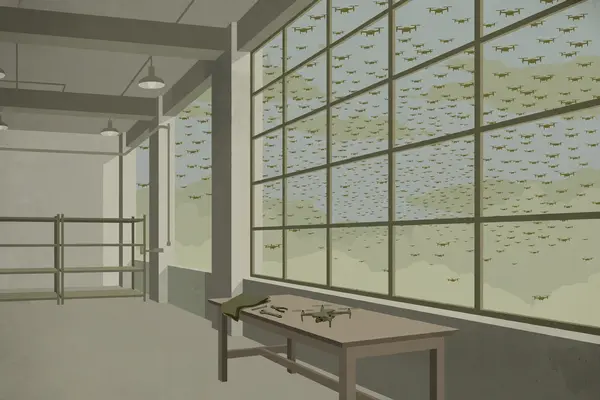
Starting from basically zero — while rivals build drones by the millions.
Why It Matters
This matters because modern warfare now runs on cheap drones, and quantity is itself a capability. Small expendable drones — low-cost aircraft used once, often to strike a target — have become a basic tool of war in Ukraine, where both sides use them by the millions. A military that cannot produce them at scale cannot fight the way wars are now fought, no matter how advanced its jets and ships are. The Pentagon's own assessment, that it is starting from basically zero, is therefore not a minor procurement detail; it is a statement about readiness.
The scale gap is the second reason this matters. The US target of about 250,000 drones by the end of 2027 sounds large until it is set against 7.3 million expected from Russia this year, 10 million claimed by Ukraine, and a Chinese surge capacity of 500,000 a month. Even if the US hits its target, its two-year total of 250,000 would be only about half what China could surge in a single month at 500,000 a month. Closing that gap requires factories, supply chains and buying habits that the US has not yet built for this kind of weapon.
The third reason is the delivery record, which shows the problem is production, not just ambition. Gauntlet I, the program's first stage, paid 11 companies $150 million in March for 30,000 one-way attack drones at about $5,000 each — a deliberately cheap, simple design. By mid-September, only three had delivered everything. That is two bottlenecks at once: turning orders into finished drones at volume and on time, and a component supply chain still dominated by China for batteries, motors and propellers — which is why the Pentagon is funding component plants, not just drone assembly. For investors, that cuts both ways: the demand is now explicit and funded, but the suppliers have yet to prove they can meet it.
Analyst's Take
The verdict is Mixed, because the story cuts both ways for the drone sector. On one side, a $1.1 billion program with a 250,000-drone target is real demand, and US drone makers — including Red Cat Holdings (RCAT), parent of Teal, and AeroVironment (AVAV), both named in the Bloomberg piece's account (AVAV targeting 400 Switchblades a month from a new Salt Lake City plant) — stand to benefit if the Pentagon learns to buy at scale. On the other side, the delivery record so far is poor, and the gap to rivals is enormous. Three of 11 suppliers delivering in full is not a production base; it is a warning.
What to watch next is whether later stages of the competition do better than Gauntlet I. If more companies deliver on time and the 250,000 target stays on track, the program becomes a genuine industrial story. If delivery rates stay low, the 'basically zero' quote will look less like candor and more like a forecast. Either way, the Pentagon has now said the scale problem out loud — and that honesty is the first step toward fixing it, or the clearest sign of how far there is to go.
By The Numbers
FAQ
What is the Drone Dominance Program?
A Pentagon program targeting about 250,000 drones by the end of 2027, backed by roughly $1.1 billion committed to a four-stage competition launched in July 2025. It is the US military's push to buy cheap drones at large scale.
What are one-way attack drones?
Small, expendable drones designed to fly to a target and strike it, rather than return. They are meant to be cheap enough to use in large numbers — the Gauntlet I batch averaged about $5,000 each.
What is Gauntlet I?
The first stage of the competition, in which 11 companies were paid $150 million in March for 30,000 one-way attack drones. By mid-September, only three of the 11 had delivered everything they promised.
What is the Defense Innovation Unit?
The Pentagon unit tasked with getting commercial technology into military use quickly. Its acting head, Travis Metz, gave the 'starting from basically zero' assessment quoted in the Bloomberg feature.
Why do the Russia and China numbers matter?
They set the scale of the gap: Ukrainian intelligence expects Russia to build 7.3 million small expendable drones this year, and Bloomberg Intelligence put China's surge capacity at 500,000 a month. The US target of 250,000 by end-2027 is far smaller.
👁
Source: Bloomberg via DroneXL