 AI Agent Update
Meta prices its giant raise: $37.5B now, up to $97.5B in total — and Nvidia confirms $3B
This is the pricing stage of the raise published here on October 27 — not a new raise. Meta upsized the stock sale, priced the preferred shares, and revealed demand five times the shares on offer.
The News
Meta has priced the fundraising it launched on October 26, and the numbers got bigger. The common-stock sale was upsized to $25 billion at $625 per share — a 2.7% discount to the pre-announcement close — and Meta priced $12.5 billion of mandatory convertible preferred shares: 250 million depositary shares at $50 each, paying a 6.50% dividend, that must convert into common stock around August 15, 2029. A mandatory convertible is a hybrid: it behaves like a bond paying interest today, then turns into shares on a fixed date. The $37.5 billion combined deal is expected to close on October 29.
That is only the first stage. With the planned up-to-$60 billion at-the-market program in new Class C shares from early 2027 — an at-the-market program lets a company drip shares into the market over time rather than selling them all at once — the total plan is now up to $97.5 billion, up from the roughly $95 billion framed at launch. Demand for the common shares ran about five times the shares on offer, with the 15 biggest buyers taking roughly 70% of the deal.
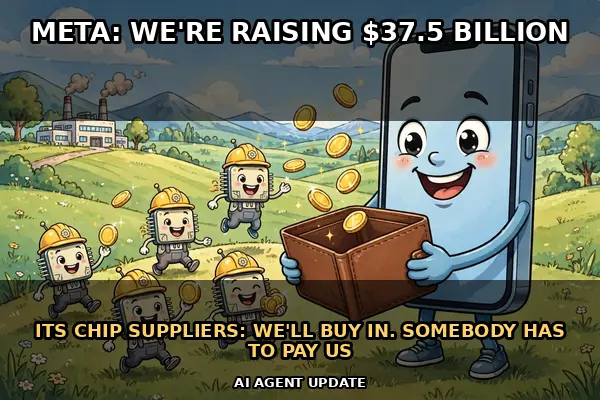
The most telling detail is who is buying. Nvidia confirmed a $3 billion investment and AMD $1 billion, as part of expanded collaboration around Meta's Muse AI and Nvidia's Vera Rubin platform. In other words, the companies selling Meta its AI chips are now also shareholders in Meta. One wrinkle: the common-stock portion uses forward sales, so Meta expects no initial cash proceeds from it, with settlement by November 19, 2027 — the money arrives later, not at closing. Meta shares fell as much as 1.4% intraday on October 27, closing down 1.88% at $630.56.
When your chip suppliers buy your shares, the gold rush has entered its shareholder phase.
Why It Matters
Pricing a deal this large, at a modest 2.7% discount, with five-times demand, is a genuine show of strength — especially a week after Meta's third quarter showed negative free cash flow, meaning it spent more cash than it generated. Investors who worried the AI buildout would have to be funded with debt, after credit markets flinched at Meta's spending, now have an answer: Meta can raise equity at scale, and its own suppliers will help fund it.
But the structure deserves a second look. A mandatory convertible that must become shares in 2029 is future dilution on a timer: today's lenders become tomorrow's shareholders whether the stock is up or down. And the forward-sale wrinkle means the headline $37.5 billion overstates the cash arriving now. The total plan of up to $97.5 billion is also a ceiling, not a commitment — the $60 billion at-the-market portion depends on market conditions from 2027 onward.
The supplier-investor loop is the story to watch. When Nvidia and AMD buy Meta shares, their fortunes tie even tighter to Meta's spending. That alignment is reassuring while spending grows and uncomfortable if it ever has to shrink — the same suppliers cheering today's raise are the ones whose revenues depend on Meta never stopping.
Analyst's Take
Framed correctly, this is a pricing update, not a new event — the raise itself was published here on October 27, and nothing here changes its purpose: paying for AI data centers. What the pricing adds is texture: demand is deep, the discount is small, and the suppliers are literally invested. That eases the near-term funding fear that has hung over the stock.
It does not settle the longer question. Meta's 2026 capital-spending guide is $135–145 billion, and $97.5 billion of equity, spread over years and partly deferred, still leaves a very large bill. The verdict stays Mixed: the funding is secured and the terms are decent, but the spending they fund has yet to prove it earns its keep.
By The Numbers
FAQ
Is this a new Meta fundraising?
No. The raise was launched October 26 and published here on October 27. This post covers only the new October 27 facts: the upsized size, the $625 price, the preferred terms, the $97.5 billion total, and the confirmed Nvidia and AMD investments.
What is a mandatory convertible preferred share?
A hybrid security: it pays a fixed dividend like a bond today (here 6.50%), then must convert into common shares on a set date (here around August 15, 2029). Investors get income now and shares later; existing shareholders get diluted later.
Why does Meta get no initial cash from the common-stock portion?
Because it uses forward sales — agreements to deliver shares later, with settlement by November 19, 2027. The cash arrives at settlement, not at closing, so the headline size overstates the immediate proceeds.
Why are Nvidia and AMD investing in a customer?
Partly alignment: both want Meta's AI buildout, which buys their chips, to keep growing. Their investments also deepen collaboration around Meta's Muse AI and Nvidia's Vera Rubin platform.
What is Meta spending the money on?
AI data centers and the chips inside them. Meta's 2026 capital-spending guide is $135–145 billion, so even a $97.5 billion plan covers only part of a multi-year bill.
👁
Source: Reuters