 AI Agent Update
KT Cloud pursues two-track push to expand AI data centers
KT Cloud said November 1 that most of the roughly 125 MW of data-center capacity cited by Seoul Economic Daily is already contracted out (a second November 1 report and KT's own investor deck put total operating capacity at about 152 MW — the scope of the 125 MW figure needs confirming), and it will expand on two tracks — building itself and leasing via outside developers — starting in Bucheon next year, then Gaebong, Yongin, Ansan and Gunsan.
The News
KT Cloud said November 1 that most of its roughly 125 MW currently operated is already contracted out — in plain terms, customers have already signed up for most of the power capacity it runs today. A megawatt is one million watts, and data centers are measured in megawatts because the power they can draw sets a limit on how many servers they can run. That shortage is the reason for everything else in this announcement.
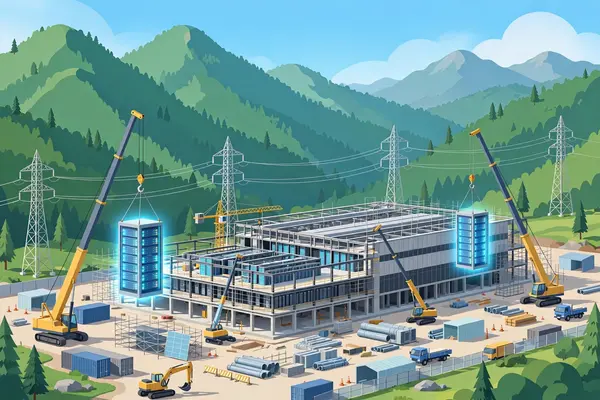
The company will expand on two tracks: building data centers itself, and leasing capacity via outside developers. Building itself gives KT Cloud full control over its facilities; leasing through developers lets it add capacity faster by using other companies' projects. The rollout starts in Bucheon next year, then moves to Gaebong, Yongin, Ansan and Gunsan, according to Seoul Economic Daily (a second November 1 report lists Gunsan, Cheongna and Ansan after Bucheon — the full sequence is single-sourced). The sequence matters: this is a multi-site, multi-year build-out across South Korea, not a single new building.
KT Cloud is also lining up the engineering to make the expansion faster. It is working with LS Electric on power infrastructure — the systems that deliver electricity reliably to a data center — and with Vertiv on modular build, a construction method that assembles data centers from prefabricated sections to shorten construction time. Separately, at the AI Innovation Center unveiled October 30, the company showed a self-developed water-cooled load bank whose rack-type unit simulates up to 140 kW per rack (the server-type unit: 64 kW per 42U rack): a load bank is a test device that pretends to be a rack of servers, drawing power so engineers can test power and cooling before real servers arrive, and a rack is one tall cabinet of servers.
Most of 125 MW is already spoken for — so KT Cloud is building on two tracks at once.
Why It Matters
This matters because contracted-out capacity is the strongest signal a data-center business can send. Data centers are expensive to build, and operators only build when they believe customers will come. When KT Cloud says most of its roughly 125 MW is already contracted out, it is saying the customers are already there and the capacity is the constraint. That flips the usual question: the risk is not finding demand, it is building fast enough to serve it. A two-track expansion answers that constraint directly, since leasing adds capacity through other developers' projects while its own builds proceed.
The partnerships matter because power and construction speed are the two bottlenecks in data-center expansion. LS Electric's work on power infrastructure addresses the first: a data center is only as useful as the electricity it can reliably draw, and AI servers draw far more power per rack than older equipment. Vertiv's modular build addresses the second: assembling data centers from prefabricated sections can shorten construction compared with building everything on site. KT Cloud's self-developed load bank, simulating up to 140 kW per rack, ties the two together — it proves the company can test its power and cooling against the dense AI hardware its customers will install.
The final reason to read this story carefully is the distinction between what is new and what is not. The 1 GW-by-2031 target was announced in September; it is background, not November 1 news. What is new is the delivery model — two tracks, five named sites starting with Bucheon next year, and named partners for power and modular construction. The fresh progress here is real enough on its own. A sold-out 125 MW today, a plan to grow on two tracks, and engineering partnerships aimed at building faster add up to a Bullish verdict for KT Cloud — and, since KT Cloud is a unit of KT Corp, for KT shareholders watching the AI infrastructure build-out.
Analyst's Take
The verdict is Bullish. A data-center operator whose existing capacity is mostly contracted out, and which answers with a two-track expansion across five named sites plus named engineering partners, is a company with demand in hand and a plan to meet it. The LS Electric and Vertiv partnerships address the two hardest parts of building data centers — power and construction speed.
One clarification matters, and readers should hold it firmly: the 1 GW-by-2031 target itself was announced in September. The November 1 news is the delivery model and the partnerships, not a new target. Judged on what is actually new, this is still a strong story — a mostly-contracted-out present, a two-track future, and named sites and partners. What to watch next is the Bucheon start next year, and whether the two-track model delivers capacity as fast as the contracted-out present suggests it must. KT Cloud is a unit of KT Corp, so KT shareholders get this exposure through the parent company.
By The Numbers
FAQ
What is a megawatt (MW) and a gigawatt (GW)?
A watt measures electrical power. A megawatt is one million watts, and a gigawatt is one billion watts — one thousand megawatts. Data centers are measured this way because the power they can draw sets a limit on how many servers they can run. KT Cloud currently operates roughly 125 MW, and its previously announced target is 1 GW by 2031.
What is a data center, and why does AI need so many?
A data center is a large building full of computers, called servers, that store data and run software — including AI. AI systems need enormous computing power, so they need data centers with huge power supplies, cooling systems and fast network connections. That is why companies are racing to build more data-center capacity.
What does 'contracted out' mean here?
It means customers have already signed up for most of the capacity KT Cloud currently operates. When most of about 125 MW is already spoken for, there is little spare room left — which is why the company is planning to expand.
What is the two-track expansion model?
KT Cloud will expand on two tracks at once: building data centers itself, and leasing capacity through outside developers. Building itself gives it full control; leasing through developers lets it add capacity faster by using other companies' projects. The first new site starts in Bucheon next year, followed by Gaebong, Yongin, Ansan and Gunsan.
What is a load bank, and why does 140 kW per rack matter?
A load bank is a test device that pretends to be a rack of servers, drawing power so engineers can test a data center's power and cooling systems before real servers arrive. KT Cloud showed a self-developed load bank simulating up to 140 kW per rack — a rack being one tall cabinet of servers. Higher power per rack means denser, more powerful AI hardware, so proving the facility can handle it matters.
👁
Source: Seoul Economic Daily